QuietStove.com

Showing posts with label backpacking stove. Show all posts

Wednesday, June 1, 2011

What's the Best Stove for All Conditions?

I thank you all for your many interesting questions and comments. I try to respond to each and every one. Here's one from "tpfishnfool" that I thought might actually make a good blog post:
"tpfishnfool" wrote: Looking for a good all around stove for everything from whitney to baldy. whats a good stove that is small and good in all conditions ?
Thanks..
It's tough to find that one stove that "does it all" and is the best stove at all times and in all conditions. Take a look at my "personal" stove list down below, and you'll hopefully see what type of stove I use for what type of trip and under what conditions.

Some questions for you:
-How much money are you planning on spending?
-Are you willing to put up with the "hassle" of liquid fuel stoves and priming? (I put "hassle" in quotes since once you get the hang of it, priming a liquid fuel stove is pretty much no big deal.)
-What's your "style?" Ultralighter? Gotta have bomb proof equipment even if it's a little heavier? Convenience driven? Cost conscious?
-What seasons do you go out in? Year round/four season? Three season including the "shoulder" seasons (early spring/late fall)? Fair weather only?

I can give you a better recommendation if I know what your answers are.

However, I can make some general remarks: If you want a stove that's good in truly all conditions, then in general you either want a remote canister gas stove or a remote liquid fueled stove. If you invert the canister and use only isobutane and propane for fuel, a remote canister gas stove will work down to 0F without needing to employ "tricks" to keep the canister warm, and a remote liquid fueled stove will take you down into arctic conditions. By "remote" I simply mean that the burner and the fuel are separated (a fuel hose connects them).

Some recommendations for a remote canister gas stove:
1. Inexpensive: MSR Rapidfire. (discontinued, but available on eBay)
2. Lightweight: MSR Windpro. (current production)
3. Really low temperatures: Coleman Xtreme. (discontinued, but available on eBay)

For a remote liquid fueled stove:
1. Inexpensive: MSR Whisperlite. (current production)
2. Versatile: Primus Omnifuel which burns canister gas, gasoline, or kerosene. (current production) If I just absolutely *had* to recommend one and only one stove, then this would be it.
3. Rugged & reliable: MSR XGK EX (current production) or earlier versions such as the MSR XGK II (discontinued, but available on eBay)

Now, having said that, most of us don't need to go super cold. If you're generally staying above 20F, there's another excellent option: the MSR Reactor (current production). It's not lightweight, and it's certainly not cheap, but it is one bomb proof stove, and as it's name might suggest, it is one hot stove. The Reactor can take on wind without missing a beat. If melting snow is what you need, this thing's a blast furnace. If you need to go below 20F, it can be done with the Reactor, but you need to employ techniques to to keep the canister warm. If I were camping in a gale on the exposed summit of a peak, I can think of no other stove I'd rather have along.

Just for fun, I'll list my "personal" stoves. These are not "shelf queens." These are the stoves I repeatedly rely on when out on the trail. What they are and when I use them may be illustrative.
LIQUID FUEL
1. Svea 123. An "upright" liquid fueled stove. Not a lot of wind protection. Super reliable. Compact and rugged. Cheap to operate.* Reasonably stable. Good for solo or small group trips. Capable of simmering.
2. MSR Whisperlite. A "remote" liquid fueled stove. Probably my most used stove; it's a real "workhorse." Cheap to operate, good wind protection. Stable; capable of handling larger pot sizes. Good for small or mid-sized groups. Difficult to simmer. A good all-around stove.
3. MSR XGK. A "remote" liquid fueled stove. Hot! Rugged. Reliable. Stable. Good wind protection. Cheap to operate. This is my "go to" stove for serious winter trips unless I might need to cook in my vestibule. Difficult to simmer.
4. MSR Simmerlite. A "remote" liquid fueled stove. Basically a lighter weight, modernized version of the Whisperlite. I use this stove when I want to carry less weight/bulk but still use liquid fuel. Difficult to simmer.

GAS
1. Optimus Crux. An "upright" canister stove. Small, light, and compact, but poor wind protection. Not super stable. Capable of simmering. Basically a fair weather stove for "fast and light" trips with smaller pots. Does not handle cold weather well.
2. Camping Gaz HP470. An "upright" canister stove. Bigger pot suports, better wind resistance, and more stable than the Optimus Crux but consequently the HP470 weighs more and is bulkier. A fair to moderate weather stove. Does not handle cold weather well.
3. Jetboil PCS. An "upright" canister stove. Efficient. Easy to use. Convenient. Reasonably good wind protection. Not super compact but not particularly bulky either. Pretty stable when the "tripod" (canister legs) is used. Does not handle cold weather well. Capable of simmering. A good intermediate weather stove.
4. MSR Reactor. An "upright" canister stove. Hot! Stable. Efficient. Excellent wind protection. Not light. Not compact -- a bit bulky actually. Capable of simmering; it's tricky, but it can be done. A good extreme weather stove when it's not going to get super cold. Fastest snow melter I know of.
5. Coleman Xtreme. A "remote" canister stove. Good wind protection. Good stability. Special canister design for cold weather which allows for operation down below 0F. If I think it's going to be really cold and I might need to cook inside my tent (or vestibule), then this is my "go to" stove. The thought of priming a liquid fueled stove inside does NOT appeal to me. A winter gas canister stove up like the Xtreme allows me to avoid priming yet still have excellent cold weather performance down to about -10F. Capable of simmering.

Notice that the above five gas stoves start with the lightest duty first and proceed to the heaviest duty.

HJ

*Indeed, "cheap to operate" is true for most liquid fueled stoves. A 110g canister of gas is about $5.00 plus tax. The equivalent liquid fuel is about $0.30 plus tax.

Saturday, March 26, 2011

Stove of the Week: Optimus Nova

The Optimus Nova is a crummy piece of junk -- or is it?  The answer:  It depends.  Buy the right version, and you might get a really good deal on a high quality expedition class stove.  Buy the wrong one, and you might just go hungry.

New post 18 Oct 2011:  Running an Optimus Nova on Canister Gas
What am I blathering about?  Optimus was bought out by Katadyn in 2007.  Katadyn has sought to reduce production costs.  Katadyn started cutting corners on the Nova.  Component quality and quality control suffered.  Indeed, the problems are so bad that Katadyn has been forced to issue a recall of the Nova.  Word of the recall and of the quality problems has gotten around.  Now, there is very little demand for the Nova.  It looks like Katadyn, in trying to milk the Nova cash cow has strangled her instead.  It's a shame.  Optimus had a very fine stove in the Nova, and now Katadyn has dealt the Nova what may very well be a death blow.  Shame on you, Katadyn!

But herein lies opportunity.  The Nova now has a bad reputation.  A stove with a bad reputation can't command much of a price.  But if you know what to look for, you can pick up a pre-Katadyn Nova, which is a very fine stove indeed, possibly for a very good price.  How will you know the difference?  I will get to that, but for now I will review a "real" Optimus Nova, a Nova from before the redesign.

First, the nova comes packaged in this padded pouch.
Frankly, when everything is in the pouch, it's a bit of a tight fit.
With care, everything can be fitted in.  However, if one carries the pump in the fuel bottle rather than in the pouch (which is the best approach anyway), then the pouch is more than adequate.

The pump on a Nova is made of very nice solid aluminum.
One of the ways we can tell a good Nova from a bad Nova is by means of the pump.  A good Nova has a connector made by AB CEJN of Sweden.  The red cover for the  connector should say CEJN on it.
If it doesn't say CEJN on it, that's a bad sign.  Likewise the male connector on the fuel hose should say CEJN.

If if doesn't say CEJN, it's not a Nova you want.  Similarly, the female connector on the pump should say CEJN.
It is not critical that the red, plastic protector on the pump be made by CEJN, but it is definitely critical that the connector on the pump and the connector on the fuel hose be made by CEJN.  If it doesn't say CEJN, don't buy it.

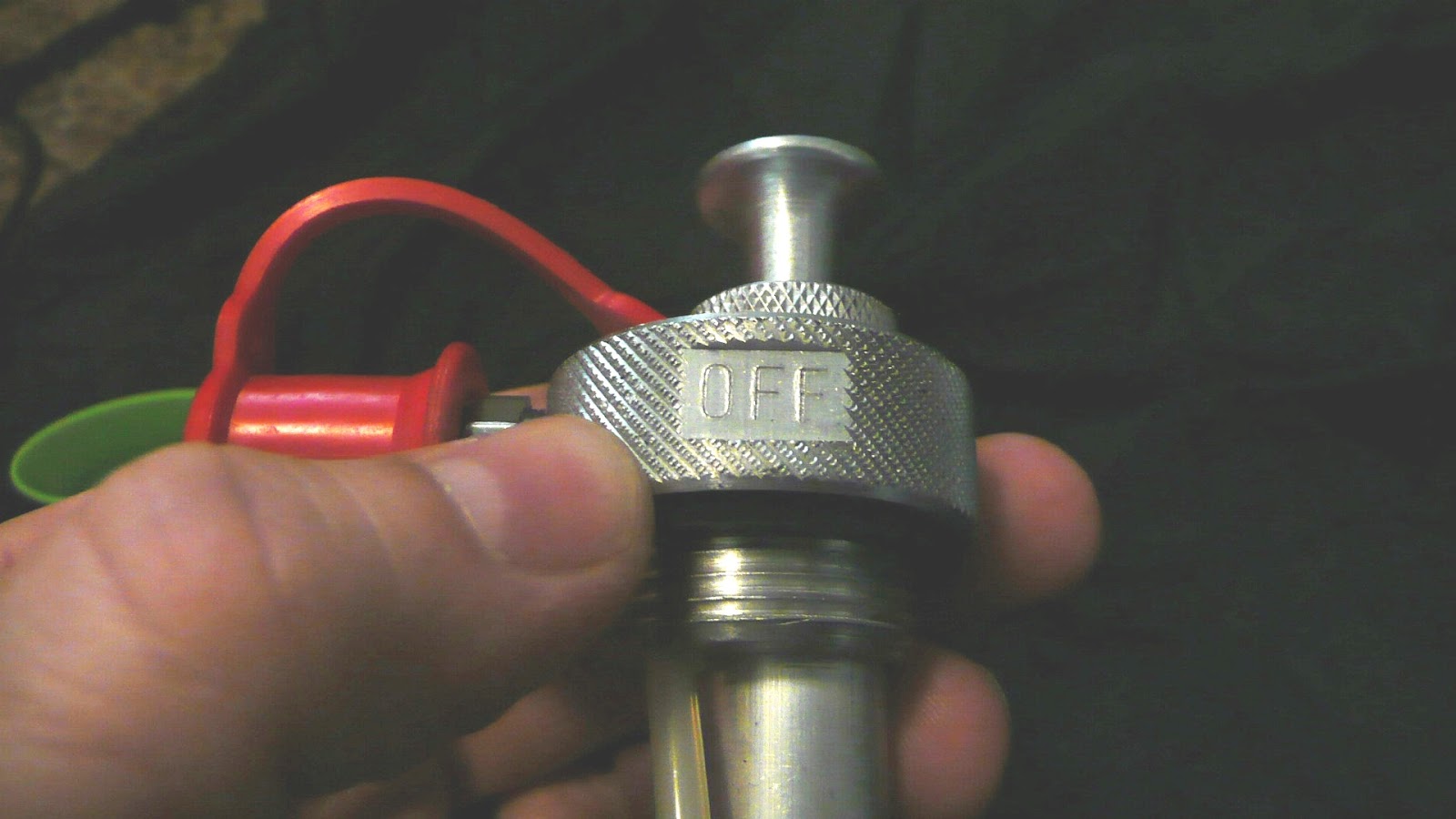
While we're on the subject of pumps, it's important to note that the pump rotates around the connector.  When you want to run the stove, rotate the fuel bottle (and therefore the pump as well) around the connector until you see the word "ON".


When you want to shut the stove down, flip the bottle over such that the word "OFF" is visible.

When the pump is rotated to the "OFF" position, the pump will draw air instead of fuel.  The air will proceed down the fuel hose just as fuel would.  Running air down the hose, clears the hose and helps prevent dried fuel deposits from building up.  Running air down the hose also helps to depressurize the fuel bottle so that fuel doesn't spray everywhere when you open the bottle.

Now, let's take a look at the stove itself.  Here it is removed from the pouch but still all folded up in transport mode.

Unfolded, the stove looks like this.
Now let's take a closer look at the valve control handle.
The valve control handle should say "made in Sweden."  It shouldn't say something else, including just the word "Sweden" alone.

Very good then, let's attach the stove to the fuel bottle and pump.  Note (if you have good eyesight) that the word "ON" can be seen on the collar of the fuel pump.  The fuel bottle is in the operating position.
Now, take a look at that bottle.  Notice that it is an MSR bottle but that this is an Optimus stove.  This is worth noting:  Sigg, MSR, Optimus, Primus, Snow Peak, and Brunton fuel bottles all have the same thread and generally are interchangeable.  I say "generally" because I have not been able to get an MSR pump to fit onto a Primus bottle.  The threads are the same, but the place where the threads start on a Primus bottle doesn't seem to work with an MSR pump.  So, good news:  if you can find one of the above brands of fuel bottles for cheap, go for it, and you can use it with stoves from that brand or any of the other brands.  But, lest there be bad news, always double check that your pump fits in a particular bottle before you head out into the field.

What's that you say?  MSR says "use MSR bottles only?"  Well, they do, don't they?  Hmm.  Isn't interesting that when MSR first started producing stoves that they didn't even make their own bottles.  What did they use?  Sigg fuel bottles (note:  fuel bottles, not drink bottles).  Has Sigg somehow declined in quality since then?  Hardly.  Now in all fairness to MSR, there were some problems in the past with people using cheap imported bottles.  However, saying "use MSR bottle only" is going a bit too far.  Any quality fuel bottle from an established manufacturer should be fine so long as the bottle has compatible threads.

Now, let's get to the meat of the matter:  actual use. The Nova is a winner.  It's got a very nice, powerful flame.
But at the same time it simmers well.
Now, that's a very nice low flame.  The Nova (pre-Katadyn) also has an excellent reputation for being able to handle cold weather and indeed is said to be better than the Primus Omnifuel in this regard.

Of course, just as the proof of the pudding is in the eating, the proof of  a stove is in the cooking.  I assure you, the Optimus Nova really cooks.

That's it for this week's stove, the Optimus Nova.  I hope you're able to tell a good one from a bad one and that perhaps you'll find yourself a really good deal on a really good stove.

Thanks for joining me on another Adventure in Stoving.

HJ

The Pre-Katadyn Optimus Nova
What's good about it?
Powerful
Reliable
Stable
Efficient
Highly adjustable flame
Pump can be rotated to purge the stove
Excellent extreme cold weather reputation
High quality CEJN connector

What's bad about it?
Expensive
A bit loud
The pouch is a bit small (minor issue)
Katadyn has now ruined the stove

Pre-Katadyn Optimus Nova:  Overall, highly recommended.
Katadyn Optimus Nova:  Unreliable, not recommended.

Tuesday, March 15, 2011

Stove of the Week: MSR Rapidfire

OK, so this week's stove is a bit of a "sleeper" in the sense that it's not a stove that you would expect a lot from -- unless you knew better.  But you'll have to read on to find out what's so interesting about this week's stove, the MSR Rapidfire.

First, let's go through our usual run down of the stove, and then we'll get into some of it's unusual qualities.  So, what's with this thing called a Rapidfire?  Isn't it just a Whisperlite?  I mean seriously, just look at it.  It's a freakin' Whisperlite for crying out loud.

Or is it?  Take a look at the bottom of the burner column.  Hmm.  No priming cup.  OK, so what the Dickens is this thing?  Well, it is a close relative of the Whisperlite all right, but made to run on canister gas.
The Rapidfire was MSR's first entry into the gas stove market.  Prior to the Rapidfire, MSR was a liquid fuel only stove manufacturer.  When MSR saw how gas stoves were really catching on, they needed an entrant into the market.  How better to get there than to simply modify their existing "workhorse" stove, the Whisperlite?  Enter the Rapidfire.  Apparently, MSR was pretty paranoid about the volatility of gas as compared to liquid fuel; they really lengthened the fuel line which is odd when you consider that now the majority of MSR gas stoves mount directly on to the canister.

The stove itself is identical to the Whisperltie except for the aforementioned lack of a priming cup.
Instead of a priming cup, there's a threaded, knurled ring that holds the fuel line and legs in place.
At the end of the fuel line, there's a gas connector and valve rather than the open ended tube with aluminum block and catch-arm of the Whisperlite.
Now take a careful look at that connector.
Note the central pin.  It is this pin that depresses the Lindal valve inside the canister of gas.  I've seen these pins go missing.  No pin, and essentially you've got no gas.  Second, note the black rubber "O" ring.  This "O" ring must be in place for you to operate the stove safely.  Without the "O" ring, gas may leak which could be quite dangerous.

Speaking of gas, it's worth mentioning here that the MSR Rapidfire stove can use any standard threaded backpacking gas canister.  Originally, the Rapidfire used a cylindrical gas canister, but that canister had the same 7/16" UNEF standard thread as used on today's dome shaped canisters, so there's no problem with respect to finding fuel even though the Rapidfire is an older stove.  MSR discontinued production, to the best of my ability to discern, in 2001.

OK, so MSR needed a gas stove, so they pressed a modified Whisperlite into service, so what?  I mean does this Rapidfire have any redeeming features or is it just some kludgey attempt to not let all the other stove manufacturers run away with the gas stove part of the stove market?  Actually, the Rapidfire has several features that distinguish it from typical gas stoves, one of which actually makes the Rapidfire potentially pretty worth owning.  I'll get to that in a moment.
First, the Rapidfire, like its progenitor the Whisperlite, is a remote fueled stove.  In other words, the fuel is not directly attached to the burner but rather fuel is brought in via a fuel line from a remote source.  This does several things for us:  1) since there's no fuel tank under the burner, the burner is lower which brings us out of the wind.  2)  Also since the burner is lower, the stove is more stable.  3) Lastly and most importantly, since the fuel isn't local to the burner, we do not have to worry about heat radiating from the burner and overheating the fuel -- which means we can use a windscreen with complete impunity.  Use a windscreen the wrong way on a typical canister stove, and you could turn your stove from a domestic servant into a domestic terrorist.  Overheated canisters can and do explode.

Speaking of windscreens, here's a Rapidfire all set up with a heat reflector and windscreen, a very efficient cooking set up.

Now, I keep blathering about something special about the Rapidfire.  Let's take a closer look at the burner itself shall we?
Do you see that loop in the burner?  That's the fuel line.  That loop is referred to as a pre-heat loop (or generator).  The loop is exposed directly to the flame when the stove is in operation.  Fuel flows into that loop before it enters the burner, which greatly heats the fuel.  In a liquid fueled stove, that heat is what turns the liquid into a vapor so that it can be burned.

Well, that's just great, Jim, but we're working with gas here, so who really cares?

Are you?  Really?  Pick up a full canister of gas and shake it.  Hear that sloshing sound?  That's a liquid in there.

OK, great, it's a liquid in the can but it's a gas when it comes out of the burner, so I still don't care about that pre-heat loop; can we just move on?

Well, not so fast there.  Yes, you're right, it is a gas when it comes out of the burner.  Usually.  But what about cold weather?  Gotcha.  That's the problem with gas stoves.  They lose power when the weather gets below freezing because the liquefied gas in the canister won't vaporize properly.  Remember that pre-heat loop?  There's our answer.  In cold weather, we let the liquefied gas stay liquid, and we let the pre-heat loop vaporize it for us.  In that way, we don't care if it's cold or not.  We don't use the air temperature to vaporize our gas, we use the heat of the flame.

Uh, great Jim, but the connector attaches to the top of the canister, and all it's going to draw is gas off the top.  If there's no gas, we've got no fuel.

This is not a problem.  Just turn the canister over.  Note:  Do not invert the canister on a gas stove that does not have a pre-heat loop.  A serious flare up might result. 
The top of the canister is now the bottom.  That portion of the fuel that is in vapor form now acts to pressurize the canister, pushing liquid down, out of the canister, and down the fuel line.  The fuel stays in liquid form until it hits the pre-heat loop where the high heat causes it to change from liquid to gas.  The resultant gas comes rushing out of the burner, and baby you've got flame.  Note that the stove is in operation in the above photo.  When gas is fed in liquid form to the burner, the stove is said to be in liquid feed mode.  Note that I said liquid feed not liquid fuel.  The fuel will still be a gas at room temperature and pressure.  We haven't changed fuel; we've merely changed the form that the fuel is fed in.
Using a gas stove in liquid feed mode is an important capability for a couple of reasons:
1.  Normal gas stoves operate in vapor feed mode, that is the fuel is fed in as a vapor, and you have to rely on the ambient temperature to vaporize your fuel.  In liquid feed mode, you rely not on the outside temperature but on the heat of the flame.  Stoves in liquid feed mode will operate in colder weather than normal gas stoves.
2.  In normal gas stoves, the fuel is typically a propane-butane or propane-isobutane blend.  Propane, the gas that works best in cold, has a higher vapor pressure and burns off faster leaving you, toward the end of the life of the tank, with a tank full of your worst performing cold weather fuel. In fact, you may wind up with a canister that is still 30% full that you can't coax any gas out of because all the good propane has burned off and nothing is left but the lesser performing fuels.  In liquid feed mode, all the fuels are burned at a constant rate.  The fuel towards the end of the life of the canister is the same mix as at the start of the canister.  In liquid feed mode, you don't get such horrible "canister fade" like you do in vapor feed mode.

I normally recommend a cut off of about 20F/-7C for normal gas stoves -- and that's with using "tricks," having to put up with less-than-stellar performance, and potentially having fuel that you can't get to vaporize.  With a gas stove in liquid feed mode, you can easily go down to 0F/-18C without having to use a lot of tricks, with full performance, and without having a portion of your fuel being unusable.

In other words, with a gas stove in liquid mode, you get all of the convenience of gas without all the low performance and hassles associated with gas in cold weather.  Uh, couldn't I just use a regular liquid fueled stove?  Sure.  If you're comfortable with liquid fuel, go for it.  But consider this:  If it's really snowing hard and you need to cook inside your tent do you really want to use liquid fuel?  What happens if your priming gets a little out of hand?  With a gas stove in liquid feed mode, you get liquid fuel performance but without the danger of priming.  And of course you get all of the usual convenience of a gas stove.  One of those conveniences is simmering.  It's pretty tough to get the typical Whisperlite to simmer like this:
And that's without monkeying around with only filling the fuel bottle half full and only pumping a few strokes.  Easy, just about automatic simmering in other words.

Now, in all fairness, other remote canister gas stoves have pre-heat loops. Other remote canister stoves can operate in liquid feed mode.  What makes the Rapidfire a "sleeper" -- a stove you wouldn't expect much from but turns out to be a pretty good stove?  Well, take a look at the price tags on some of those stoves out there that are remote canister stoves and have pre-heat loops.  They're expensive.  The Rapidfire is an older, discontinued stove, most people haven't heard of it, and you can pick one up for a much more reasonable price than you can some of the current production stoves.  All the performance at a fraction of the price.  You heard it here on Adventures in Stoving.  :)  Also, the Rapidfire's fuel line rotates easily at the connector which makes it easy to invert the canister to put the stove into liquid feed mode.  The Rapidfire's more modern cousin, the Windpro, does not rotate easily at the connector.

Yep, the Rapidfire is a "sleeper," but don't underestimate this stove.  It's a lot of stove for the money.

Well, looks like the kettle's boiling.  I'd best get to that cup of hot chocolate before it gets cold.

Thanks for joining me on another Adventure in Stoving.

HJ

The MSR Rapidfire
What's good about it?
Able to operate in liquid feed mode
Economical
Can use a full windscreen with impunity even though it's a gas stove
Simmers well
Connector rotates easily for liquid feed mode
Quiet
Fairly compact
Reasonably powerful
Reliable
Stable
Efficient

What's bad about it?
The wire pot supports are difficult to get back into "true" if they get bent.  (so don't bend them!)
The fuel line is a little stiff particularly when compared to newer stoves like the WindPro.
A tad heavy when compared to newer stoves like the WindPro.

Overall, recommended.

Friday, February 4, 2011

Types of Gas Canisters

Article revised Nov 25 2011.

First, there are six main types of gas canisters out there, only four of which are really appropriate for use in backpacking.  The six are:
1.  The heavy steel, typically green, Coleman type 16.4 oz/465g 100% propane canisters.  These are great for car camping, but are generally too heavy and bulky for backpacking.
2.  The tall steel cylindrical canisters that look like a traditional can of hair spray.  These canisters contain, typically, 100% butane. These canisters are frequently used by the restaurant industry, particularly for tableside cooking.  These "long" butane cans have a "bayonet" connector that protrudes out of the canister's valve.  This "bayonet" is exposed and therefore vulnerable to accidental discharge or damage.  These to my mind have an inferior connector that is not robust enough for back country use although in some areas people do use them, particularly in Asia.  They are cheap, I will say that for them.

OK, so the first two really aren't for backpacking.  Let's get to the backpacking appropriate ones:
3.  The dome shaped canisters with a threaded connector.
4.  The dome shaped canisters with a smooth connector.
5.  The dome shaped canisters with a dimple in the top.

The dome shaped canisters with a threaded connector are the standard canister for backpacking in the US, UK, Australia, Canada, New Zealand, and Japan (and probably a few other places).  They're not unknown elsewhere, but they're not necessarily standard.

The dome shaped canisters with a smooth connector is the Camping Gaz type connector.  This is the standard in Europe.  Other types of canisters may be available, but they generally won't be as easy to find if you can find them at all.

The dome shaped, backpacking packing canisters with a dimple in the top are an older type of canister but are still the standard some areas including many parts of Eastern Europe, South America, the Middle East, and Africa.  These are piercable canisters.  The stove has a sharp piece of metal on it.  When you attach the canister to the stove, the sharp piece of metal forces itself through the top of the canister, puncturing a hole in the canister.  The canister is then locked into place.  Once the canister is attached to the stove, you cannot remove it until it is empty (unless you want flammable gas spewing everywhere).  This type of canister has been blamed for a number of accidents, and many countries have banned or have tried to ban them.  This type of canister is not recommended.  If the canister connection works loose, you could have a real disaster on your hands.  Avoid this type if you can, but be aware this is all that is available in some localities.

6.  Lastly, there is the Coleman Powermax canister.  This is a cylindrical, silver colored canister.  One end of the canister is rounded and has a non-threaded connector on it.  If you look closely at the connector, you'll see that the connector is hexagonal around the middle.  These canisters are actually a better canister than the standard dome shaped canisters, but they are not as widely available, particularly outside the US.  In addition, they require a specialized stove that has a matching connector.  These canisters will work in all conditions but are especially good in cold weather because they are liquid feed canisters.  Update November, 2011 on Powermax Canisters


See my earlier post on Winter Gas Choices for more on liquid feed gas stoves.

As I'm sure you've realized by now, not all canisters are available in all places, and in many areas no canisters of any type will be available.  If you plan to use your canister stove when you travel, do your homework.  Make sure the canisters you need are available in the area you are going to.

Generally all of the threaded dome shaped canisters are interchangeable.  Yes, I know that MSR says you should only use MSR canisters with MSR stoves and that JetBoil says you should only use JetBoil canisters with JetBoil stoves.  That's a bunch of bull.  They're interchangeable.  Maybe you'd have some problems if you bought some cheap brand in a remote country, but all of the ones sold here in the US have a standard 7/16ths UNEF thread and are interchangeable.  Where I live, Snow Peak is generally the cheapest and Coleman is generally the most expensive -- except at Walmart where Coleman gas is a real bargain at $4.88 for the 7.5oz canister. The brand you get for warm weather use doesn't make much difference.  I usually buy whatever is cheapest.

Caution!
The newer orange label Coleman canisters do not work with many brands of stoves.  The older green label Coleman canisters typically have worked fine.

I've now broken out my discussion of which brands are best for cold weather into a separate post.  Please see What's the Best Brand of Gas for Cold Weather?  for further information.

HJ

Related articles and posts: