QuietStove.com

Showing posts with label cartridge stove. Show all posts

Wednesday, April 4, 2012

Canister Stoves 101: Thread Care

Don't screw on your canister stove too tight.

Why not?

Well, take a look at the threads on a canister some time.
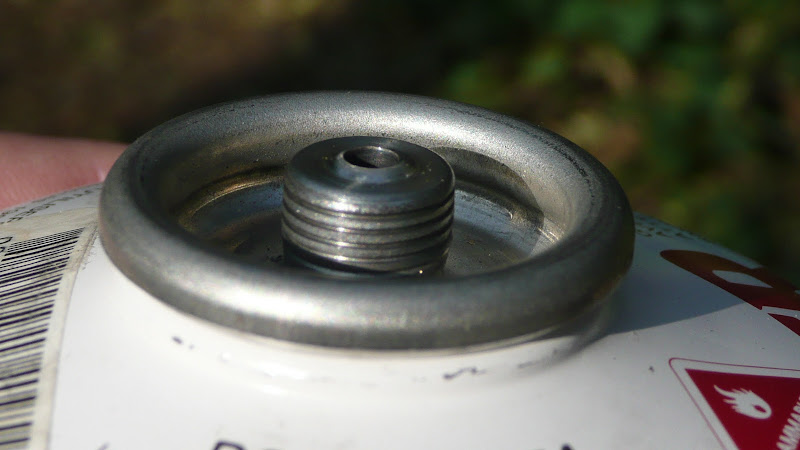
Notice how the threads do NOT go all the way out and form a sharp line.  These threads are rounded off.  That means that the only part of your stove's threads that are going to grip the canister is the very tip (very outer edge) of your stove's threads.

Whoa!  Wait a minute.  Do you mean to tell me that the only thing holding the stove on to a canister is the edge of the threads?

Yes, that's what I'm saying.  And that's a fairly thin bit of metal.  Too much pressure will put excessive wear on your stove's threads.  Heavy users have reported threads so worn that stoves have literally fallen off the canister.  Once your stove's threads are so worn that they no longer grip the canister, you're pretty much out of luck; you have to replace the stove.

So, Canister Stove Thread Care 101:
  • Don't over tighten.  If you're getting good gas flow and no leaking, that's tight enough.
  • Use the little cap on your canister.  Sure, it's a hassle to keep track of the little plastic cap, but dirt, sand, etc on the canister's threads could screw up that nice  stove you've got.  
  • Keep the threads clean on your stove.  Keep it wrapped in a bandana or something to keep crud out of the threads.  I normally keep my canister stove wrapped up and in my cook pot when it's in my pack.  Some stoves come with a little pouch or case which may be a good alternative if you don't store your stove in your pot.  Don't wrap your stove in something that sheds a lot.
  • Inspect the threads on your canister.  If there's damage on the canister threads, get a new canister (if available).  It's not worth it to use a damaged canister which might screw up your stove.
  • Do NOT cross thread.  Make sure you thread the canister on correctly and that it turns smoothly.  If it feels "funny," stop and check.  Cross threading is a great way to damage your stove.
I generally don't recommend lubricating the canister threads because crud might be more prone to stick to the lubricant, but I do know some people who lubricate the canister threads with silicon grease to prevent binding.  Perhaps there may be some advantage to this approach.

The main thing to remember with canister stoves is that a little care goes a long way.  Keep things clean, don't over tighten, and be careful how you screw on the canister.

I thank you for accompanying me on another Adventure in Stoving.

HJ


Related articles and posts:

Saturday, September 3, 2011

MSR Whisperlite Universal -- First Videos, Detailed Photos

I'm in the process of writing a review of the new MSR Whisperlite Universal stove.


UPDATED 10/4/2011:  I have written a review of the MSR Whisperlite Universal.

See also this related post which contains additional info on the new (for 2012) stoves from MSR.

The new MSR Whisperlite Universal

I'm still working on the review, but I've posted some rough videos. Don't be expecting slick production values, but if you're interested in the stove, these videos should be pretty informative.

MSR Whisperlite Universal -- First Look


Field trial: MSR Whisperlite Universal, running on canister gas.


Another video of running the MSR Whisperlite Universal on canister gas.


The MSR Whisperlite Universal -- changing from liquid fuel to canister gas:


MSR Whisperlite Universal -- Flip Stop:


I've also posted some detailed photos -- and commentary:


I'll have more to say after I get the stove out in the field, but I thought I'd give you some preliminary thoughts now.

HJ

Thursday, August 25, 2011

Stove of the Week: Hank Roberts Mini Stove, Mark III

I happen to like my old Hank Roberts stove, a stove that dates back to the 1960's. It's in very nice condition. I have the Mark III version.

So compact! And inside, the original accoutrements that came with the package.

Unfortunately, it's been some years since either the stove or its proprietary fuel canisters have been produced (see The Hank Roberts Stove -- With a Proper Canister for information on and photos of the original canister type).  Therefore, to the original contents, I add a few "essentials," all of which are easily contained within the outer shell of the stove.
Now, you probably recognize the Bic type lighter, but what of the other items?

Well, let's take a look.

The silver colored cylinder is an adapter made by Henrik from Denmark who I met on an internet forum.  Unfortunately, I've lost touch with Henrik.  :(

The hose is a spare gas hose to a Chinese made stove that I bought on eBay. The hose screws into the threaded end of the adapter, like so:

Now, let's take a look at the stove itself. That little discus you saw earlier? Here's what it looks like assembled. Pure genius.

Here's the valve assembly.
Do you see that brass "needle" to the right? That needle fits into a "rosebud" on a proprietary canister. Such canisters are alas no longer made.

Here's where Henrik's adapter comes in.
 The adapter slips over the needle.

And voila! here we are ready to cook.

Did someone say "cook?" Now, where would we be without some flame shots?

A very nice, efficient blue flame.

The Hank Roberts Mini Stove (Mark III) really has a good strong flame.

The original proprietary canisters contained a wick. The wick conducted liquefied gas into the burner. Liquid did you say? Why then we ought to be able to invert the canister and be able to run the stove in liquid feed mode. Indeed, we can do just that.

Be sure to let the stove warm up before inverting the canister. If you don't let the stove warm up a bit first, the stove will flare.  Running a gas stove in liquid feed mode allows one to operate a gas stove in much colder temperatures than in conventional upright (vapor feed) mode.

As they say, "the proof of the pudding is in the eating," so it's time for the "tea test."  Handily passed.

And if tea test, then tea.
Delicious, I assure you.

I thank you all for joining me on another Adventure In Stoving,

HJ

The Hank Roberts Mini Stove (Mark III version)
What's good about it?
Compact
Capable of operation in colder weather than conventional (upright) gas stoves
Highly adjustable flame
Good, strong flame
Stable because of nice wide base
Good pot stability because of well designed windscreen/pot support
Some wind protection from windscreen (it really needs a separate windscreen in a stronger wind)

What's bad about it?
Canisters are no longer available (but can be operated with an adapter, if you can get one)
A little heavy (about 8 oz) by modern gas stove standards
No longer available in stores (but available on eBay and such)

Hank Roberts Mini Stove:  Highly Recommended (considering its era).


Hank Roberts Stove -- Related Blog Posts

Friday, June 3, 2011

Why a Gas Stove?

I recently got a note from "DG" concerning what type of stove is best:
I vote for liquid fuel type stoves. Fast heat no matter what condition.
--DG
I don't disklike liquid fueled stoves the least bit, but I thought I'd talk a little about why I also like gas stoves.  Read on...

DG,

My first stove that was all my own (i.e. not my dad's) was an MSR Whisperlite that I bought in 1987. It's still going strong.

You're absolutely right that a liquid fueled stove will work in all conditions. But let me list out a few reasons that people might want to also have a gas stove on hand:
1. Bulk and weight. A liquid fueled stove typically takes a fair amount of room in the pack as does the fuel bottle. I can literally hold a little gas stove in the palm of my hand.
Optimus Crux
And in no way is a liquid fueled stove anywhere near as light as a gas stove.

2. Speed. I've been using liquid fueled stoves for years. My family used them back in the 60's and 70's when I was a kid, and I've been using them on my own since the 80's. I've got priming and set up down to a science. HOWEVER, even if you're good at set up and priming, it takes time. I started noticing that my friends were getting tired of waiting for me when we were breaking camp. I bought my first gas stove just so I could break camp as quickly as my friends.

3. Cost. You can go on down to Walmart and get an inexpensive Coleman gas stove for something on the order of $30.00. The cheapest white gas stove is at least double that. The cheapest decent white gas stove is probably another $10 to $20 more expensive than that. The cheapest decent multi-fueled (white gas or kerosene) is at least $10 over that.  Over time, a liquid fueled stove may prove cheaper -- if you stick with it. For those just trying out backpacking or who aren't going to do a lot of backpacking over time, the gas stove will be significantly less expensive.

So there you have it: Gas stoves are lighter, faster/more convenient, more compact, and less expensive than liquid fueled stoves. They're great for fair weather hikers or as a supplement to four season hikers.

All that said, I continue to use white gas as my primary stove fuel. But on those trips where the weather will be good and I want to go fast and light, gas is my choice.

HJ