
INTRODUCTION
Soto Outdoors recently introduced their OD-1R Micro-Regulator stove. Soto created a good deal of buzz when they posted the following video which makes it look as though a regulator valved stove has quite an advantage over a conventional needle valved stove. The relevant segment starts at 1:03.
What advantages, if any, do regulator valved stoves offer?
This post is Part I of Advantages (?) of Regulator Valved Stoves, an investigation into the advantages, if any, of stoves that have a regulator valve.
Part II can be seen here: Advantages (?) of Regulator Valved Stoves, Part II
Several people have mentioned in passing that their canisters were more fully drained after using a regulator valved stove than when using a conventional needle valved stove. In addition, in a discussion with an individual who has worked a good deal with LPG commercially, said individual felt that a regulator valve would function at lower gas pressures (such as those in a seemingly exhausted canister) than a needle valve. If in fact a regulator valved stove were to make more full use of the gas carried when backpacking, this more full use would be of value to backpackers. I set out to conduct a simple experiment to see if indeed a regulator valved stove might make more full use of the gas in a canister. My experiment would exhaust a canister using a needle valved stove and then replace the needle valved stove with a regulator valved stove to see if the regulator valved stove could operate on a canister that, to a needle valved stove, was exhausted.
ENVIRONMENT
Location: Stove Test Area 1 (UTM: 11S 383294 3792457), Haines Canyon, City of Los Angeles, California, USA
Date/Time: 30 JUL 2011, 1830 hours
Elevation: 2600'/792m MSL
Conditions:
27.20 InHg/921 mBar
80F/27C
Little to no wind (no audible susurrus, no visible leaf motion)
EQUIPMENT
Regulator Valved Test Stove:
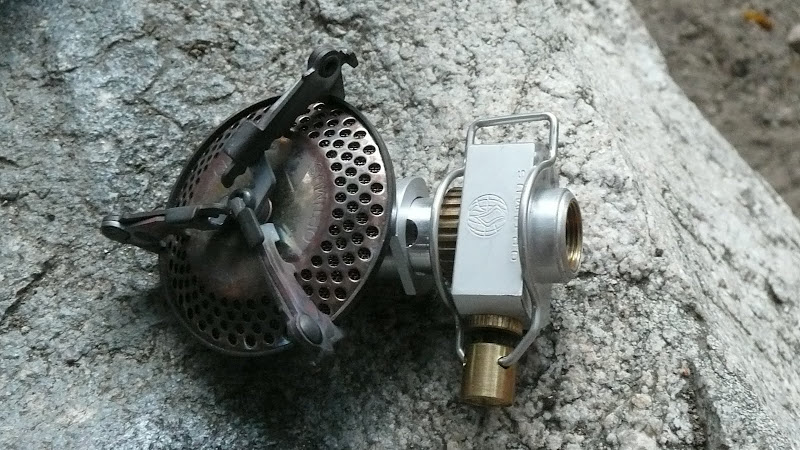
-Soto OD-1R Micro Regulator

Conventional needle valved stoves for comparison:
-MSR Superfly

-Optimus Crux
-Snow Peak GST-100

All stoves together:

Fuel:
-Canister 1. Snow Peak 110g, weighing 88g
-Canister 2. Snow Peak 110g, weighing 93g
-Canister 3. Snow Peak 110g, weighing 166g
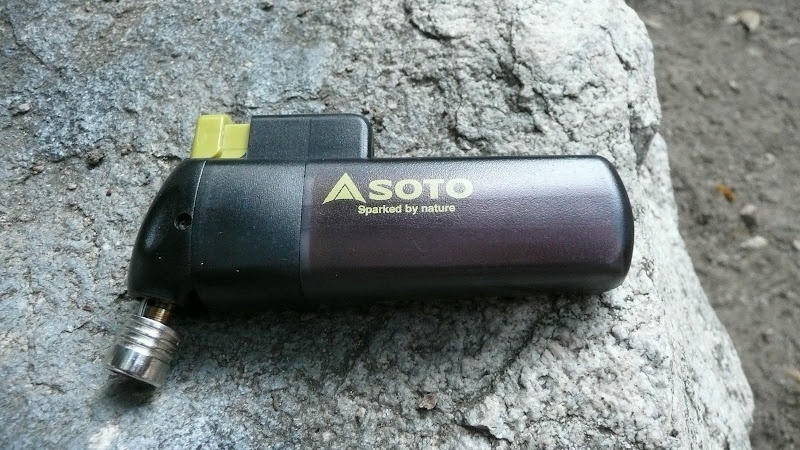
Ignition source: Soto Pocket Torch.
TEST RESULTS
Test 1, canister 1 (88g)
A. Superfly, valve fully open, flame on, run to exhaustion. Flame out. Cannot restart. No sound of gas escaping.
B. OD-1R, valve fully open, cannot start stove. No sound of gas escaping.
C. GST-100, valve fully open, cannot start stove. No sound of gas escaping.
D. Crux, valve fully open, cannot start stove. No sound of gas escaping.
Test 2, canister 2 (93g)
A. Crux, valve fully open, flame on, run to exhaustion. Flame out. Cannot restart. No sound of gas escaping.
B. OD-1R, valve fully open, cannot start stove. No sound of gas escaping.
C. GST-100, valve fully open, cannot start stove. No sound of gas escaping.
D. Superfly, valve fully open, cannot start stove. No sound of gas escaping.
Equipment Checking, canister 3 (166g). Each stove tested for normal operation.
A. Superfly. NORMAL

B. Crux. NORMAL

C. GST-100. NORMAL

D. OD-1R. NORMAL.

DISCUSSION
Two very nearly empty canisters of gas were used to conduct the experiment. A third canister containing far more gas was used to verify that each stove used in the experiment was working properly. All stoves were in fact working normally. To avoid the chance that the results might be skewed by some unknown, unusual characteristic in one of the needle valved comparison stoves, multiple comparison stoves were used. A butane torch was used as the ignition source for all stoves whether or not a given stove had a piezoelectric ignition so that ignition failures could not skew the results. At random, a needle valve stove was chosen and used to exhaust the canister. When flame out occured, a brief re-ignition was quickly attempted in order to confirm exhaustion of the canister. If the re-ignition failed, the needle valve stove was swapped out for the regulator valved stove, and an attempt to run the regulator valved stove was made.
I ran two tests. See TEST RESULTS section above for details. In both cases, the Soto OD-1R could do no more than a conventional needle valved stove. An exhausted canister to a needle valved stove was an exhausted canister to a regulator valved stove. For additional confirmation, after the test with the Soto OD-1R, the remaining needle valve stoves were tried. No stove was able to operate after intitial exhaustion. A exhausted canister was an exhausted canister, irrespective of the stove used. After the test, canister 1 weighed 86g, and canister 2 weighed 86g.
CONCLUSION
A Soto OD-1R regulator valved stove is not able to burn off more gas from a canister than a conventional needle valved stove. This is not to say that a regulator valve might not have some value in keeping a flame constant as canister pressure drops, but when the canister is finally exhausted, a Soto OD-1R regulator valved stove offers no advantage over a conventional needle valved stove.


