
Basically, there are two common modern gas canisters suitable for backpackers, Camping Gaz (non-threaded) and 7/16ths UNEF threaded canisters. Generally, stoves built for one type will not work with the other, but there are exceptions such as the relatively heavy MSR Superfly. There are also much lighter DIY exceptions such as the "Super Gnat" that you can assemble in the matter of a few minutes.
UPDATE 28 March 2017: No, manufacturers don't recommend it, and, yes, there are dangers, but canisters can be re-filled. See: Refilling Backpacking Canisters II
 |
| A non-threaded CV270 Camping Gaz canister (left) and a threaded 110g Snow Peak canister (right). |
Before I discuss backpacking suitable canisters, let's clear out what's not really suitable:
Canisters NOT Suitable
Obsolescent Canisters: There are also older formats including the old puncture type gas canisters that have no valve. There's a sharp metal "bayonet" type object on stoves that use puncture canisters. The "bayonet" quite literally punctures the canisters. Yes, that's right, you're ripping through the metal top of the canister in order to get to the gas. Needless to say, this is an older type canister! On these old style canisters, the stove must remain in place until the canister is fully empty. There is no valve built into the canister to allow you to separate the canister from the stove (until fully empty) for safe transport. You can still buy the old puncture type canisters, but they have been implicated in a number of accidents and are not as safe as modern canisters with valves. Not recommended. Note: In some lesser developed countries, puncture type canisters may be the only gas canisters available. Travelers should check on what canister formats are available in the countries they intend to visit before departure.
Obsolete Canisters: There are also dozens of old canister formats that have been discontinued including Hank Roberts, Campak, and PowerMax just to name a few. Some of these were excellent formats. However, they are no longer produced. I'm not going to discuss them other than to mention that they exist.
Suitable Canisters
Modern Backpacking Canisters: OK, now we're to the meat of this post: Today's modern backpacking canisters. There are two common types of gas canisters suitable for backpackers:- Camping Gaz Canisters (non-threaded).
- Standard threaded canisters (with a 7/16ths UNEF thread).
 |
| A 230g Camping Gaz canister. |
 |
| A close up of the (non-threaded) connector on a Camping Gaz canister |
UPDATE 2016. Camping Gaz canisters, both the old puncture type and the newer non-threaded valved type are no longer distributed in North America. You can find some old canisters sometimes, but once those are gone, that's it. Personally, I would no longer buy a Camping Gaz type stove with the non-threaded connector unless maybe you just want it as a collector's item.
Camping Gaz canisters have a Lindal valve inside the connector. The valve allows the canister to be removed from the stove for safe storage or transport.
Camping Gaz canisters come in two sizes: 230g and 450g. A smaller size in the 100g range is not available.
Camping Gaz canisters contain a blend of propane and butane. As such, Camping Gaz canisters are not the best choice for cold weather. See What's the Best Brand of Gas for Cold Weather? for further information.
Standard Threaded Canisters: In most of the developed world, the standard for gas canisters for backpacking is a threaded canister with a 7/16ths UNEF thread.
 |
| A standard threaded backpacking type canister. This one happens to be made by Snow Peak. |
Caution!
The one exception to the above is Coleman gas threaded canisters. At least for the ones with the orange label Coleman canisters do not work with many brands of stoves.
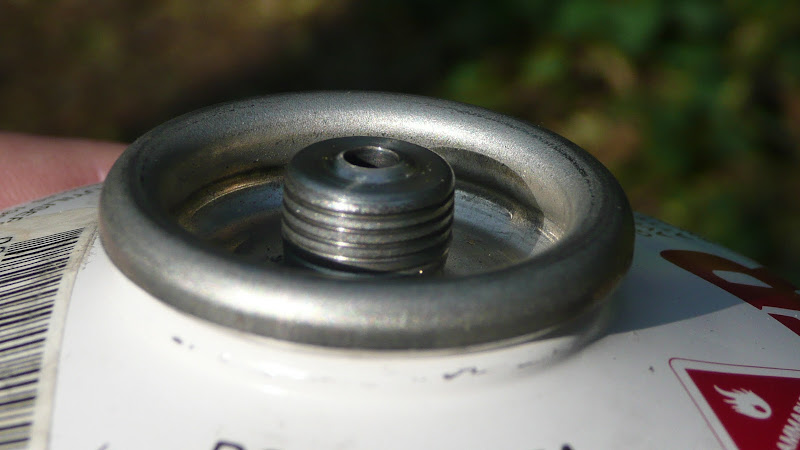 |
| The 7/16ths UNEF threads of a standard threaded canister |
Like Camping Gaz canisters, standard threaded canisters have a Lindal valve inside the connector. The valve allows the canister to be removed from the stove for safe storage or transport.
Standard threaded canisters come in three size ranges: small (100g to 113g), medium (220g to 230g), and large (450g). The classes can also be expressed as 4oz, 8oz, and 16oz. Be careful calling a canister "large." Many stores only carry the 1xxg and 2xxg sizes. Some people refer to the 2xxg canisters as "large." It's best to specify what size you want in grams or ounces.
There you have it, a brief look at the basics of gas canisters. Hopefully, that's helpful as you shop for gas or as you consider which stove to buy.
HJ
Related articles and posts:
- Cold Weather Tips for Gas Stoves
- What's the Best Gas for Cold Weather?
- Gas Stoves: How Cold Can I Go? <==Most comprehensive article on canister gas and cold
- Canisters, Cold, and Altitude: Gas in a Nutshell
- Canister Stoves 101: Thread Care
- Gas Blends and Cold Weather Performance. (Why not just use propane?)
- The "Super Gnat" (Camping Gaz or threaded canisters with one lightweight stove)
- Backpacking Gas Canisters 101
- Gas in Extreme Cold: Yes or No?
- Gas in Cold Weather: The Myth of "Fractioning"
- Stoves For Cold Weather I (Upright canister stoves) – Seattle Backpacker's Magazine
- Stoves for Cold Weather II (Inverted remote canister stoves) – Seattle Backpacker's Magazine

