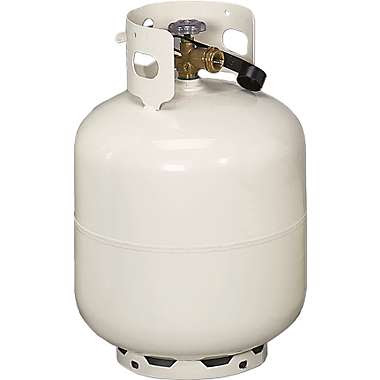
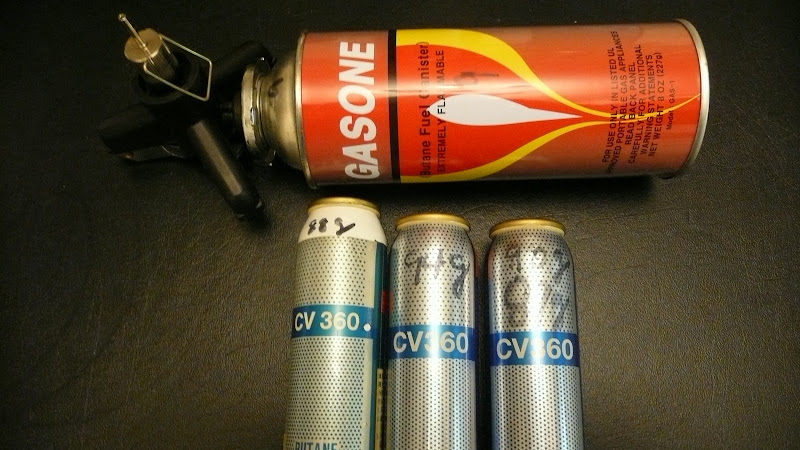
I refill my own gas canisters. This procedure is not recommended by any manufacturer. There may also be certain legal sanctions against refilled canisters. I'm not a lawyer, but my understanding is that in the US refilled canisters may not be transported across state lines and that refilled canisters may not be sold.
UPDATE 26 March 2017: There is a another method of canister refilling, a method using the G-Works Gas Saver. The G-Works Gas Saver is
cheaper and
easier to use than the adapter I used in the below post. The G-Works Gas Saver is also better in that it does not use 100% butane (which is only good for warmer weather). Please see:
The G-Works R1 Gas Saver – Refilling Backpacking Canisters II.
There are certain dangers that go along with using gas, even if you're using your stove in exactly the manner prescribed by the manufacturer. Gas is flammable. Gas can explode. Know and understand the dangers before working with gas.
If one chooses to refill his or her own canisters, there are certain additional dangers including but not limited to:
- Overfilling. If you fill a gas canister beyond it's stated capacity, the internal pressure may cause the canister to leak, burst, or explode.
- Gas leaks. Gas may escape during refilling with or without equipment failures or malfunctions. Such gas could ignite or explode. Leaking gas can also be very very cold, and cold injuries could result.
- Damage to valve or threads. The valve or threads could become damaged or worn during refilling. No problem may occur during the refilling itself, but the damaged threads or valve could be hazardous later on.
- Refilling with gases with too high a vapor pressure. Canisters come with a specific mix of gases. If one were to refill with different gases or a different mix of the same gases, the vapor pressure of the resultant mix might exceed the strength of the canister. Do NOT fill backpacking type canisters with 100% propane under any circumstances.
Clearly, there are dangers to canister refilling. If you choose to refill gas canisters, you are making a decision to engage in a practice that you know to be dangerous. If you of your own free will choose to engage in a practice that you know to be dangerous, don't blame me or anyone else for your choices.
That said, I will describe how I refill canisters. I will also describe what steps I take to partially mitigate the dangers of refilling, but understand that no matter how safe your procedures are, refilling gas canisters is by its very nature dangerous. You might be able to somewhat reduce the danger, but refilling is dangerous no matter what.
Step one is of course to get an empty canister. Today, I'm going to refill a Coleman brand standard threaded 220g canister.
Caution
The newer orange label
Coleman canisters do not work with many brands of stoves. The older green label Coleman canisters seem to work fine.
 |
| A Coleman brand 220g standard threaded gas canister. |
The first step in refilling is to weigh the canister. Why weigh the canister? I weigh the canister to establish a maxium full weight. You do NOT want to overfill the canister. The best practice is to weigh the full canister when you first bring it home from the store. The weight of the full canister when you bring it home from the store should be considered the maximum full weight.
What if I forgot to weigh the canister when it was new? Well, if you weigh the canister when it is empty and then add the capacity of the canister, in this case 220g, then you should also be able to determine the maximum full weight of the canister.
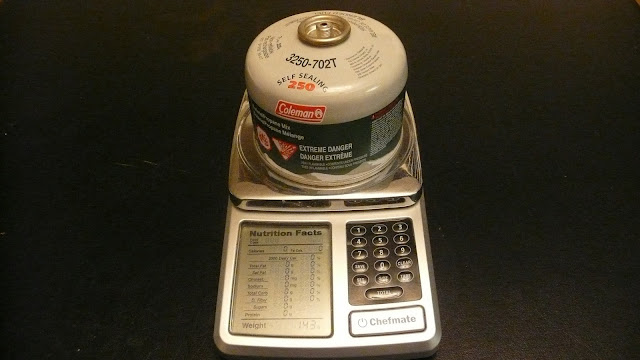 |
| The empty weight of a Coleman 220g canister is approximately 143g |
The empty weight of a Coleman brand 220g canister is 143g. The capacity is 220g. Therefore, the maximum full weight is 363g. Do NOT exceed the maximum full weight when you refill. If you exceed this weight, the pressure inside the canister may exceed the strength of the canister. If the canister leaks, bursts, or explodes, very serious injuries could result. Do NOT exceed the maximum full weight of the canister.
Next, I mark the weights on the canister. I tend to lose slips of paper, so I mark the canister itself.
 |
| The empty and full weights, marked directly on the canister. |
Next, I mark the canister as refilled by writing an "R" on the bottom of the canister. I then put a hash mark next to the "R" every time I refill the canister. One hash mark indicates one refill, two hash marks indicates two refills, and so on.
 |
| An "R" on the bottom of the canister indicates that the canister has been refilled. Hash marks indicate the number of refills. This canister has been refilled one time. |
Eventually the valve may become weakened with use. After I've refilled a canister 12 times, I take the canister to the recycling center. Twelve is an arbitrary number, but it is a relatively low number. So far twelve has been a safe number. I visually inspect the canister and threads/valve before refilling. If it looks bad, it is bad, and it goes in the recycle bin.
Now, after all that, I take out my refiller.
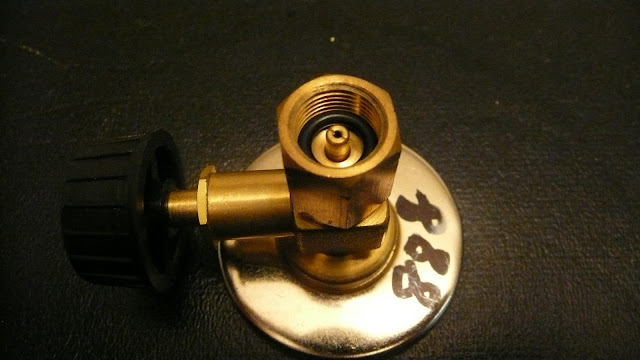 |
| A refiller for standard threaded gas canisters. |
I bought this refiller via eBay seller world_wide_2009 who apparently is in Japan. I believe I paid $37.00 USD for the refiller. I've had the refiller for at least two years. With this somewhat expensive but high quality refiller, I feel like there is a) a reduced risk of damaging the threads or valve on a receiving canister, and b) very little gas leaks -- about the same amount as would normally leak when hooking up or unhooking a stove. Very little in other words. I've seen lots of scary looking homemade rigs of questionable quality. I personally would rather pay the extra money and do it right.
The instructions that came with the refiller were in Japanese but did include helpful pictograms. Notice that I have the weight written on the refiller itself (88g). While I'm in the process of refilling, I can weigh the canister without removing the refiller. I just subtract 88g from the weight displayed on the scale in order to know the weight of the canister I'm in the process of refilling.
Note in the above photo that the connector shown attaches to a standard threaded backpacking type canister. What does the other side connect to?
 |
| This side of the refiller connects to 100% butane canisters. |
The opposite side of the refiller connects to the inexpensive 100% butane canisters of the type used in the restaurant industry. Why butane? Well, first butane is cheap. If you're going to do your own refills, then you'd better have a source of gas cheaper than backpacking canisters. If your refill gas isn't cheaper, why would you refill? You'd just go buy the regular backpacking gas. In my area, 227g of butane is $1.25 USD. Backpacking canisters are about $5.00 for 110g or $6.00 for 220g. 100% butane is far cheaper. Personally, I use 110g canisters more than any other size. With refilling, I'm in effect paying $0.63 per 110g canister. If you saw perfectly good 110g canisters on sale for $0.63, wouldn't you pick a few up? I bet most people would. My canisters are always on sale for $0.63. I never hesitate to take out the gas stove whether on a day hike or a backpacking trip. You want another cup of coffee? Sure! Why not? How about two? I rather like having an abundant source of cheap gas. YMMV. Each to his or her own.
Second, butane is relatively safe. Pick up one of those little clear plastic cigarette lighters some time. Hold it up to the light. That clear liquid you see in there is butane. Of the gases commonly used for backpacking canisters, butane has the lowest vapor pressure. If that little cheap plastic lighter can hold the pressure of butane, your steel backpacking canister certainly can. No matter what mix originally came in your backpacking canister, butane will have a lower vapor pressure. Butane is pretty safe to use for refilling. Do NOT fill backpacking type canisters with 100% propane under any circumstances.
The next step in refilling is to hook everything up. First I screw the refiller onto the receiving canister.
 |
| The refiller screwed on to an empty 220g backpacking type gas canister |
Next, I hook up the donating butane canister. The larger hook on the connector clips onto the collar on the butane canister.
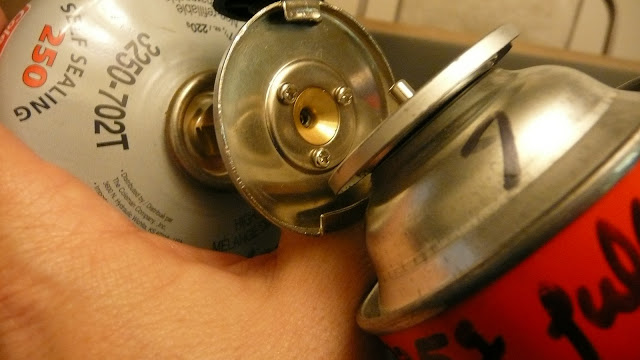 |
| The collar on the butane canister clips on to the larger of the two hooks on the connector of the refiller. |
The smaller of the two hooks on the refiller's connector slips through the notch on the collar of the butane canister.
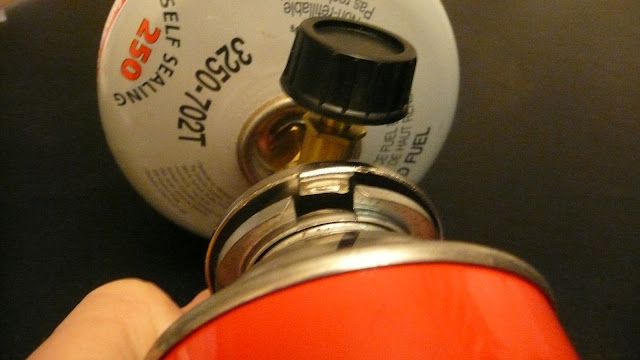 |
| The smaller of the two hooks on the refiller goes through the notch on the butane canister's collar. |
The canister is then rotated to the right approximately 1/16th of a turn, locking the canister into the connector on the refiller.
 |
| The butane canister turns to the right and locks in place. |
When all is said and done, the rig looks like this:
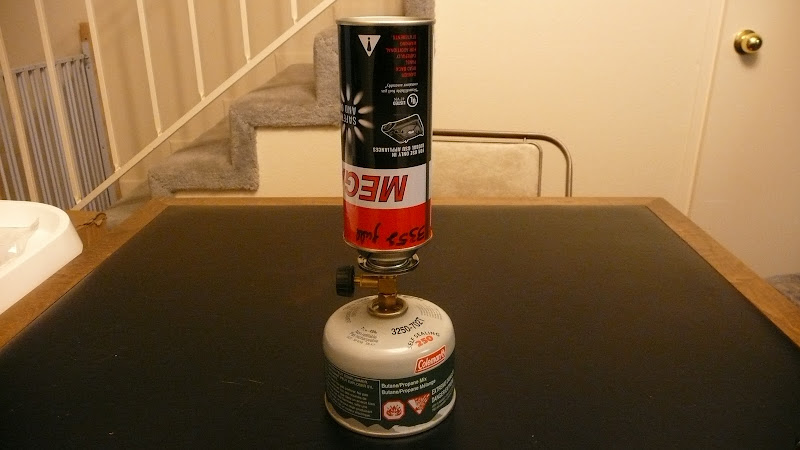 |
| A refiller all hooked up and ready to transfer fuel. |
Now, simply open the valve, and gravity will do the work for you. The liquid butane in the donor canister will flow into the receiving canister. Recall though that there is one complication: There is a vapor feed tube inside the canister.
 |
| There is a plastic vapor feed tube inside the butane canister. |
That tube aligns with the notch in the collar of the butane canister. For maximum transfer, you want to tilt the canister at a bit of an angle with the notch on the collar of the butane canister pointing
down.
 |
| Prop the canister at a steep angle as shown with the notch pointing down. |
The transfer is very slow. Normally, I set it up and then go about my business. I check it after a couple of hours. The vapor feed tube appears to vary slightly brand to brand. As a purely practical matter, MegaOne gas seems to be the easiest brand to transfer gas from. GasOne is a bit more tricky. Sometimes I've had to chill the receiving canister and warm the donating canister to get it to work right. Each canister brand has a "sweet spot," that is an angle where the transfer works best. You'll just have to experiment with that. I've tried three different brands of butane thus far. I've always been able to get it to work although some brands require more fiddling than others.
Since I'm writing a blog post, I don't want to wait a couple of hours for my results, so I'll just detach the refiller now and weigh it after only a few minutes. Recall that our receiving canister weighed 143g when empty.
 |
| The canister now weighs 184g |
Not the world's clearest photo, but the canister now weighs 184g, a gain of 41g in just a few minutes. I notice that there's typically a rush of gas when I first open the valve, and then a very very slow bubbling after that. I can only hear the slow bubbling if I physically press my ear up to the donating canister. When using a slow gravity feed like this, I haven't had a lot of problems with overfilling, but remember to periodically check the canister, especially with the small 100g class canisters. When filling a 220g canister from a 227g canister, there is no worry of any significant overfilling. I often leave 220g canisters hooked up overnight and simply unhook them in the morning. The transfer is never 100%. The donating canister almost always has at least a few grams of gas left behind. Such is life.
NOTE: These photos were all taken indoors where the light is good. I typically refill outdoors where vapors cannot build up and there are no sources of ignition.
That's it. That's how to refill canisters. Remember, no matter how you go about it, refilling is innately dangerous. Refill at your own risk.
Thanks for joining me on another Adventure in Stoving,
HJ
Appendix -- Advantages and Disadantages of Refilling
Advantages
1. Lower cost in the long run.
2. Custom filling. If I am going on a trip where I'll need 140g of gas, I fill my canister to 140g and stop. I do not need to carry a full 230g canister. Weight savings: 70g.
3. Topping off. Say I come back from a trip with a canister with only 25g left. Before I had a refiller, that gas would just sit on a shelf with no real value to me. 25g is too little to bother with. Now, I just top off the canister, and the canister is as useful to me as the day I bought it.
4. Reduced environmental impact. Reusing anything reduces one's overall impact on the environment. Yes, canisters can (and should!) be recycled, but recycling has environmental costs. Yes, recycling is better than the landfill, but there are transport, processing, re-manufacturing, and distribution costs associated with recycling. Yes of course I have the empty butane canister to deal with after refilling, but I'm primarily refilling the small 110g canisters from the larger 227g butane canisters. I'm therefore reducing the overall number of waste canisters. Ideally, I'd like to find an even bigger canister to refill from, but that opportunity has so far failed to materialize.
Disadvantages
1. "Fiddle" factor. You have to spend some time to refill the canisters. Of course, any such fiddle is done in advance. There is zero extra fiddle out on the trail. I much prefer filling in advance over using an adapter out on the trail.
2. Butane is only good for warm weather use. 100% butane is only good so long as the fuel stays above about 40F/5C. If the fuel gets colder than 40F/5C, then your stove will have lackluster performance. I personally do the majority of my backpacking and hiking in warmer weather, so this is not an inconvenience to me.