QuietStove.com

Showing posts sorted by date for query Kovea. Sort by relevance Show all posts

Tuesday, September 19, 2017

The Kovea EZ Eco – "Canisterless" Canister Stove

Last year, I wrote a review of the EZ Eco version of Kovea's Alpine Pot.  At the time, the EZ Eco was having some "technical difficulty."  Kovea did not market the product at that time and went back to the drawing board to work out some of the kinks based on my feed back.

A few months ago, they sent me a re-worked version.  I have reviewed the stove, and there is now a New Review of the Kovea EZ Eco on SectionHiker.com.

The stove I used in my review was sort of a pre-production version, the version they started selling in Korea before they started selling them here in the US.  Just after I finished my review, I got a production US version, with the same markings and color as the version now commercially available in US.  Naturally, it had to come a week or two after I had already written and submitted my review, lol, but other than the color and some other cosmetic changes, the stove I reviewed is the same stove as is now for sale in the US. I will include a couple of photos here of the production version just so you can see what it looks like and exactly what you will get if you buy one.
What's in the box?
Top, L to R:  Stove bag, pot, and lid
Bottom, L to R:  Cup, burner, and instructions
Between the instructions and the lid, notice the adapter.  See review for details.

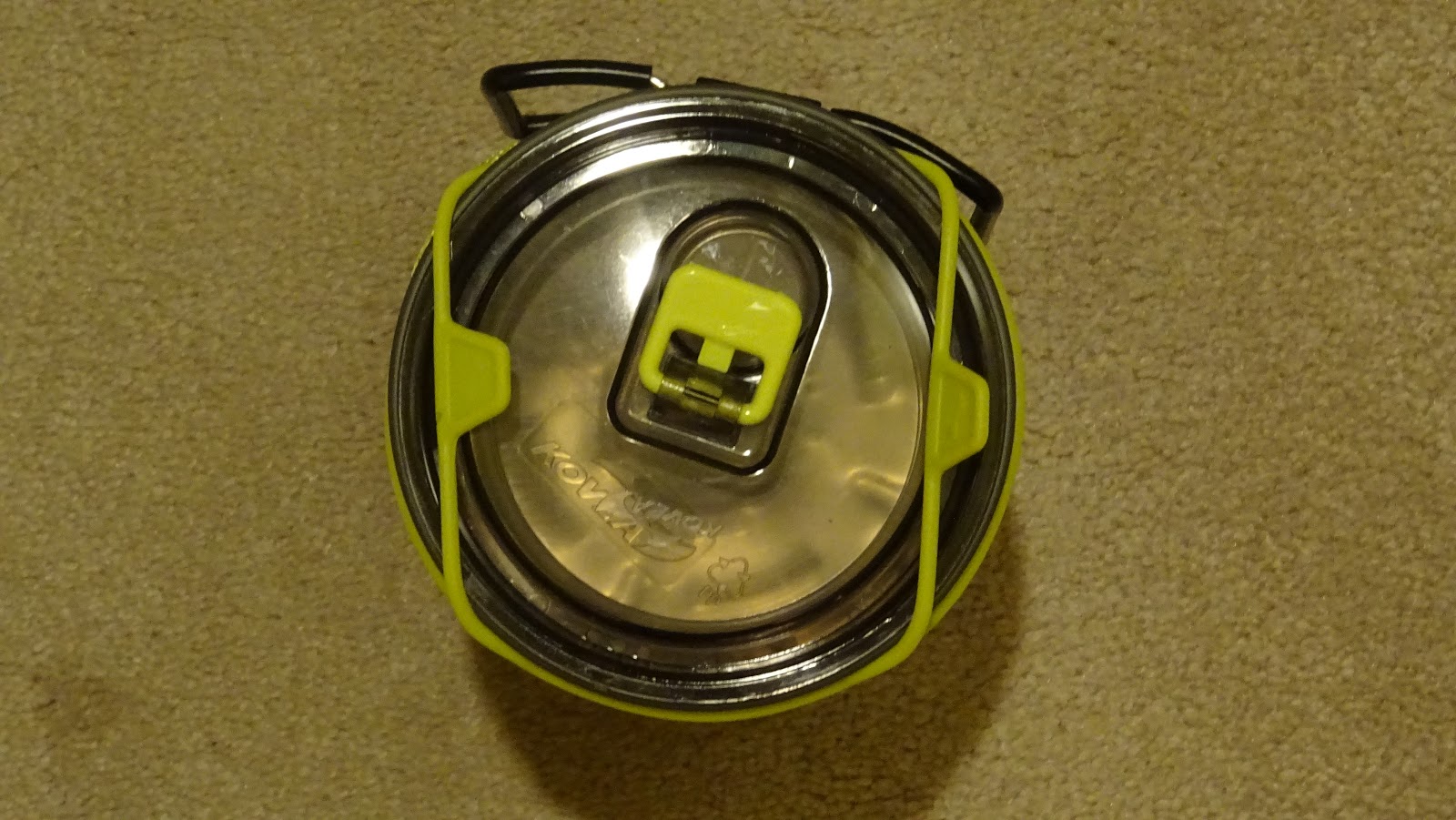
Here's a top down look at the whole assembly.
Note the rubber band like "straps" to retain the lid.

OK, not a whole lot to see here, so head on over to Section Hiker and have a look at the full review.

Thanks for joining me,

HJ

Sunday, May 21, 2017

What is a Light (or Ultralight) Canister Stove?

The words "light" and "ultralight" get thrown around like so much chump change.  Marketers play fast and loose with those terms hoping to score a few more gear sales.  Is there a way we can assign real meaning to these terms?
An FMS-116T "Gnat" stove weighs less than two ounces.
Actually, there is.  We can "grade on the curve."

What the heck do I mean by that?  Well, when I was in school, some instructors would look at the scores on their tests, expecting to see a "normal" (bell shaped) curve.  If the center of the curve didn't line up with "average" performance, they might adjust the test scores.  In other words, students were judged not just on their test scores alone but on how well they did in relation to the class as a whole.  This is referred to as "grading on the curve."

So also, we can judge canister stoves not just on their weight alone but also on how their weights compare to other stoves in their class.
Some stoves today weigh under one ounce, giving new meaning to the term "ultralight."
With that in mind, take a look at the below chart.  This chart applies to upright (top mounted) canister stoves only.  Obviously "integrated" canister stoves (like a Jetboil or Reactor) and remote canister stoves (like an MSR WindPro or Kovea Spider) have to have their own categories in order for those categories to be meaningful.
Upright Canister Gas Stove
Weight Classes
(Less Than or Equal To)
OuncesGrams
Heavy
 4+
113+
Moderate< 4< 113
Light< 3< 85
Ultralight (UL)< 2< 57
Super Ultralight (SUL)< 1< 28

Upright canister stoves today weigh as little as 25 grams – less than one ounce! There are five commercially available stoves that weigh less than two ounces.

Given the light weight of stoves available today, it's reasonable to insist on that a stove be truly light in order for it to belong to the class of "ultralight" and to be even more demanding of weight savings for a stove to earn the title "super ultralight."
We give meaning to terms like "light" and "ultralight" by categorizing stoves relative to one another.
Here then are four examples:
Top row, right:  MSR Pocket Rocket, 3.1 oz (Midweight) 
Top row, left:  MSR Pocket Rocket 2, 2.6 oz (Light)
Bottom Row, left:  FMS-116T ("Gnat"), 1.7 oz (Ultralight)
Bottom Row, right:  BRS-3000T, 0.9 oz, (Super Ultralight)
In summary, based on what is available today, real meaning can be given to terms like "light" and "ultralight" by looking at a given stove's weight in relation to other stoves.  Based on those relative weights, I have created the following upright canister stove weight classes:
  • SUL:  If an upright canister stove weighs less than or equal to an ounce (28 g), it's super ultralight.
  • UL:  If a stove weighs less than or equal to two ounces (57 g) but more than one ounce, then it's ultralight.
  • Light:  If a stove weighs less than or equal to three ounces (85 g) but more than two ounces, then it's light.  
  • Moderate:  If a stove weighs less than or equal to four ounces (113 g) but more than three ounces , then it's moderate.  
  • Heavy:  If it weighs more than a quarter pound (4 oz/113 g), then, by modern standards, it's heavy.  
The above is a reasonable categorization, given the state of the art and the stoves commonly available today.

Next time you read an ad or hear a salesman say that a three (or more) ounce stove is "ultralight," just nod your head and say "unh hunh, sure," and have yourself a little chuckle.  Now, you know better.

Thanks for joining me,

HJ

For Further Reading:
The Purpose of this Post:
As a brief post script, let me just reflect for a moment.  I wrote this post with two things in mind:
1.  To let people know, particularly those less familiar with backpacking stoves, what's out there.  There are stoves being marketed as "ultralight" that are above three ounces in weight.  That's actually on the heavy end of the scale.  It's not even light let alone ultralight.  If you're shopping for a stove and trying to get your base weight down, you need to know that you can do better.
2.  ALL WEIGHT CATEGORIES ARE ARBITRARY including those that talk about total base weight. I like weight categories insofar as they give me a goal that I can challenge myself with, but I don't like weight categories if they lead to one upmanship or a loss of focus on the true bottom line:  enjoyment.  Reduced gear weight should facilitate the enjoyment of one's hiking.  Increased enjoyment of hiking is the true bottom line, not some arbitrary weight class.  

Monday, April 24, 2017

Canister Stoves, Compared – A Compendium of Canister Stoves

Canister gas stoves are the most popular type of stove for backpackers today, but what type makes sense for what use? It's not always clear what the advantages of say a Jetboil are compared to say a Pocket Rocket. Why are some canister stoves better in cold weather than others? Let's see if we can get a high level view and make sense of the world of canister gas stoves.

Canister gas stoves.
A Soto Amicus, left, and an MSR Pocket Rocket 2, right.
Types of Canister Stoves
Three are three general classes of canister stoves.  I'll say a little in brief here and then break things down in detail further on.

The types are:
  • Upright (top mounted) canister stoves.  These are the type of canister stoves that screw directly onto the canister.  The stoves in the photo above are upright canister stoves.  Generally these are the most compact, lightest, and least expensive.  On the downside, they tend to be more vulnerable to wind and pot stability on some is limited.
  • Integrated canister stoves.  Think Jetboil.  This type of stove is sold as a set and includes a pot and stove that are designed to work together.  They may also include some type of cup or bowl.  Often the pot on this type of stove will have a heat exchanger for improved efficiency (fuel economy).  This tends to be the most expensive type of canister stove, but you do get complete set and don't have to buy a separate pot.
  • Remote canister stoves.  This type of canister stove consists of a burner that is connected to the fuel via a hose.  This type of stove can be used with a full 360 degree windscreen without the danger of overheating the canister, has good pot stability, and, on certain models, can be run with the canister upside down (inverted) for greatly improved cold weather operation.  On the down side, remote canister stoves are typically more expensive, heavier, and bulkier than upright canister stoves.  However, remote canister stoves are typically less expensive than integrated canister stoves.
Upright (Top Mounted) Canister Stoves
I recently wrote up a sort of "survey" of what's out there in terms of the typical upright canister gas stove.  The survey is in order by weight, lightest to heaviest, and lists a lot of facts like MSRP, weight, and BTU's/hr as well as my personal remarks.  See:
Upright Canister Stoves – the State of the Art.

Of the stoves that have come out in the last year or so, my two personal favorites are shown above, the Soto Amicus and the MSR Pocket Rocket 2.  If you have any interest in either of those two stoves, I have an article that compares them:   The MSR Pocket Rocket 2 vs. the Soto Amicus.

The Soto WindMaster operating in the Sierra Nevada on a PCT/JMT section hike.

This isn't exactly a new stove, but another one of my favorites is a stove that came out several years ago, the Soto WindMaster, which is the world's lightest stove with piezoelectric ignition.

One note on upright canister stoves:  You should not use a full 360 degree windscreen on them. If you fully enclose the canister and burner, you can overheat the canister.  That might be, uh, bad.  Explosion, flying shrapnel, you know, bad.  Don't do that.  Upright canister stoves do need to be protected from wind, but you need to be safe.  Please see:  Canister Stoves and Wind.

Integrated Canister Stoves
Some people of course are going to want something "more" than an upright canister stove, something like, say, a Jetboil.  This class of stoves is typically referred to as an "integrated" canister stove.  They're a little heavier, but they really save fuel and they're oh-so-convenient.

I've got a survey article on this type of stove:
Integrated Canister Stoves – The State of the Art.

A Primus Eta Express stove system is one example of an integrated canister stove.
One review I completed recently is for the Primus Eta Express stove system (see photo above).

Another popular integrated canister stove – a stove that is utterly "bomb proof" in wind – is the MSR WindBurner (see photo below).

Note:  The Windburner was originally named the Windboiler.  If you see or hear "Windboiler" instead of "Windburner" in my blog or in my videos, don't freak out.  They are one and the same stove.

The MSR Windburner

And of course there's always the Jetboil line of stoves.  I wrote a review of the Jetboil Sol which was featured in Seattle Backpacker's Magazine.  This review should give you some idea of the general features of a Jetboil even if you're considering other Jetboil models (Zip, Flash, Flash Lite, MiniMo, MicroMo, etc.).

Remote Canister Stoves
There are several reasons you might want to go with a remote canister stove.
1.  Stability.  They're generally lower to the ground and wider.  They're typically better for bigger pots as in group cooking.  Families with small children, Scouts, etc. may in particular value the improved pot stability of this type of stove.
2.  Wind resistance.  With an upright canister stove where the fuel is directly under the burner, if you put a windscreen around the stove, you also put a windscreen around the fuel.  Overheat a canister, and Boom!  You can kiss your dinner and possibly a whole lot more goodbye.  With a remote canister stove, the fuel is off to one side, connected by a hose.  A windscreen separates the fuel from the flame.  In other words, a windscreen actually makes a remote canister stove safer (the opposite of an upright canister stove).
3.  Cold weather operation.  If a given remote canister stove has a way to vaporize the fuel before the fuel reaches the burner head, then the stove can be run with the canister upside down (inverted). Hunh? Who cares?  Well, you do if you're out in cold weather.  If you're headed out into cold weather, a remote canister stove capable of inverted operation will handle the cold weather better than any other canister stove.  This is a bit complicated, so I've written a separate article on it.  Please see:  Gas Stoves in Cold Weather – Regulator Valves and Inverted Canisters.

I don't have a survey article (yet) on remote canister stoves, but below are some links to remote canister stoves I've reviewed:
Below is a photo of a remote canister stove, a Kovea Spider, running in inverted mode.  Note how the fuel is connected to the stove via a hose.  Note also the use of a full, 360 degree windscreen (don't do this with an upright type canister stove!).
A Kovea Spider remote canister stove.
Note how the canister is upside-down (inverted).
Conclusion
In addition to all of the above, there are a whole lot more articles on my blog if you want to geek out on stoves.  You can Google search to your heart's content.  If you prefix your Google search with "site:AdventuresInStoving", then Google will search just my blog.

Now, whatever stove you pick, I hope it serves you well out there on the trail.  Of course, even the safest designs need a smart operator in order to be safe.  So, be careful out there – but of course enjoy.

Happy hiking,

HJ

Thursday, April 6, 2017

Integrated Canister Stoves – The State of the Art

I thought I'd conduct a survey of the integrated canister stoves available today (e.g. Jetboil, Reactor, etc.).  I therefore give you:  Integrated Canister Stoves – The State of the Art.
Integrated Canister Stoves
Left to right:  Jetboil Joule, Jetboil Sumo, original Jetboil PCS, Jetboil Sol

I recently posted a table of "regular" upright (top-mounted) canister stoves in my Upright Canister Stoves – The State of the Art article.  Today's article is in the same vein – but it pertains to a different class of stoves, i.e. those stoves that are "integrated" in that they are not just a burner but rather are a complete system that includes both a pot and a burner that are designed to work together.  Typically such stoves are the high end product for a given company and are usually highly efficient and have special features like heat exchangers and frequently have regulator valves.

A Jetboil Joule, left.  An MSR Reactor (2.5 Liter size), right

Click to enlarge this graphic:
A comparative table of integrated canister stoves in order by brand and then stove within brand.
Click to enlarge
Absent from this table are stoves from Kovea and Fire Maple as well as some other lesser known integrated canister stoves.  I'll keep adding to this table as time permits.

Discussion
How do you pick which one might suit your needs?  Well, the table above may be sufficient alone, but let me make some additional comments:

Wind
If you think you'll be facing windy conditions on a regular basis, then there is no better choice than an MSR integrated canister stove, either the Reactor or the Windburner.  These MSR stoves scoff at wind.  They are just the absolutely most "bombproof" stoves in wind, bar none.  I've been on multiple desert trips where Jetboil stoves wouldn't stay lit in gusty winds and I just couldn't boil water – at all.  In those same conditions, my MSR Windburner acted as though nothing unusual were occurring.  These MSR stoves are amazingly wind proof.  Did I mention amazing?

The Reactor is geared towards mountaineers and is a powerful stove suitable for snow melting.  It can also burn through a lot of fuel if you let it. The Reactor is quite expensive. The Windburner is more targeted towards backpackers and is at a far more reasonable price.

When the Windburner came out, Jetboil started advertising the rail upon which the pot rests as a "windscreen."  Ha!  What a joke.  The Jetboil may have many features, but a windscreen is not one of them.  Saying that a Jetboil has a built in windscreen is wishful thinking and is just marketing spin on the part of Jetboil.

Doubt my word?  Check out the two videos on this blog post:  Jetboil Sol vs. MSR Windburner – Wind Testing.  NOTE:  In the video, you'll hear me call the Windburner the "Windboiler" which was the name of the stove until Jetboil threatened legal action.  MSR renamed the Windboiler to the Windburner, but I had already made and posted the video.  In your mind, just substitute "Windburner" every time you hear me say "Windboiler."  They are one and the same stove.

Cold
If you're going to be operating in temperatures below 0 Celsius (32 Fahrenheit), then it behooves you to get a stove with a regulator valve.  Why?  See my recent article:  Gas Stoves in Cold Weather – Regulator Valves and Inverted Canisters.  Yes, they cost more, but they perform better in cold weather – read the article.  It will explain the whys and wherefores of cold weather canister stove technology as well as offer tips and tricks.

High Elevation
Don't worry about it.  You heard me right; don't worry about high elevation with respect to canister gas stoves.  The spiel about elevation affecting canister gas stoves in a negative way is a myth.  It got started in the 1970's when 100% n-butane (normal butane) was used as a fuel.  N-butane is a lousy cold weather fuel.  When people went high (where it was cold), the stoves often didn't work.  Thus gas stoves got associated with not working well at high elevation when in fact with 100% n-butane, they wouldn't have worked any better at sea level.  The really issue was a crappy fuel.

Today, we don't use just straight n-butane.  We use fairly sophisticated blends of propane, isobutane, and n-butane.  These blends work a heck of a lot better in cold weather than 100% n-butane. High elevation has nothing to do with it, so don't worry about it.

Real Cooking
Once I was out with some friends at a beautiful lake in the Sierra Nevada Mountains.  They caught some nice, tasty trout.  They had a Jetboil.  They boiled the trout.  Yuck!  What a waste of precious trout!  The next day, they caught more trout and wisely came to me (I didn't have a Jetboil with me on that trip) and traded their fish for some time on my stove.  Yum!  It was delicious!

Now, don't get me wrong, a Jetboil is a great stove, but it's tall and skinny.  It's really not meant for frying fish.  It's great for boiling water, but it's lousy for doing any real cooking.  Yes, you can use their little steel adapter and then use some other pot or pan on a Jetboil burner, but that sort of defeats the purpose.   I mean the great efficiency of a Jetboil is due to it's special heat exchanger pot.  Absent that pot, a Jetboil burner is pretty ordinary.  Oh, and yeah, you have to keep track of the steel thingy to use with other pots – and it's extra weight.  You're better off with a Jetboil Mini-Mo or a Primus Eta Express stove system which have wider pots.  The Eta Express is the wider of the two and has a really nice non-stick coating.  For those who want to do real cooking and use an integrated canister stove, the Eta Express is actually a really nice option.  For my review of the Eta Express, here's a link: Review – The Primus Eta Express stove system.  Note also that the Eta Express system can use any pot or pan without any adapters or modifications.  There's no steel thingy to carry and keep track of with the Eta Express.

Price
The Jetboil Zip is the low price leader.  If you're looking to save bucks, the Zip might be your best option.  However, be aware that the Zip has no ignition and has only 800 ml capacity.

The Jetboil Flash series is a nice moderately priced (for an integrated canister stove) option that has a built in piezoelectric ignition.

Size
If you want to save a little weight, the 800 ml size pots that come with the Zip, Flash Lite, and Micro Mo might be a good option, but realize that you can only boil about 500 ml at a time (two cups).  That's basically just dinner alone when using an 800 ml pot.  If you want dinner and a cup of tea or hot chocolate, then you'll probably want to get the full one liter size.  NOTE:  You have to leave some "margin for error" at the top of a pot of a Jetboil type stove because the can rapidly boil over, so you typically only want to boil about 500 ml of water with an 800 ml Jetboil pot and only boil 750 ml of water with a one liter Jetboil pot.

If you need more capacity, Jetboil sells a 1.8 L pot called the Sumo.  Jetboil also sells a frying pan for use with its stoves.  I have not used the Jetboil frying pan, but in general it has gotten a lot of negative reviews.  Most people say "save your money."

MSR has 1.0, 1.7, and 2.5 liter pots available for its Reactor system and 1.0 and 1.8 L pots available for its Windburner system.  MSR also has a frying pan available for its Windburner system.  I have not yet tested the frying pan.

Primus has 1.0, 1.8, and 3.0 liter pots available for it's Eta Express system, but note that you can use any pot or pan with the Eta Express system.

The Primus Eta Express system is the most versatile integrated canister stove system.

Hikin' Jim's Pick
If I had to take my pick, my pick would probably be the Primus Eta Express system for all around general use. All of the stove systems herein listed are good integrated canister stove systems.  I don't dislike any of them (note that I have not tried the Primus Eta Lite series of stoves), but I think the Eta Express system is the most versatile.  With the Eta Express I can use any pot or pan without having an adapter, and it's wide and has a good non-stick coating, so I can do real cooking in it if I want to.

However, were I facing wind, I would pick a Reactor or Windburner.  Were I facing cold, I'd pick one of the regulator valved stoves which will in general perform better in cold weather.  The Eta Express does not have a regulator valve.

Deal alert!  This is going to sound like I'm selling something (I'm not; I receive no benefit from the purchase of any stove), but I do note that as of this writing Massdrop has the Eta Express on sale for $75 to $80, depending on how many people sign up for the "drop" (group buy).  That's a heck of a price for a MSRP $130 stove system. A "drop" on Massdrop only lasts about a week or so.  If you want to sign up for Massdrop, here's a link:  https://www.massdrop.com/r/ETFBT7. I do get some benefit from that link, maybe a free T shirt or something if enough people sign up (and buy something).  If you use that link, I thank you, but please just buy what you need.  I have plenty of T shirts.

Final Remarks
So, there's my survey of the state of the art of integrated canister stove.  I'll add more (I'm reviewing a Kovea stove now) as time permits.

Thanks for joining me,

HJ

Disclosures:  Massdrop provided me with an Eta Express stove system for the purposes of my review.  I assume that the reason that Massdrop is now offering the Eta Express system on sale is that my review just came out.  Note that I do not receive any compensation from Massdrop for my reviews other than my getting to keep the stove that I reviewed.  Inasmuch as I actually really liked the Eta Express, I suppose you could say that is a benefit, but I try really hard to review stoves objectively regardless of their personal appeal.  I for example don't do a lot of winter group trips, but I've spent a considerable amount of time working with the Reactor and Joule stoves simply because they're fascinating stoves and deserve a fair shake.  I receive no percentage of any sales, no salary from any outdoors brand, and have no financial relationship with any stove company.  I have purchased items from Massdrop using my own money just as anyone else from the buying public would.  I did get some free socks from Massdrop at one point, partly to get my opinion of them.  I don't really consider socks a financial relationship, but there you have it; my cards are all on the table.  Now, if Massdrop offered me a six pack of beer or some nice thank you chocolates, it would be rude of me to refuse, now wouldn't it?  Are you listening, Massdrop? I like dark chocolate, OK?

As I wrote above, i
f you want to sign up for Massdrop, here's a link:  https://www.massdrop.com/r/ETFBT7. I do get some benefit from that link, maybe a free T shirt or something, if enough people sign up (and make a purchase).  If you use that link, thank you very much, but please don't feel obligated.


Appendix I – MSR vs. Jetboil Integrated Canister Stoves

It's interesting the direction that Jetboil has taken since they were sold to Johnson Outdoor.  They now have not one but three 800 ml size offerings:
-The Zip, $80 (economy model)
-The Flash Lite, $100 (middle of the road model)
-The Micro Mo, $130 (high end model)

They only have two 1000 ml offerings:
-The Flash, $100 (middle of the road model)
-The MiniMo, $135 (high end model)

One 1800 ml offering:
-The Sumo, $140

And one 2500 ml offering:
-The Joule, $200

MSR by contrast has fewer offerings, and those offerings are more specialized.  Clearly MSR is only trying to compete on the high end and isn't even trying to touch the Zip.

MSR has
Two 1000 ml offerings:
-1.0 L Windburner, $140
-1.0 L Reactor, $200

Two 1700/1800 ml offerings:
-1.8 L Windburner, $160
-1.7 L Reactor, $220

And one 2500 ml offering:
-2.5 L Reactor, $240

I don't believe that MSR plans to offer a 2500 ml version of the Windburner.

Both the Joule and 2.5 L Reactor are fairly specialized set ups that would be used frequently for snow melting where the greater capacity would be advantageous.  The Joule incidentally is the fastest backpacking stove I have ever seen, bar none.  The Joule blows the Reactor away in terms of speed.


Appendix II – Table in HTML form

Below is an HTML version of the above table which may be easier to read in some browsers.
Adventures In Stoving -- https://AdventuresInStoving.blogspot.com
Brand Stove BTU Grams Oz's Size $$'s Pros Cons Comments
Jetboil Flash 4,500 397 14.0 1.0 L $100 Moderate price Not as good in cold weather as regulated burners Basic 1 liter Jetboil
Jetboil Flash Lite 4,500 312 11.0 0.8 L $100 Moderate price Not as good in cold weather as regulated burners Basic 0.8 liter Jetboil
Jetboil Joule 10,000 715 25.2 2.5 L $200 Fastest stove ever.  Regulator valve; inverted canister. Fuel hog.  Unstable.  Only uses 100 and 230 g size canisters.  Big and klunky.   Best cold weather Jetboil.
Jetboil Micro Mo 6,000 340 12.0 0.8 L $140 Regulator valve Better in cold weather than Flash
Jetboil Mini Mo 6,000 415 14.6 1.0 L $130 Regulator valve.  Wider pot for easier access Better in cold weather than Flash
Jetboil Zip 4,500 333 11.7 0.8 L $80 Least Expensive No piezo ignition.   Economy model Jetboil
MSR Reactor 9,000 417 14.7 1.0 L $200 Regulator valve, extremely  wind resistant.  Good handle. No piezo ignition.  Expensive. Very fast.  Turn down to save fuel.  Very popular with mountaineer for snow melting.
MSR Windburner 7,000 432 15.2 1.0 L $140 Regulator valve, extremely  wind resistant. Nice handle. Heaviest 1 liter integrated canister stove. No piezo ignition.   More targeted towards backpackers whereas the Reactor is more toward mountaineers.
Primus Eta Express 8,900 395 13.9 1.0 L $130 Wide pot; easy access.  Nice non-stick coating "Windscreen" is a joke; leave it at home. Very fast.  Turn down to save fuel.  Very good unit overall despite bad windscreen.
Primus Eta Lite 4,500 360 12.7 0.5 L $105 Haven't ever seen; can't comment.
Primus Eta Lite+ 4,500 390 13.8 0.5 L $115 Haven't ever seen; can't comment.
Adventures In Stoving -- https://AdventuresInStoving.blogspot.com

Sunday, April 2, 2017

Review – The Primus Eta Express Stove System

The Primus Eta Express stove system is an upright integrated canister gas stove system (something along the lines of a Jetboil).  I really liked this wider pot approach (as compared to a typical skinny Jetboil or an MSR Windburner pot), but before I give you my final analysis of the system, let's go through the features.
The Primus Eta Express stove system
The system features a really nice ceramic based non-stick coated one liter pot with a well shielded, built in heat exchanger.  The pot has volumetric markings on the side wall at 0.3, 0.6, and 0.9 liters.  The markings are clearly visible on both the inside and outside of the pot.  The exterior of the pot is hard anodized.

Note:  This pot is also available in 1.8 L and 3.0 L sizes.
The one liter pot (with heat exchanger) of the Primus Eta Express stove system.
Note volumetric markings on the side of the pot.
With the way the heat exchanger is protected, you've got little to worry about when packing it or setting it down on the ground in camp.  The guard of the heat exchanger will itself conduct heat to the contents of the pot making it all the more efficient.  Boils were noticeably fast even on low flame settings. This is a very efficient set up with excellent fuel economy.

The non-stick coating feels silky smooth and slick to the touch.  Nothing stuck to it even when I overcooked some noodles – which could be a real mess on a non-coated pot.
The glossy, slick non-stick coating of the Primus Eta Express pot
The Primus Eta Express stove system comes with a red plastic bowl that nests inside the pot.  The bowl is actually quite functional, in marked contrast to the little plastic cup that protects the heat exchanger on a Jetboil.  I've never found the cup on a Jetboil very useful, but the bowl on the Primus Eta Express stove system is pretty nice bowl.  Now, for a soloist, you'd probably want to leave the bowl at home, but for a team of two, one person could eat out of the pot (if you were cooking in the pot, not out of a bag) and the other out of the bowl.

The bowl also protects the pot from any scratches if you store either the stove or a canister in the pot.  There's a small rectangle of foam that can be laid on the bottom of the pot if so desired such that the bowl does not rest directly on the non-stick coating.
The Primus Eta Express stove system's bowl nests neatly inside the pot
The Primus Eta Express stove system can accommodate both the stove and a 110 g canister of fuel inside.
Both the stove and a 110 g canister will fit inside the Primus Eta Express stove system
The canister sticks up a little bit, but that's not a problem since the lid has a raised portion that serves as a means to pick up the lid off the pot.  The lid also has a built in colander for draining, say, pasta or vegetables.
The lid of the Primus Eta Express stove system has a built in colander.
One grabs the lid by the insulated red portion.
The pot handles well insulated so that one does not burn one's hands when picking up the pot.  The handles are long and provide ample leverage.

Central to any stove system is of course the stove itself.  The Primus Express stove is a nice, well made stove, but at 98 g/3.5 oz is a bit heavy for its class.  Many comparable stoves are about one ounce lighter.  Yes, that's "only" an ounce, but remember that if on average one can shave just two ounces off of each piece of gear, one would reduce their pack weight by about ten pounds (assuming that one is a typical backpacker that carries 80 - 100 items in their pack).  As Colin Fletcher put it so well:  "Take care of the ounces, and the pounds will take care of themselves."

The stove comes in a little roll top type bag with a plastic clip closure.  The stove bag is tough and well made, but at 25 g/0.9 oz, it's a bit heavy in my opinion.  I'd probably just toss my stove directly in the red plastic bowl or wrap my stove in a bandana and leave the stove bag at home.
The stove bag for a Primus Eta Express stove
The Primus Eta Express stove comes with a piezoelectric ignition.  Should you dislike the ignition, it can be removed.  The ignition is very functional but is a little bit big and isn't quite as sophisticated as the ignition systems coming out from some other manufacturers, most notably Soto.  The ignition also sticks up above the burner where it is prone to snagging.  Still, the ignition works well and is super convenient.  Note however that no ignition system is every 100%, particularly at elevations above 10,000 feet (about 3,000 meters).  Always carry a back up means of ignition.  Always.  Personally, I like a fire steel, but flint wheel type lighter or matches are other good means of ignition.

I can't comment on the long term reliability of the ignition on a Primus Eta Express stove, but I do note that the spark wire sits directly in the flame at all times.
The flame of a Primus Eta Express stove.  The yellow portion of the flame is where the ignition is.
The valve knob works well and provides excellent flame control.  The stove simmers well.  Users of heavy mittens or gloves might have trouble gripping the knob.  Most manufacturers use a wire handle that is easier to grip when wearing mittens or gloves.  It's interesting that Primus here differs in their approach.  I wouldn't say this is necessarily a negative, but it is something to think about and be aware of.
The Primus Eta Express stove is roughly as big around as the base of a 110 g canister.
The pot supports of the Primus Eta Express stove are wide with grippy, well defined teeth.  I find that Primus is doing a really good job, better than other stove manufacturers (except maybe Soto), with make sharply defined teeth on their pot supports that really grip a pot well.  The one criticism of the pot supports that I have is that they don't fold well out of the way.  They take a lot of room up.
Left to right:  Primus Eta Express stove, Kovea Supalite (aka "Camp 56"), and a Markill Hot Rod.
Note how far to the left the pot supports stick out on the Eta Express stove.
Just about every stove manufacturer out there has figured out a way to make things a bit more compact than the Primus Eta Express stove's pot supports.  They're not horrible in terms of the space they take up, but there is room for improvement.  In terms of function, they are excellent pot supports, far above average.
Most stoves use folding pot supports to save space.  The Primus Eta Express stove takes up more room than average.
Left to right:  MSR Pocket Rocket, Primus Eta Express stove, MSR Pocket Rocket 2, Kovea Supalite
The Primus Eta Express stove system comes with a little partial windscreen that fits neatly around the pot for efficient packing.
The Primus Eta Express stove comes with a small windscreen
 The windscreen has a slot in it.  A pot support fits into the slot, and the stove then rests on a red plastic "shelf" attached to the burner.
Slide the pot support with the red "shelf" into the slot on the windscreen
The far ends of the windscreen are held to the other two pot supports by magnets.  I found it pretty easy on and easy off.  I also found it reasonably secure when in place.  The windscreen will not easily fall off although it can shift a bit if you bump it.
The windscreen in place on a Primus Eta Express stove.  Note the large hole in the windscreen.
You will note in the above photo that there is a large hole in the windscreen.  Presumably this hole is to preclude any possibility of the windscreen causing heat build up that might cause a canister explosion.  While the hole removes any chance of an explosion, it also removes any chance that the windscreen will block any wind.  In my testing, I found the windscreen to be of no benefit whatsoever.  Maybe if one were in a lab with very sensitive test equipment, then maybe could detect some subtle improvement in performance brought about by this windscreen, but I was unable to find any perceptible benefit.  It looks like the lawyers killed this one folks, and it's dead on arrival.  The best place for this windscreen?  In the recycle bin.  Seriously, leave this one at home, folks, it's utterly useless.

Now, don't get me wrong.   I said up front that I like this stove system, and indeed I do.  But this windscreen should never have gotten out of the door of the Primus development lab.  It's more gimmick than windscreen.  Perhaps one could use some aluminum foil or heat resistant tape and block off the hole, but as is, it just doesn't work in any discernable way.

The entire system is held together by a mesh bag and is quite compact as a set.  I think the compactness of the Primus Eta Express integrated stove system compares well with the compactness of other integrated stove systems like the Jetboil Flash or the MSR Windburner.
The Primus Eta Express stove system is quite compact for a one liter integrated stove system.
Flexibility
The Primus Eta Express stove system is a really flexible system.  If you want to use a different pot on this system, you just do it.  There's no steel attachment that you have to carry as with a Jetboil.  There are no little screws you have to emplace as with a Primus Eta Lite.  Really, you can use any stove or any pot with this system, swapping things out at will.  Indeed, had you a stove that you really liked, you could presumably just buy the pot and use your existing stove, but do note that the Eta Express stove is ideally suited and tuned for the Eta Express pot.
Simultaneous wind testing using a "control" stove vs. the Primus Eta Express stove.
Note the 0.9 L Primus kettle on the Eta Express stove.  One can use any pot with the Primus Eta Express stove.
Component weights
If you brought along everything that comes in the box, you'd have a total weight of 530 grams/18.7 oz, as shown in the first table below.

But I wouldn't bring everything.  I'd probably leave the bowl at home unless I were traveling with a partner.  I'd also most likely leave the little stove pouch at home, and I'd certainly leave the useless windscreen at home.  Leaving those items at home, your weight would be a far more reasonable 397 g/14.0 oz, as shown in the second table.

397 g/14.0 oz compares reasonably well with other integrated canister stove systems.

Everything Weights
Item Grams Ounces
Stuff Sack 21 0.7
Windscreen 56 2.0
Stove pouch 25 0.9
Lid 60 2.1
Foam 2 0.1
Bowl 50 1.8
Stove 98 3.5
Pot 218 7.7
Total (weighed) 530 18.7

Minimum Weights
Item Grams Ounces
Stuff Sack 21 0.7
Lid 60 2.1
Stove 98 3.5
Pot 218 7.7
Total (weighed) 397 14.0

Price
MSRP for the entire (see full component list, above) Primus Eta Express stove system is $130.  This compares favorably with a Windburner (MSRP $140) or a Mini-Mo (MSRP $140), but the Primus Eta Express stove does not have a regulated burner.  A regulated burner can give one a distinct advantage in cold weather (see Gas Stoves in Cold Weather – Regulator Valves and Inverted Canisters for further information).  The Primus Eta Express stove does not have this cold weather advantage.  It's a bit higher priced than say a Jetboil Flash (MSRP $100).  I strongly prefer the more flexible (both in terms of cookware and what you can cook) Primus Eta Express stove system, but it remains to be seen whether the system will be economically viable.  I notice that REI was carrying the Primus Eta Express stove system last year but that they are not this year.  This may be an indicator that the Primus Eta Express stove system may not be selling well, but I speculate.

Analysis and Conclusions
Overall, I really liked the system.  Yeah, the windscreen is lousy, but overall, this is a really nice system.  I found the wide pot was much easier to cook in than a tall, skinny pot.  The simmer control is excellent, and I could do real cooking.  The non-stick coating is very good; a spider wouldn't be able to climb up the sides of this pot.  The pot is wide and low enough that it can be used as a frying pan.  It wouldn't be an ideal frying pan, but it would be a reasonable compromise for backpacking, and would be outstanding compared to a tall, thin pot (like a Jetboil).  Eggs, even a single pancake could be cooked herein.  I'd prefer the Eta Express pot 10 to 1 over a tall Jetboil style pot for frying fish.

The real advantage of this system to my mind is in its flexibility.  One gets a very functional complete kit, but one can easily swap out pots or stoves as desired with no adapters or modifications needed.

The Primus Eta Express Stove System

What's good about it?
  • Very flexible #1 – use any pot or pan you like, no adapters, no modifications
  • Very flexible #2 – the wide pot allows one to cook a variety of foods, foods more complex than merely boiling water.  The wide pot can double as something of a frying pan.
  • Highly efficient – fast boils and good fuel economy
  • Excellent non-stick coating
  • Great pot stability
  • Silicone coating on the pot handles
  • Silicone band on pot lid
  • Packs compactly
  • Well protected, durable heat exchanger
What's not so good about it?
  • The windscreen is a joke
  • The stove could be more compact and is too heavy for its class
  • The stove bag could be lighter
  • Spark point on piezoelectric ignition sticks up and can get snagged

The Primus Eta Express Stove System:  Highly recommended (except for the "windscreen")

I thank you for joining me,

HJ

Disclosures:  The Primus Eta Express Stove System used in this review was provided to me at no charge by Massdrop, a "group buy" site.  I have no financial stake in Massdrop, neither do I receive any payments for my reviews from Massdrop (or anyone else for that matter).  I have received some free socks as a beta tester as well other stoves for other reviews.  In addition, I have made several purchases with my own money from Massdrop just as any other member of the public would do.  I do not receive any discounts or special pricing from Massdrop.  The fact that Massdrop gave me an all expenses paid trip to Rio de Janeiro in their luxurious corporate jet of course had no influence whatsoever on my review (don't I wish?).  I do hope maybe Massdrop will buy me a beer some day, but we'll just have to see about that.  In the mean time, rest assured that my stove reviews are independent and as free of bias as I can humanly make them.

If you want to, you can join Massdrop via this link:  https://www.massdrop.com/r/ETFBT7.  If enough people sign up and actually buy something, I think I get a free T shirt or something.  Do as you see fit, but you wouldn't want to see me naked, now would you? 


Simul-testing the Primus Eta Express stove against other stoves.
Photos were shot and testing was conducted at:

  • My place of residence, primarily out doors
  • Crystal Cove State Park
  • Angeles National Forest
  • Cleveland National Forest
  • Thomas F. Reilly Wilderness Park