 |
| The Dragon's Head |
QuietStove.com

Friday, September 21, 2012
A New Blog
I've got a new blog. Odd as it may seem, sometimes I actually go hiking. Yes, it's true. I don't just sit around and play with stoves all day. If you're interested in a trip report from my recent ascent of Bighorn Mtn (10,997'/3352m) and The Dragon's Head (10,866'/3312m), take a look at my new blog: Hikin' Jim.
HJ


Friday, September 7, 2012
What's the Best Gas Stove?
Recently, I got asked "what's the best gas stove?" In my ever-so-helpful way, I replied "it depends." :)
While that might seem a bit evasive, it really isn't -- it really does depend on what you, the user, want to do with the stove and under what conditions.
In an effort to better answer my friend's questions, I put together the following concerning the question of the best canister gas stove:
HJ
Note: Prices are shown in US dollars and were current as of the date of publication and reflect MSRP. Prices may vary by retailer.
While that might seem a bit evasive, it really isn't -- it really does depend on what you, the user, want to do with the stove and under what conditions.
In an effort to better answer my friend's questions, I put together the following concerning the question of the best canister gas stove:
- For colder weather (from about 50F/10C down to about 0F/-18C), the MSR WindPro (187g/6.6oz; $100) is a good choice. Since the WindPro is a) a remote canister stove and b) has a generator (pre-heat loop), it can be run with the canister upside down. Because it can run with the canister upside down, a WindPro can run in temperatures about 20F lower than typical canister stoves. The WindPro is also, as the name indicates, much easier (and safer!) to shield from wind and handles big pots well. The down side is that the WindPro is more expensive, heavier, and bulkier than other stoves. I myself probably wouldn't buy a WindPro unless I were intending to do some colder trips, doing gourmet cooking, or cooking for larger groups (3 or more). The Primus Express Spider (198g/7oz, $70) is a similar stove with similar characteristics. The Kovea Spider (KB-1109) is a lighter version (168g/6oz; $52.90) of this class of stoves and shows great promise. However, the Kovea Spider to my knowledge is not available in the US; you might be able to get a Kovea Spider on eBay. Yes, the Kovea Spider is a little lighter than other stoves in this category, but the real story here is that the Kovea Spider is particularly compact. The Kovea Spider is my favorite stove of 2012. Look for a review here of the Kovea Spider soon.

The new Kovea Spider (KB-1109)
My review of the original WindPro is available here on Adventures in Stoving; the only real difference between the original Windpro and the new (2012) Windpro II is that the Windpro II has a rotating coupler at the valve which makes it easier to invert the canister.
I have not yet reviewed the Primus Express Spider.
An MSR WindPro


- For lightweight, the Snow Peak LiteMax (54g/1.9oz, $60) is a favorite of mine. The new MSR MicroRocket (73g/2.6 oz, $60) is also good and is quite compact. There are lighter gas stoves out there, like the Fire Maple FMS-116T (48g/1.7oz, $50). The FMS-116T is a good stove and is currently the world's lightest production canister stove, but I find the FMS-116T to be a bit bulky for what it is. Note that the FMS 116T is typically sold as the Monatauk Gnat or the Olicamp Kinetic Ultra outside China. The down side to these lightweight stoves is that a) they have limited pot stability if you're using a bigger pot, b) they have no wind resistance, and c) it's not safe to use a windscreen with them unless you really know what you're doing and are very careful. I've got an article on windscreens at Seattle Backpackers Magazine as well as a blog post on windscreens if you're interested. A word of warning: Do NOT ever let the gas canister of your stove get hot when using a windscreen on a canister stove. Overheating the gas canister could lead to a potentially deadly explosion. I have not yet reviewed the Snow Peak LiteMax. My review of the MSR MicroRocket is available at Seattle Backpackers Magazine. I have not yet reviewed the FMS-116T.
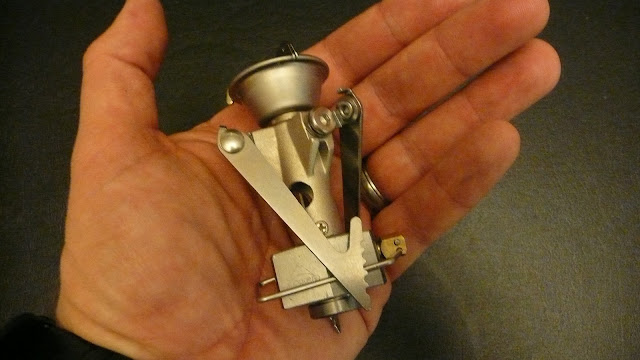
An MSR Micro Rocket

- For convenience, the Jetboil can't be beat. Just clip the pot to the stove, screw on the gas, press the auto ignitor, and go. Not only is it convenient, but the Jetboil has some built in wind resistance, and the Jetboil is also really efficient. Your gas goes a looong way, but don't expect that efficiency to result in any weight savings. You'd have to be on a fairly long trip before the weight of the fuel saved by using a Jetboil would be greater than the weight of the stove itself. The downside to the Jetboil as you may have already guessed is that the Jetboil is heavy when compared to other upright canister stoves. The new Jetboil Sol (312g/11oz, $120) is a significant improvement over the first generation Jetboils in terms of both weight and bulk, but I would not recommend the Ti version of the Sol which only saves about one ounce in weight yet costs $50 more. The Ti version of the Sol has an aluminum heat exchanger with which there have been some melting problems reported. I wrote a review of the Jetboil Sol for Seattle Backpackers Magazine if you're interested.
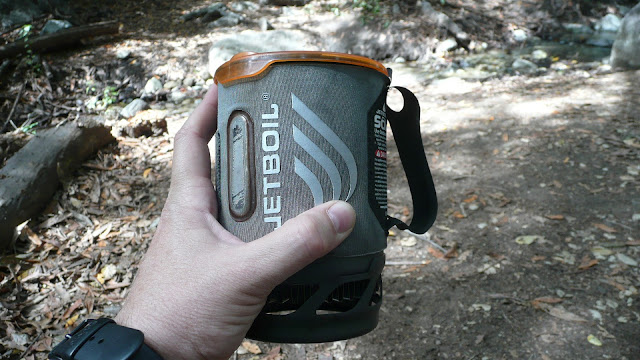
The new Jetboil Sol

- For "bombproofness", the MSR Reactor (496g/17.5oz, $160) can't be beat. If I were on a windswept plateau at 13,000 feet in a howling wind, I can't think of a stove I'd rather have. Not only is it highly wind resistant, it's also blazing hot, making it an excellent snow melter. The downsides of the Reactor are a) high fuel consumption (if run on high), b) poor simmer control, c) high cost, d) weight, and e) bulk. However, if you intend to go into extreme conditions, the Reactor is worth it. The Reactor is very popular with moutaineers who tend to melt a lot of snow and go into extreme conditions. My review of the Reactor is available here on Adventures in Stoving.

The MSR Reactor

- For value, I really like the Snow Peak GigaPower GS-100 (92g/3.25oz, $40). For $40.00 bucks, it's tough to beat unless you want to buy something direct from overseas. Yes, there are other stoves that you can buy for $40.00 or even less, but not of this quality. The GigaPower GS-100 is just an all around excellent design. Many consider the GigaPower GS-100 to be the "gold standard" of small, lightweight canister stoves, yet it is only $40.00. Any time a new canister stove comes my way, the first stove I compare it to is a GigaPower. The GigaPower is compact yet very sturdy and has excellent pot stability for its class. The GigaPower is my benchmark for lightweight canister stoves. I have not yet reviewed the Snow Peak GigaPower, but I have previously recommended it as a good "value for the dollar" stove here on Adventures in Stoving.
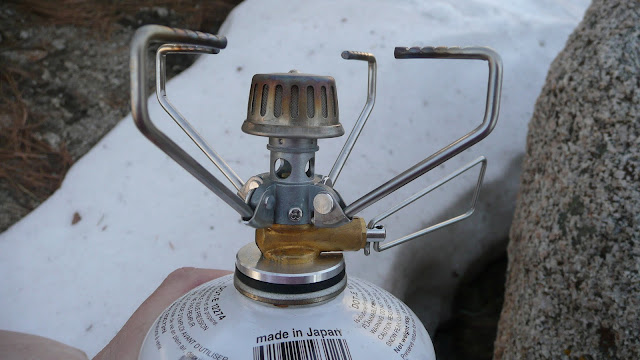
The Snow Peak GigaPower, an excellent stove and an excellent value

HJ
Note: Prices are shown in US dollars and were current as of the date of publication and reflect MSRP. Prices may vary by retailer.
Sunday, June 17, 2012
Happy Fathers Day
Happy Fathers Day from all of us here at Adventures in Stoving
Hope all you fathers out there had some adventures of your own this day.
HJ
 |
| The Adventures in Stoving Team on the trail in Monrovia Canyon |
HJ
Friday, June 15, 2012
California, Stoves, "Campfire" Permits, and ESBIT
I live in California in the United States. I thought I'd comment about what is and is not permissible with respect to stoves, fires, and fuels in the backcountry here.
Unfortunately, there are a welter of jurisdictions including state parks, national parks, city parks, national forests, county parks, and Bureau of Land Management areas. Each of these may have their own rules and restrictions. Even different units of the same overarching agency will have differing rules.
However, there is one thing that is generally required in California across the various jurisdictions: the California Campfire Permit. Basically, outside of a developed campground, to have any kind of fire (a wood fire or a camp stove), you have to have a campfire permit. And, yes, you read that right; you have to have a permit in order to operate a camp stove in the backcountry. Based on the name, you would think a campfire permit would be for wood fires alone, but, no, a campfire permit is for any type of fire, including all backpacking type stoves.
It's easy to get a permit; just click on the above link, print it, fill it out, and sign it. You don't have to go to a ranger station, pay a fee, take a test, or anything like that. I think they just want you to have the regulations in front of you.
A campfire permit generally allows one to use a woodfire, charcoal fire, or "chemical" stove, but each local jurisdiction places additional restrictions as to where fires and what fuels are permitted. Wood and charcoal fires are generally the most restricted with many jurisdictions confining wood fires to developed campgrounds only. With respect to those restrictions, gas and pressurized liquid fueled stoves are always OK in state and federally controlled backcountry areas, but I have seen local cities prohibit even gas and pressurized liquid fuel stoves (e.g. the City of Monrovia). Jellied petroleum (I assume they mean Sterno type stoves) is also permitted (but who the heck uses a Sterno stove?).
Alcohol and hexamine (e.g. ESBIT) stoves are generally lumped in with wood fires and are typically more restricted. Alcohol and wood stoves are prohibited in many backcountry areas in California, especially in Southern California. The rule of thumb is: Where wood fires are permitted, alcohol stoves are permitted; where wood fires are not, alcohol stoves are not. Unfortunately, the Forest Service lumps ESBIT in with alcohol and wood even though ESBIT is very different (and very safe). See the Appendix below for further discussion on this topic.
SUMMARY
HJ
APPENDIX
So why so many restrictions on alcohol and ESBIT type stoves? Well, the San Bernardino National Forest website has a helpful Q&A section from which I quote:
Q: Why are jelly petroleum-fueled stoves okay and campfires aren’t?
A: Jelly petroleum-fueled stoves can be extinguished by putting a metal lid over the container. This makes their use much safer than campfires. Ashes or hot briquettes can blow outside of the fire pit; these embers can easily start a wildfire. Also, visitors might discard ashes or hot charcoal briquettes before they are completely cool, which could cause vegetation to ignite later after they are gone. Wood, charcoal, or any solid fuel fires are not allowed within the San Bernardino National Forest outside developed campgrounds, picnic areas, yellow post sites, and special use permitted sites in agency-provided fire rings or designated sites at any time of the year.
So, based on the Forest Service's above answer, a fuel that can be reliably extinguished, whose flame cannot be spread by wind, and does not leave behind by-products that might start a fire is an appropriate fuel for backcountry use. Based on the Forest Service's own answer, I'd say that ESBIT is an appropriate fuel for backcountry use. Burning ESBIT can be reliably extinguished by blowing it out; ESBIT flames are not spread by wind, and ESBIT leaves behind no by-products that might start a fire. I think ESBIT gets lumped in with wood fires simply because the land agencies aren't familiar with it. Bureaucracies being what they are, it probably won't happen, but it sure would be nice if the various agencies that have jurisdiction over backcountry areas would take a second look at ESBIT.
With alcohol stoves, I understand the restrictions a little bit more (note that I said "understand" not "like"). Alcohol can spill and spread flames, and many alcohol stoves cannot be extinguished once lit.
Unfortunately, there are a welter of jurisdictions including state parks, national parks, city parks, national forests, county parks, and Bureau of Land Management areas. Each of these may have their own rules and restrictions. Even different units of the same overarching agency will have differing rules.
However, there is one thing that is generally required in California across the various jurisdictions: the California Campfire Permit. Basically, outside of a developed campground, to have any kind of fire (a wood fire or a camp stove), you have to have a campfire permit. And, yes, you read that right; you have to have a permit in order to operate a camp stove in the backcountry. Based on the name, you would think a campfire permit would be for wood fires alone, but, no, a campfire permit is for any type of fire, including all backpacking type stoves.
It's easy to get a permit; just click on the above link, print it, fill it out, and sign it. You don't have to go to a ranger station, pay a fee, take a test, or anything like that. I think they just want you to have the regulations in front of you.
A campfire permit generally allows one to use a woodfire, charcoal fire, or "chemical" stove, but each local jurisdiction places additional restrictions as to where fires and what fuels are permitted. Wood and charcoal fires are generally the most restricted with many jurisdictions confining wood fires to developed campgrounds only. With respect to those restrictions, gas and pressurized liquid fueled stoves are always OK in state and federally controlled backcountry areas, but I have seen local cities prohibit even gas and pressurized liquid fuel stoves (e.g. the City of Monrovia). Jellied petroleum (I assume they mean Sterno type stoves) is also permitted (but who the heck uses a Sterno stove?).
Alcohol and hexamine (e.g. ESBIT) stoves are generally lumped in with wood fires and are typically more restricted. Alcohol and wood stoves are prohibited in many backcountry areas in California, especially in Southern California. The rule of thumb is: Where wood fires are permitted, alcohol stoves are permitted; where wood fires are not, alcohol stoves are not. Unfortunately, the Forest Service lumps ESBIT in with alcohol and wood even though ESBIT is very different (and very safe). See the Appendix below for further discussion on this topic.
SUMMARY
- Print and carry a California Campfire Permit
- Gas and pressurized liquid fuel stoves are almost universally permitted for backcountry use
- Expect greater restrictions on wood and charcoal fires
- Alcohol and ESBIT stoves are generally lumped in with wood fires -- and are more heavily restricted
- Generally, in an area where wood fires are permitted, alcohol and ESBIT stoves are permitted; where they are not, alcohol and ESBIT stoves are not.
- Always check with each local jurisdiction as to the specific rules governing your type of stove or fire
HJ
APPENDIX
So why so many restrictions on alcohol and ESBIT type stoves? Well, the San Bernardino National Forest website has a helpful Q&A section from which I quote:
Q: Why are jelly petroleum-fueled stoves okay and campfires aren’t?
A: Jelly petroleum-fueled stoves can be extinguished by putting a metal lid over the container. This makes their use much safer than campfires. Ashes or hot briquettes can blow outside of the fire pit; these embers can easily start a wildfire. Also, visitors might discard ashes or hot charcoal briquettes before they are completely cool, which could cause vegetation to ignite later after they are gone. Wood, charcoal, or any solid fuel fires are not allowed within the San Bernardino National Forest outside developed campgrounds, picnic areas, yellow post sites, and special use permitted sites in agency-provided fire rings or designated sites at any time of the year.
So, based on the Forest Service's above answer, a fuel that can be reliably extinguished, whose flame cannot be spread by wind, and does not leave behind by-products that might start a fire is an appropriate fuel for backcountry use. Based on the Forest Service's own answer, I'd say that ESBIT is an appropriate fuel for backcountry use. Burning ESBIT can be reliably extinguished by blowing it out; ESBIT flames are not spread by wind, and ESBIT leaves behind no by-products that might start a fire. I think ESBIT gets lumped in with wood fires simply because the land agencies aren't familiar with it. Bureaucracies being what they are, it probably won't happen, but it sure would be nice if the various agencies that have jurisdiction over backcountry areas would take a second look at ESBIT.
With alcohol stoves, I understand the restrictions a little bit more (note that I said "understand" not "like"). Alcohol can spill and spread flames, and many alcohol stoves cannot be extinguished once lit.
Tuesday, June 5, 2012
Blog Status 5 Jun 2012
Rumors of my demise are greatly exaggerated. :)
Yes, I still exist even though I haven't been blogging much lately. My new job requires a good deal of commuter travel. Commuting more than 2 hours a day in heavy Southern California urban traffic seems to have sapped my energy to the point where blogging isn't very appealing, even blogging on a fascinating subject like stoves.
Time also is far more dear. With my old job, I had in effect an extra 2.5 hours per day. Those extra 2.5 hours per day are now a thing of the past. Still, I hope to periodically post some updates, and who knows my job situation may change again. I'm still getting out and dealing with interesting stoves, stoves which I think are worthy of your attention, stoves that I'd like to share with you.
My first priority is of course to keep my family fed, clothed, and housed. My stove blog will never make any real money, and I'll never come anywhere close to being able to earn a living through blogging, so my blog is and will remain just a hobby. My family must of course come first. I do hope you understand and will bear with me.
In order to whet your appetite, here are a few previews of coming attractions:
Yes, I still exist even though I haven't been blogging much lately. My new job requires a good deal of commuter travel. Commuting more than 2 hours a day in heavy Southern California urban traffic seems to have sapped my energy to the point where blogging isn't very appealing, even blogging on a fascinating subject like stoves.
Time also is far more dear. With my old job, I had in effect an extra 2.5 hours per day. Those extra 2.5 hours per day are now a thing of the past. Still, I hope to periodically post some updates, and who knows my job situation may change again. I'm still getting out and dealing with interesting stoves, stoves which I think are worthy of your attention, stoves that I'd like to share with you.
My first priority is of course to keep my family fed, clothed, and housed. My stove blog will never make any real money, and I'll never come anywhere close to being able to earn a living through blogging, so my blog is and will remain just a hobby. My family must of course come first. I do hope you understand and will bear with me.
In order to whet your appetite, here are a few previews of coming attractions:
 |
| The new Primus OmniLite Ti (Right) |
 |
| Baking on the trail. |
 |
| Snow melting 101 |
 |
| The Snow Peak white gas stove (a personal favorite) |
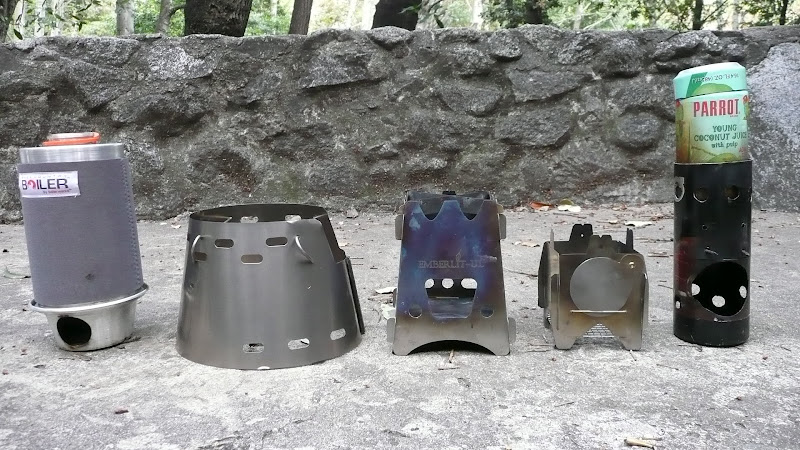 |
| Wood stoves compared |
Stay tuned!
HJ
Subscribe to:
Posts (Atom)