QuietStove.com

Monday, December 12, 2016

Review: The Snow Peak GeoShield

The GeoShield is a new remote canister gas stove from Snow Peak of Japan.

What's that?  You're not sure exactly what a "remote" canister stove is?  No worries.  See:  What is a Remote Canister Stove?  It's worth knowing the differences between the two major types of canister stoves.
 The Snow Peak GeoShield remote canister gas stove
The GeoShield is a really interesting stove.  It's different.  It consists of three main components:
  1. The burner, which does not have legs; the burner mounts directly to the windscreen.
  2. The windscreen, which is series of aluminum plates.
  3. A base plate which serves as a heat reflector.
The rather interesting burner of the Snow Peak GeoShield.
The burner does not have legs but instead mounts directly to the windscreen.
The GeoShield's base plate/heat reflector and the windscreen, shown here snapped together.
An optional hand held piezoelectric ignition comes with the stove.  The ignition is actually a nice one, but I'm not really big on separate piezoelectric ignitions.  When an ignition is built into a stove, it's super convenient.  If I have to fish around in my pack for it, I may as well bring a conventional lighter or a fire steel which can light other things besides just a stove.  Piezoelectric ignitions are in general single purpose:  They will light your stove but nothing else.  Piezoelectric ignitions do fail, particularly at higher elevations, so one should always bring a second source of ignition (matches, lighter, fire steel, etc.).  If I'm going to have to bring a secondary source of ignition anyway, I don't see the advantage of a detached piezoelectric ignition.
The hand held piezoelectric ignition that comes with the Snow Peak GeoShield stove.
Now, if you saw up above how large the windscreen looks when fully assembled, take heart.  The Snow Peak engineers actually have something kind of nifty here.  Everything folds up into a pretty small package.
The base plate and windscreen fold up and fit into the small pouch, shown at right.
The pouch comes with instructions printed directly on the pouch.
 To assemble the windscreen, one simply pulls on the cable that holds everything together, and then wraps the cable around the provided cleat on the windscreen.

To assemble the windscreen, simply pull the cable taut, and wrap the cable around the cleat as shown.
 Once the windscreen is assembled, the base plate snaps into place in the provided slots.
The clips on the base plate snap onto the strip of metal in the grooves in the windscreen.
The stove then clips on to the windscreen.  The windscreen, baseplate, and stove act as one single assembly when all is snapped together.  The windscreen has a high configuration (for pots larger than the diameter of the windscreen) and a low configuration (for pots smaller than the windscreen).  One simply swaps the base plate and the burner to switch between the two configurations.
The stove,base plate, and windscreen, all snapped together.
The configuration show here is the "high" configuration where the burner is at the height of the windscreen.
The high configuration allows one to use pots that are larger in diameter than the windscreen,
If this all sounds like a lot of fiddling around, well, it is, kind of, but it's really not all that bad.  With a couple of practice runs, I could assemble everything in about 40 to 45 seconds.  It's certainly easier than pumping and priming a white gasoline or kerosene type stove.

And what do you get for all this?  Well, a really large, stable cooking platform.  I mean this thing is solid.  It's perfect for Scouts, families with children, or any group that might be worried about inexperienced users knocking over a pot.  It would also be great for anyone who wants superb stability or a big cooking platform.  You could easily put a 5 or 6 liter pot on this thing, with no problem.  
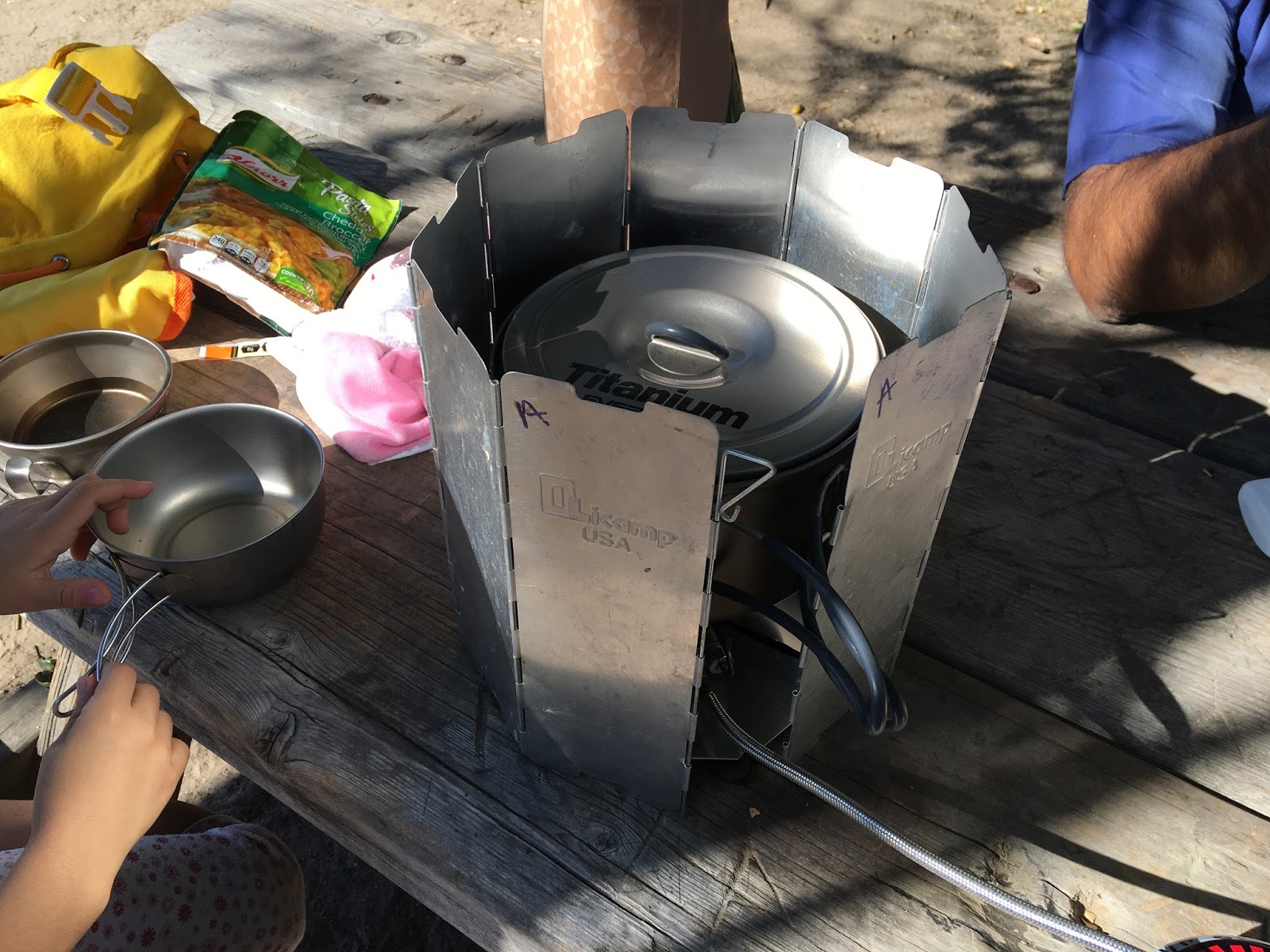
My daughter, the Adventures in Stoving spokesmodel, cooking on a Snow Peak GeoShield with a 2.6 liter pot.
I have absolutely no fear of that pot tipping over and scalding her.  The GeoShield is extremely stable.
This is a great stove for families with children, Cub Scouts, younger Boy or Girl Scouts, etc.
I could see this stove being used for guided trips, horse/mule packing, motorcycle touring etc.  The GeoShield would be ideal for any trip where space were at a premium but a large, stable cooking surface were needed.
When packed, the GeoShield is incredibly compact for such a large stove.
For size reference, the stove is shown here with a 230 g canister of gas.
Something else to note is that the GeoShield does have a generator (a "pre-heat loop"), so it can be safely used with the canister inverted for cold weather use.  See Stoves for Cold Weather II for details.

OK, so this is a great stove if you want a big cooking surface but need something that packs away small, and it can be used for colder weather than regular upright canister stoves.  What is it not good for?

Well, smaller pots for one thing.  The Windscreen has one setting.  Big.  In addition, the burner head is fairly wide.  Flames go up around the sides of a small pot and are wasted.  This really isn't a stove for small pots.  I really wouldn't recommend the stove for pots of less than 1.5 liters, and those pots would best be wider than tall.
A small 550 ml pot on the GeoShield.
Notice how much empty space is around the burner with such a small pot.
The GeoShield really doesn't work well with small pots.
And then there's my major complaint regarding the stove:  The Windscreen.  It's really not all that great of a windscreen in my opinion.  It's a great, stable platform, but it's only marginal as a windscreen.  Oh, it's fine in light breezes, but if the wind picks up at all, even moderate breezes go right through the rather airy windscreen.  I suppose that they deliberately put all the holes in the windscreen to reduce its weight, but those holes do allow a lot of wind to pass through.  In addition, it's not a full 360 degree windscreen.  The opening at the rear of the windscreen is large enough that I can put my whole hand through it.
There is a gap in the windscreen large enough to pass one's hand through it.
The windscreen is also too short to be fully effective.  Normally, one would want the windscreen to extend up 75% of the way up the side of the pot when the pot is on the stove.  Because of it's design, the GeoShield's windscreen is only going to have about a finger's width of coverage when in low mode, and none at all in high mode.
The windscreen only extends up the side of the pot about the width of a finger.  It's not enough.
The windscreen has a lot of holes in it.  While the hole no doubt reduce weight, they also allow the wind to come in.
Really, in anything more than mild breezes, you have to bring a separate windscreen if you want to protect the GeoShield's burner from wind.
The GeoShield's flame being forced over to the left in a light to moderate breeze.
The Snow Peak GeoShield
What's good about it?
  • Very stable
  • Large cooking surface
  • Packs up really small for a cooking platform of it's size
  • Reasonable "fiddle factor" when considering how compact it is when stowed and yet how large it is when deployed.
  • Has a generator ("pre-heat loop"), so it can be used safely with the canister inverted for cold weather use.  See Stoves for Cold Weather II for details.
What's not so good about it?
  • You really need to carry a separate windscreen in anything more than a light breeze
  • Heavy for its class (see Appendix, below)
  • The durability of the base plate and its connection to the windscreen is somewhat uncertain
  • Limited to larger pots and pans only.  

The Snow Peak GeoShield  – recommended for:
  • Families with small children, Scouts, or any young, inexperienced user.
  • Those who need a large cooking surface that packs up small
  • Anyone needing a large, stable cooking surface.
  • Base camping, trailhead camping, etc.
  • Winter use (but study up on this; there are limits)
The Snow Peak GeoShield  – not recommended for:
  • Soloists or anyone who uses small pots
  • The weight conscious (although what is heavy to one isn't necessarily heavy to another)
I thank you for joining me,

HJ


Appendix.  A point by point consideration of those things which make for a good stove.
  1. Suitability – Is this stove suitable for what I want to do?
    • Cooking  – The GeoShield can pretty much support any type of cooking from high heat, rapid boiling and snow melting to slow simmering.  The fine control of the flame is very good.
    • Conditions – The GeoShield has superior cold weather performance when compared to upright canister stoves.  The GeoShield will handle windy conditions well if you bring a separate windscreen for it.  The windscreen that comes with the stove is inadequate by itself.
    • Capacity  – The GeoShield can support pots of nearly any size from about 250 ml  to about six liters (possibly more), but anything smaller than 1500 ml will be really inefficient.  Best use is for pot sizes of two liters and up, and that's for pots that are wider than they are tall.
  2. Reliability/Robustness – Can it “take a licking and keep on ticking?”
    • I found the stove to be quite solid.  The attachment of the base plate to the windscreen may not last long term, but if it did fail, one could simply lay the base plate on the ground below the burner.
    • As with all canister stoves, one must keep the threaded area clean, and one should avoid spilling food on the burner head.  Do not set the stove down in the dirt if you can avoid it.  One should also keep the canister threads clean lest abrasives (dirt, grit, etc.) get into the threads of your stove.  Always use the cap on the canister when not in use.  Avoid Coleman brand canisters which don't have a cap – or save a cap from another brand and use it if you buy a Coleman canister.  Why Coleman doesn't provide a cap on their canisters is beyond me.  Dumb idea, Coleman.
  3. Weight  –  The GeoShield's weights are as follows:
    • Burner.  210 g/7.4 oz.
    • Windscreen. 151 g/5.3 oz
    • Base plate.  29 g/1 oz
    • Handheld piezoelectric ignition.  14 g/0.5 oz
    • Stove bags.  5 g/0.2 oz (each)
    • Total 390 g/13.8 oz without ignition or stove bags.
    • Grand Total 414 g/14.6 oz with ignition and both stove bags.
  4. Price – MSRP $100, a bit on the high side, but it is a lot of stove. Always look for sales. Never be in a hurry to purchase gear.  MassDrop has offered this stove for sale.  You might bug them to run another "drop" on this stove if you want one.  See also Disclosures, below.
  5. Stability – Best stability of just about any backpacking type stove anywhere.
  6. Efficiency (i.e. fuel economy) – Well, it depends.  If you bring a separate windscreen, it will do fine as long you don't go heavy on the gas.  The GeoShield has a big burner and will eat gas if you run it on high.  Would you run your automobile with the pedal always pressed all the way down to the floor?  Well, not if you wanted reasonable gas mileage.  So it is with the GeoShield.  Run it at a reasonable setting, and it will do fine.  If you don't bring a separate windscreen, and it's a windy day, you may eat through a lot gas trying to heat things up.
  7. Windproofness –  Poor to fair at best with the provided windscreen.  Excellent if you bring a good windscreen to supplement the one that comes with the stove.  Because it is a remote canister stove, a full 360 degree windscreen can and should be used.
  8. Compactness – The GeoShield is very compact for a stove of its size.
  9. Ease of use – Some set up is required, generally more than most remote canister stoves, but not as much as with a white gasoline or kerosene type stove.
  10. Ease of maintenance/field repair –  Like most canister gas stoves, tools and spares are not included with the stove.  In my testing, I never encountered a problem with the stove, but I haven't had the stove long enough to really have a good sense of whether or not it's maintenance free or not.  Inasmuch as it is a canister stove, I do not anticipate a great deal of maintenance headaches.
  11. Speed – Decent speed, but the speed will vary with the conditions, fuel, and type of pot.  Honestly, I think you should be worried more about fuel economy (efficiency) in the back country than speed.  As long as the speed is reasonable, focus on conserving fuel over fast boil times.
  12. Noise – Average. About the same as most ported gas stoves, i.e. fairly quiet.  Not as quiet as an alcohol stove but no where near as loud as a liquid fueled stove with a "roarer" type burner (e.g. Primus Omnifuel, MSR XGK or DragonFly, Optimus Nova, etc.)
  13. Fuel considerations (availability/versatility/morality) 
    • Availability.   The GeoShield uses standard threaded canisters.  One can use any reputable brand of canister gas.  See Can I Use Any Brand of Gas Canister?  Standard threaded canisters are widely available in the United States, Canada, the UK, Australia, New Zealand, and Japan.  Availability may be limited elsewhere.  In some areas, particularly in France, non-threaded canisters are the norm.  In the Middle East and Eastern Europe, only puncture type canisters (no valve) may be available.  No matter where you are planning to go, check the availability of fuel.
    • Versatility.  Generally, only threaded canisters may be used, but there are adapters that will allow one to use non-threaded valved canisters, puncture type canisters, 100% propane canisters, and 100% butane bayonet-connector type canisters.  Always check availability of adapters before embarking on a trip.  If possible, obtain and test adapters in advance.  Some adapters from China are of extremely poor (i.e. dangerous) quality.  Liquid fuels such as alcohol, gasoline, or kerosene may not be used.
    • Fuel economy.  Reasonable on the GeoShield, but remember, much depends on you.  See Fuel Economy with Stoves.
    • Morality/Ethics.  Canister gas is generally considered to be better for the environment than wood fires. Use of wood fires a) often lead to an area being stripped of wood and b) have significantly higher fire danger.  However, on the other hand, while canisters can be re-cycled, most of the canisters wind up in the land fill.  Even recycling of canisters takes energy and other resources and is not as low impact, environmentally, as a liquid fueled stove or alcohol stove.  Some people have gone back to liquid fueled stoves (gasoline or kerosene) or alcohol stoves to reduce their environmental impact. 
  14. Safety/Legality.  
    • General.  Standard threaded canisters are generally considered safe; however, do not allow the temperature of the canister to exceed 50 degrees Celsius (122 Fahrenheit).  Leaving a canister in the back window of a car on a hot day is not a good idea.  Neither is allowing boiling water to spill onto the canister.  It probably won't explode, but do you really want to chance it? 
    • The valve on a canister can stick in the open position when you disconnect the stove.  NEVER disconnect the stove near a candle or other open flame or hot surface.  Disaster may result if the valve sticks open.  If the valve does stick in the open position, simply replace the burner on the canister and try again.  If the valve on the canister continues to stick, leave the burner on the stove and control the gas with the valve on the burner.
    • Fire safety and regulations.  In terms of fire safety, canisters are fairly safe, but care must be taken not to allow the canister to tip over while the stove is cold.  If the liquid fuel inside the canister goes to the burner before the flame, a fireball several feet in diameter may erupt.  This may cause an injury, a fire, or worse.  Canister stoves are generally allowed during most fire bans in the western United States whereas alcohol and wood stoves are generally not allowed.  Regulations may vary elsewhere.  A California Campfire Permit is required in California for stoves of all types.   There are also total fire bans that are sometimes invoked.  Always check with the local land management agency where you intend to hike.
    • Canister stoves do not require priming and are free from the dangers of priming.

Disclosures.
The stove used in this review was provided to me free of charge by Massdrop, an on-line retailer.  I receive no remuneration from Massdrop for this or any other review.  

I have purchased several items from Massdrop, but I did so as an ordinary customer; I received no discounts.  I once did receive some free socks from Massdrop.  I actually have a job and can afford to buy my own socks, so I don't think the socks in question will sway my opinion one way or the other with regard to my reviews.  However, if Massdrop wants to send my wife and I on a two week all expenses paid trip to some exotic locale, I might have to seriously rethink my review process.  Given Massdrop's somewhat limited resources, I suspect we're pretty safe here. 

You will note that I did mention Massdrop in my review as one possible place to obtain the stove reviewed.  I receive no compensation for my recommendation; indeed the recommendation was unsolicited and was based on my personal opinion alone.  Neither do I receive any compensation if you, the reader, make a purchase from Massdrop.  However, I do like dark chocolate, so if you save enough money by purchasing through Massdrop, by all means feel free to spend the cash saved on buying me chocolate.  65% or better cacao content, please.

Sunday, December 11, 2016

What is a Remote Canister Gas Stove?

Sometimes you'll hear me (or others) talking about "remote" canister stoves.  What the heck is a remote canister stove?  And how is that different from just a regular upright canister stove? (like a Pocket Rocket)
A pot of tea on a remote canister stove.
Note how the gas canister is not at the burner but rather is at a distance, connected by a hose.
Well, there are two general classes of canister gas stoves:
  1. An upright canister stove, which mounts directly onto the top of the canister of gas.  
  2. A remote canister stove, which has the gas off to the side, connected by a hose.
Why might this be important?  Well, each type has real advantages – and disadvantages.  You need to understand the pros and cons in order to make an intelligent choice.

Take  a look at the below photo.
An upright canister stove, left, and a remote canister stove, right.
Note how the set up on the left, the upright canister stove, sits up really high.  Generally, upright canister stoves, because of their height are a little more "tippy" and are more exposed to wind.

On the other hand, the set up on the right, a remote canister stove, is far lower, giving it greater stability and making it less exposed to any potential breezes.  In addition, you can use a full 360 degree windscreen on a remote canister stove whereas you cannot safely do so with an upright canister stove.  Why? Well, with an upright canister stove, the canister (of highly flammable gas) is directly under the burner.  Surround the burner, and you surround the canister as well.  The windscreen traps a lot of heat.  Heat a canister too far, and KABOOM!  Uh, you wouldn't want that, trust me.

Canisters are required to be able to withstand temperatures of 50C (122F) – which really isn't all that hot if you think about it.  There are plenty of days in deserts around the world where the afternoon high is nearly that temperature.

Now, will a canister blow up the minute it reaches 51C?  Probably not, but it's going to blow somewhere above 50C, and do you really want to be around when that happens?  By the way, it's generally a bad idea to let boiling water spill over onto a canister.  Boiling water is 100 C (212F) at sea level.  The canister is designed to withstand 50 C (122F).  Get it?

On the other hand, with a remote canister stove, the fuel is nowhere near the burner; it's off to the side.  In fact, a windscreen will separate the fuel from the heat of the flame, making your stove actually safer to operate.
A remote canister stove nestled deep down inside a full windscreen – impervious to normal winds.
Do NOT try this with a regular upright canister stove.
Well, shoot, more stable and far better wind resistance, that sounds pretty good.  Why doesn't everyone just use a remote canister stove?

Well, not so fast.  Remote canister stoves are heavier, less compact, and more expensive.  Upright canisters stoves are affordable, compact, and light.

Here's a list of some of the pros and cons of remote canister stoves, below.

Remote Canister Stoves
Pros:
  • More stable, less likely to tip.  Great for families with small children, younger Scouts, et al.
  • Can safely use a full 360 degree windshield
  • Sticks up less into the wind
  • Can be far better in cold weather (see Stoves For Cold Weather II for details).
  • Better for large pots or large frying pans
Cons:
  • Heavier
  • More expensive
  • Bulkier
  • Fewer choices (there are far more upright canister stoves to choose from)
Many people that plan to be out in winter, use larger pots or pans, place a premium on safety and pot stability, or need improved wind resistance will choose a remote canister stove.

I hope you have found this post useful.  I thank you for joining me,

HJ

Thursday, November 24, 2016

Can I Use Any Brand of Gas Canister?

Most stove companies have warnings on their backpacking stove instructions that only their brand of gas canisters should be used with their stoves.  Really?
A backpacking type canister of gas.
Um, no.  All of the threaded canisters (which at least in North America are all that are available anymore for backpacking type stoves) use a 7/16ths UNEF thread.  They're all compatible with one another from the point of the mechanical connection, and gas is gas.  There aren't any blends of canister gas out there that are incompatible with one stove or another.

And besides that, there's a lot to suggest that all the major brands except Coleman are made by the same company in South Korea.

Caution!
The newer orange label Coleman canisters do not work with many brands of stoves.  The older green label Coleman canisters typically have worked fine.

A few years ago, I noticed MSR changed the shape of their canisters, the hue of their red color, and their caps instead of flat were more raised, had a more separated pull tab, and had a little hole and a square on top.  The following year, Snow Peak Canisters, which had relatively flat caps with “Snow Peak” molded into them became… you guessed it, more raised, had a more separated pull tab, and had a little hole and a square on top, and whereas they had always been labeled “made in Japan”, they now were clearly labeled “made in Korea”.
An old Snow Peak canister, left, and a new Snow Peak canister, right.
Note how caps have changed and that the shape of the canister has changed subtly.
Curious, I started looking at a number of different brands.  They all had the same caps, and the canister shapes were all now the same.
Gas canister from three major brands.  All have the same shape.  All have the same cap.
I looked at Primus, Optimus, Olicamp, MSR, Jetboil, Brunton, Snow Peak, and Burton.  All of these brands now had the same caps and the same canister shape, and all were made in Korea.  The only exception I could find was Coleman which is made in France.

It was pretty clear to me that whereas before there had been a diversity of canister caps, countries of origin, and canister shapes, there now was only one.  They were now all being made by the same manufacturer.

A little research revealed that the Taeyang Industrial Co. Ltd. of South Korea was the largest manufacturer of gas canisters in the world, controlling about 75% of the market.  Then, I found this photo of a Kovea gas canister on-line:
A canister of Kovea brand gas, clearly marked "Taeyang Ind. Co., Ltd.".  Note canister cap.
The cap?  You guessed it, raised, with a little hole and a square on the top, and unlike many of the major brands who for whatever reason don’t want to let on (and I have asked, directly) who makes their canisters, Kovea prints it right on the side of the canister:  “Taeyang Industrial Co. Ltd.”.

So, pretty much all the major brands are actually manufactured by the same company.  The blend of gas and the labeling may vary, but the physical canister is identical.

Before, when there were a greater number of manufacturers, one could interchange canisters because of the 7/16 UNEF standard thread.  Now, they are literally identical.

Why do stove companies say to only use their brand?  Well, to sell more canisters for one, but also for liability.  If you use some other brand of canister and something bad happens, they can say in court, "well, we warned you not to use other brands of canisters."

While it doesn't really matter which brand* of canister one buys, gas blends do vary.  The composition of gas in a canister, typically some mix of propane, isobutane, and "plain" butane, doesn't matter too much in warmer weather, say no colder than 50 Fahrenheit/10 Celsius, but the colder one goes, the more the blend of gas matters.  In cold weather, the general rule of thumb is to avoid butane and stick to canisters that have a propane-isobutane blend.  Propane is generally the best cold weather fuel – but if it's mixed with just plain butane, avoid that brand.  An isobutane blend, even if it contains less propane than another brand, is going to perform best in cold weather.  For more on this subject see What's the Best Brand of Gas for Cold Weather?.

The bottom line?  Except in cold weather, just buy whatever is cheapest.

I hope this is helpful,

HJ

*I'm speaking here of major brands in developed countries.  China, for example, has many smaller manufacturers of gas canisters.  Chinese canisters have reputation for leaky valves and for having impurities in the gas that can clog stoves.  Many travellers simply refuse to buy Chinese made canisters even if they are the cheapest in a given area.

Sunday, November 20, 2016

Review: The Soto WindMaster – World's Lightest Gas Stove with Piezo Ignition

I've talked about the Soto WindMaster (OD-1RX) upright canister gas in several of my posts lately.  The WindMaster's claim to fame is that a) it is the world's lightest (67 g/2.3 oz) upright canister gas stove with piezoelectric ignition and b) that it has superior wind handling capability.

I was really skeptical about this stove at first. As it turns out, it's one of my favorite canister gas stoves.  Ever.

UPDATE 27 November 2016:  I have added a point by point consideration of the stove based on my "What Makes a Good Backpacking Stove?" framework in the appendix
The Soto WindMaster (OD-1RX)
Why was I skeptical?  Well, the name of the stove sort of tells you why I was skeptical.  Soto is making the claim that their stove handles wind well.  An upright canister stove?  A master of the wind?  Really?

Let me explain. There are two general classes of canister gas backpacking stoves:  upright and remote.
An upright canister stove, left (a Soto Amicus), and a remote canister stove right (a Snow Peak GeoShield).
An upright canister stove screws directly onto the top of a canister of gas.  The advantage here is weight:  There's no need to have "legs" to support the burner.  The canister itself supports the stove.  Also, there is no need of any means to bring the fuel to the stove since the stove is directly attached to the canister.  Upright canister stoves are light, plentiful, affordable, compact, and simple.

Wow, sounds great, right?  So what's the disadvantage?  Well, notice how high the stove and pot are in the photo above.  Since the stove mounts on top of the canister, it sits higher up, more exposed to wind.  

Can't you use a windscreen?  Well, yes, kind of, but BE CAREFUL.  If you trap too much heat in the enclosed space around the fuel canister, the canister could overheat.  Heat the canister sufficiently, and it could burst, spewing highly flammable gas all around.  Let's see, flammable gas spraying all around a flame.  Say, that might be, um, bad, couldn't it?  Well, let's just say this could be your "last supper."  Most manufacturers strongly recommend against the use of a windscreen with an upright canister stove.  There's more to say here, but rather than go on and on, if you're interested in the subject of windscreens, I suggest you check out my blog post on Windscreens.  Another disadvantage to upright canister stoves is that they aren't all that great in cold temperatures.  Even with the best fuel, you probably don't want to go much below 20F/-7C.  There are tricks in cold weather.  If you're interested see: Canister Gas in Cold Weather.

Now, on the other hand, a remote canister stove has the fuel off to the side.  Fuel is delivered to the burner via a fuel hose or line of some type.  The advantages here are:  1. The stove sits lower to the ground, so it's more stable and more out of the wind, 2. The stove can be used with a full 360 degree windscreen with no risk of overheating the canister, and 3. Many remote canister stoves can be run with the canister inverted for cold weather operation.  If you're going to run a stove with the canister inverted, do your homework first.  Not all remote canister stoves can handle inverted canisters.  For starters, check out my article in Seattle Backpackers Magazine:  Stoves for Cold Weather II.  

The disadvantages to a remote canister are stove are:  1.  It takes up more space in your pack, 2. It weighs more, and 3. It typically costs more.  There are also fewer choices with remote canister stove than upright canister stoves, but there are some good ones out there.  If you're interested in a remote canister stove,  I suggest you check out the Kovea Spider remote canister stove. 

OK, enough background.  Here's the point:  The WindMaster is an upright canister stove.  In other words, the WindMaster is the kind of stove that does the worst in wind.  So, yeah, I was a little skeptical.  An upright canister stove that's good in wind?  Yeah, right.  But then I tested it.  

Please take a look at this video:


The test in the video wasn't the only test I ran.  I ran dozens of tests over a long period of time.   My conclusion:  Soto really has succeeded in making a more windproof upright canister stove.
In every test, the Soto WindMaster (left) boiled faster than the Microregulator which is basically the same stove but without the wind resistant burner head.
Well, um, if this stove is so great, why isn't it the number one best seller?  Well, several reasons:
  1. It's kind of tall (see photo below).  It's not bad, but it is a little on the tall side.  I can't lay it on it's side in the bottom of my 550 ml mug-type pot.
  2. The pot support is kind of, uh, well, "different". I'll explain more, below.
  3. It's expensive.  It's about $75 MSRP.  (Note Campsaver* has them on sale right now for $52.47 which is a deal).
If you can handle the size and the pot support, I'll explain why I think the WindMaster might be worth the price (especially if you can get it on sale).

By the way, Soto has come out with a new, more affordable stove, the Amicus.  The Amicus has the same style burner head as the WindMaster.  Is the Amicus as good in wind as the WindMaster?  I don't know yet, but keep an eye on my blog.  I plan to post a review of the new Amicus some time in the next four to six weeks.

*Disclosure:  I have no relationship with Campsaver, financial or otherwise.  I don't think I've ever purchased anything from them.  Someone tipped me off to this sale; I pass the tip on to you.  As I say, I have not done business with them.  This link in no way constitutes an endorsement.  Caveat emptor.
The Soto Microregulator, left, and the Soto WindMaster, right.  The WindMaster is somewhat taller than average.
OK, so what's this about the pot support?  Well, it's detachable.  This is a feature that you're either going to love or you're going to hate.  It works for me, but a lot of people apparently didn't like it or weren't willing to try it.  There are actually two pot supports available for the WindMaster.  I'll discuss the basic one that comes with the stove first and then the optional, larger "4Flex" pot support later.

The basic pot support is actually pretty good.  It provides plenty of support and is pretty grippy.  It supports small diameter pots well, including something as small as a standard Sierra cup.  And it's not hard to take on and off.  All it takes is a little practice.  I can even do it wearing fleece mittens.
The pot support attaches easily with just a bit of practice – even in midweight fleece mittens
So that little metal bit in my left hand, above, is the pot support.  It's kind of a flat color.  If you drop it, it's hard to find.  My solution is to use a Sea to Summit mini carabiner (9 grams) to immediately clip the pot support to the valve handle the second I remove the support from the stove.
A Sea to Summit mini carabiner
In the photo below, you can see the carabiner hanging off the valve handle. The carabiner hanging there takes a bit of getting used to when you turn the valve handle, but it's no big deal.
A Soto WindMaster in use.
Note carabiner hanging on the valve handle.
OK, so I've talked about the relative wind proofness of the WindMaster.  How does it work?  Well, for one, the burner head is recessed which tends to guide the flames up toward the pot and limits the amount that wind can blow the flames off course.  Second, the lower portion of the burner head is angled such that wind naturally flows down, around, and away from the burner head.
The Soto WindMaster, left, has a recessed burner head.  Note that you can barely see the flame.
Most stoves have an open burner head, such as the stove on the right.
Note how the flame on the stove on the right is being blown over to the left by the wind.  Goodbye, heat.
I actually kind of enjoyed watching just how well the Soto WindMaster's burner head worked.  In test after test, I could see an open burner's flame being blown to one side or another whereas the WindMaster's flame was still centered on the pot.

Now, how wind proof is the WindMaster?  Is it as windproof as say the high tech MSR Windburner? Um, no.  No way.  The Windburner is a freaking miracle of windproofness.  If you expect to be in seriously windswept areas and really need just absolutely rock steady performance in wind, then get the MSR Windburner not the Soto WindMaster.

However, the Windburner* is larger, heavier, and more expensive than the WindMaster.  If you do your homework and find that an upright canister stove is right for you, the WindMaster will offer far better performance in wind than other similar stoves.  How do you "do your homework?"  Well, you might check out my post, What Makes a Good Backpacking Stove?

*The Windburner is on sale at REI for $99 right now which is a pretty good price considering that MSRP is $130.
Disclosure:  I receive no remuneration from REI for mentioning them here.  I just happen to know that they have the Windburner on sale right now.  I am however an REI customer, and I do occasionally make purchases from them.
Soto WindMaster, left, with a recessed burner head.  Soto Microregulator, right, with an open burner head.
Note how the Microregulator's flame is blown off to the left whereas the WindMaster's is not.
Much ado has been made about stoves with regulator valves being able to really cook lately.  I kind of laugh.  Yes, Jetboil made a big deal about how you can really control the flame on their relatively new MiniMo regulator valved stove.  Why do I laugh?  Because Soto has been doing it all along. Soto is really ahead of other stove companies in terms of technology, so I laugh when other companies make a big deal about something that Soto has been doing for several years.  Soto would never have put out stoves with crappy burner control like that on the first generation regulator valved Jetboils.
Noodle dish prepared on a Soto WindMaster.
You can actually cook with the Soto WindMaster, to include fine simmering.
Now, another thing about the WindMaster:  The "Stealth" ignition.  Soto's Stealth ignition (found on several Soto stoves) is the best in the industry.  Period.  Nobody's ignition is as sophisticated and reliable as Soto's.  Many companies sort of bolt this big kludgy ignition thing to the side of their stoves and then have a wire running up the side of the burner column.  The ignition system then ends with an exposed wire directly in the flame.  This wire often warps in the heat or snags on things – and fails.  Soto has a much more elegant control and runs their wire up through the inside of the burner column.  Then, at the top of the burner column, instead of a little wire sticking out just waiting to be snagged, they put a much more stable strip of metal that doesn't jut out the way wire ignitions do.  Notice also, in the photo below, that the ignition point is in the center of the burner.  This has two advantages:  1) It's a heck of a lot less likely to snag on something when located in center of a burner than an ignition on the rim of a burner and 2) there's a sort of "island" in the center of the burner head that the ignition point sits in.  The ignition point is less exposed to heat and is less likely to become warped or otherwise damaged.
The ignition point of Soto's Stealth ignition is the strip of silver colored metal (not a wire) in the center of the burner head.
Now, notice something else in the photo, above.  Look at the pot supports.  Those are not that little pot support we saw before.  This is the optional "4Flex" pot support that can be purchased to supplement the pot support that comes with the stove.  The 4Flex offers a wide surface for larger pots.
A 2.6 liter pot on a a Soto WindMaster equipped with the optional 4Flex pot support.  Really stable.
In fact, the supports are not the worry here; the small size of the canister is.
Canister "feet" can help but are not absolutely required.
 I found the 4Flex to be a really nice option with large pots (as in group cooking or snow melting).
The WindMaster's optional 4Flex pot support offers excellent stability for larger pots.
I've gone from skeptic to convert.  I really like the quality and flexibility of the WindMaster – as well as it's ability to handle wind.  If I go out solo or with one other person, I can take the basic pot support.  I don't have to take up a lot of room in my kit with an unnecessarily large pot support.  On the other hand, on trips with a larger group or larger pots – or pans as in fish frying, pancakes, etc. – I take the 4Flex, and then I don't have to worry about my pot being "tippy."  With the 4Flex, even fairly large pots are very stable.  The one thing you might worry about with large pots is not the pot supports at all but rather the canister.  A large pot with a small canister at the base could be a little tippy on uneven ground.  Several companies offer canister "feet" that one could purchase if one were concerned.  I didn't find them necessary,

A final note:  On local hikes, I might do stove testing, but on my "big" hikes where it's a really a special hike, I don't do stove testing.  I take stoves that I like and trust.  The last couple of photos were from my hike on the John Muir Trail this past summer.  In other words, this isn't a stove that I test and then stick on a shelf never to be seen or heard from again.  No, this is a stove I actually use.  I have dozens and dozens of stoves sent to me for free from companies that would like me to do a review.  I can pretty much use any stove I like.  If a stove makes it on a trip where I'm not testing, you know it's a good stove.

The Soto WindMaster

What's Good About It?
  • World's lightest canister gas stove with piezoelectric ignition  (67 g/2.3 oz).
  • Superior wind handling
  • Reliable, sophisticated piezoelectric ignition
  • Good pot stability on both large and small pots with multiple pot support options
What's Not So Good About It?
  • A little on the tall side.
  • More expensive than many comparable stoves
  • The smaller pot support is easy to lose – unless you use a mini carabiner and always clip the support to the valve handle when you take the pot support off.
The Soto WindMaster:  Highly Recommended.

I thank you for joining me on another Adventure In Stoving.

HJ

Disclosures:  I received the WindMaster stove free of charge from a third party (not Soto in other words) for the purpose of this review.  I purchased the 4Flex support with my own money.   I am not compensated for my reviews except for the trivial amount of money I receive from the ads on my blog (about $1.00 USD per day at last check).  The income from my blog pays for fuel and occasional parts and accessories, but I in no way derive my living from my blog.  My blog is basically a hobby which leaves me free to review stoves any dang way I please.  


Appendix – "What Makes a Good Backpacking Stove?"

An evaluation of the Soto Windmaster based on my fourteen point "What Makes a Good Backpacking Stove?" framework.

  1. Suitability – Is this stove suitable for what I want to do?
    • Cooking  – The Windmaster can pretty much support any type of cooking from high heat, rapid boiling and snow melting to slow simmering.  The fine control of the flame is very good.
    • Conditions – Like all upright canister stoves, the WindMaster would not be my first choice for temperatures under 20 Fahrenheit/-7 Celsius.  The WindMaster may be used at all elevations although the piezoelectric ignition will be less reliable above 10,000 feet/3000 meters in elevation.  No matter what elevation one uses a stove with a built in ignition, always carry a second source of ignition (non-piezo lighter, matches, firesteel, etc.).  The WindMaster will handle windy conditions better than most upright canister stoves but would not be a good choice for extremely windy conditions.
    • Capacity  – The Windmaster can easily support pots from about 250 ml (depending on proportions) to about 2000 ml with the basic pot support, but over 1500 ml, you'd have to be a bit cautious about using a small canister.  With the larger 4Flex pot supports, 1500 ml to 3500 ml, probably larger, pots can be accommodated, but one might want to use canister "feet" to make the whole assembly more stable.
  2. Reliability/Robustness – Can it “take a licking and keep on ticking?”
    I found the stove to be quite solid.  Some have complained that the basic pot support is "flimsy."  I did not find it so, and found it to be quite solid once properly emplaced on the burner head.  As with all canister stoves, one must keep the threaded area clean, and one should avoid spilling food on the burner head.  Do not set the stove down in the dirt if you can avoid it.  One should also keep the canister threads clean lest abrasives (dirt, grit, etc.) get into the threads of your stove.  Always use the cap on the canister when not in use.  Avoid Coleman brand canisters which don't have a cap  or save a cap from another brand and use it if you buy a Coleman canister.  Why Coleman doesn't provide a cap on their canisters is beyond me.  Dumb idea, Coleman.
  3. Weight  –  The WindMaster weighs 67 g/2.3 oz which is in line with other major stove brands (MSR, Snow Peak, Optimus, Primus, etc.).  There are titanium stoves coming out of China, some by Fire Maple which is actually a decent brand, that are lighter, but you will sacrifice pot stability and the ability to handle wind.  Some will find this trade off acceptable; others will want to carry the extra ounce to get better pot stability and windproofness.  It is a choice; the choice is yours.
  4. Price – Do I have mortgage my home to afford this thing? 
    At MSRP $75, the WindMaster is in the upper range of upright canister stoves.  The WindMaster offers high quality construction and engineering, good pot stability, an excellent ignition, and superior wind performance.  Some will consider it worth the price; others will not.  Always look for sales. Never be in a hurry to purchase gear.
  5. Stability – Pot stability is well above average for upright canister stoves.  The detailed engineering of the pot supports makes them more grippy than most.
  6. Efficiency (i.e. fuel economy) – The WindMaster has better fuel economy than most upright canister stoves, particularly in wind.  The WindMaster will not have as good fuel economy as an integrated canister stove like a Jetboil  unless one uses a heat exchanger pot in which case the fuel economy of a WindMaster may rival that of a Jetboil.  
  7. Windproofness –  The WindMaster is of a design that gives it better performance in wind than other upright canister stoves.  This is one of the chief features of the stove (hence the name).  One should not use a full 360 degree windscreen with the WindMaster or any upright canister stove.  Overheating the canister could result in an explosion.  See my post on Windscreens for ideas and precautions related to windscreens with upright canister stoves.
  8. Compactness – The WindMaster is reasonably compact for its class, but it is taller than most upright canister stoves.  There are many upright canister stoves that are significantly more packable.
  9. Ease of use – Generally, the WindMaster is a pretty easy to use stove, but it does have the detachable pot support.  I found that I could put on the pot support with one hand, even in midweight mittens, and I didn't think it was a big deal, but some people just absolutely hate the detachable pot support.  You must make provision to not lose the post support.  I clip mine to the valve handle when not in use.
  10. Ease of maintenance/field repair –  Like most upright canister gas stoves, tools and spares are not included with the stove.  Note that in four years of using the stove, I encountered no instances where I needed to perform maintenance or repairs on the stove.  Spares and tools are more typically included with liquid fuel or multi fuel stoves.
  11. Speed – Please refer to the video in the main body of the review.  Basically, I found the stove to be fast.  Boil times will vary with conditions, but the WindMaster is far less affected by wind (the chief enemy of good boil times) than other upright canister stoves.  No, I won't quote an exact time.  Such quotes are fairly irrelevant since there are no standards for test conditions.  The water temperature, air temperature, fuel used, valve setting, elevation above sea level, and type of pot will all cause the boil time to change.  I found boil times to be in line with other major stove brands and faster in wind.
  12. Noise – Average. About the same as most ported gas stoves, i.e. fairly quiet.  Not as quiet as an alcohol stove but no where near as loud as a liquid fueled stove with a "roarer" type burner (e.g. Primus Omnifuel, MSR XGK or DragonFly, Optimus Nova, etc.)
  13. Fuel considerations (availability/versatility/morality) 
    • Availability.   The WindMaster uses standard threaded canisters.  One can use any reputable brand of canister gas.  See Can I Use Any Brand of Gas Canister?  Standard threaded canisters are widely available in the United States, Canada, the UK, Australia, New Zealand, and Japan.  Availability may be limited elsewhere.  In some areas, particularly in France, non-threaded canisters are the norm.  In the Middle East and Eastern Europe, only puncture type canisters (no valve) may be available.  No matter where you are planning to go, check the availability of fuel.
    • Versatility.  Generally, only threaded canisters may be used, but there are adapters that will allow one to use non-threaded valved canisters, puncture type canisters, 100% propane canisters, and 100% butane bayonet-connector type canisters.  Always check availability of adapters before embarking on a trip.  If possible, obtain and test adapters in advance.  Some adapters from China are of extremely poor (i.e. dangerous) quality.  Liquid fuels such as alcohol, gasoline, or kerosene may not be used.
    • Morality/Ethics.  Canister gas is generally considered to be better for the environment than wood fires. Use of wood fires a) often lead to an area being stripped of wood and b) have significantly higher fire danger.  However, on the other hand, while canisters can be re-cycled, most of the canisters wind up in the land fill.  Even recycling of canisters takes energy and other resources and is not as low impact, environmentally, as a liquid fueled stove or alcohol stove.  Some people have gone back to liquid fueled stoves (gasoline or kerosene) or alcohol stoves to reduce their environmental impact. 
  14. Safety/Legality.  
    • General.  Standard threaded canisters are generally considered safe; however, do not allow the temperature of the canister to exceed 50 degrees Celsius (122 Fahrenheit).  Leaving a canister in the back window of a car on a hot day is not a good idea.

      The valve on a canister can stick in the open position when you disconnect the stove.  NEVER disconnect the stove near a candle or other open flame or hot surface.  Disaster may result if the valve sticks open.  If the valve does stick in the open position, simply replace the burner on the canister and try again.  If the valve on the canister continues to stick, leave the burner on the stove and control the gas with the valve on the burner.
    • Fire safety and regulations.  In terms of fire safety, canisters are fairly safe, but care must be taken not to allow the canister to tip over while the stove is in use.  If the liquid fuel inside the canister hits the flame, a fireball several feet in diameter may erupt.  This may cause an injury, a fire, or worse.  Canister stoves are generally allowed during most fire bans in the western United States whereas alcohol and wood stoves are generally not allowed.  Regulations may vary elsewhere.  A California Campfire Permit is required in California for stoves of all types.   There are also total fire bans that are sometimes invoked.  Always check with the local land management agency where you intend to hike.
      Canister stoves do not require priming and are free from the dangers of priming.