QuietStove.com

Tuesday, March 12, 2013

The Soto Microregulator (OD-1R)

Soto Outdoor is a high end stove manufacturing concern based in Japan.

Previously, I've done the following reviews of Soto gear:
Today, I'd like to review an upright canister gas stove from Soto, the Microregulator (OD-1R) which is the world's lightest upright canister stove with auto ignition.  Note:  In Japan, for whatever reason, the stove is referred to as the SOD-300 instead of the OD-1R.
The Soto Microregulator on high.
I've characterized Soto as a high end stove manufacturer, and indeed they are.  Their manufacturing quality is very high, and their stoves show a level of attention to detail that very few other stove manufacturers can rival.  Dare I call a stove beautiful?  If any stove may bear that appelation, it is a Soto.  Soto stoves are a study in precision manufacturing.
The burner head of a Soto Microregulator.  Note the piezoelectric ignition at the very top of the burner head.
While I think quality of manufacturing sets Soto apart from the crowd, there's another thing that makes the Soto Microregulator stand out in particular:   The Microregulator is the world's lightest upright canister gas stove with auto ignition.  Soto's site advertises a weight of 73g.  On my gram scale at home, I register a mere 70g.  Either way, it's about 2.5 ounces and is very light weight.
The piezoelectric auto ignitor of a a Soto Microregulator
Not only did Soto come up with a lightweight auto ignition, they did a darned fine job of it.  Whereas most auto ignitions look like they just crudely bolted an ignition to the side of the stove as more of an afterthought, the Soto Microregulator's ignition was clearly part of the design from the beginning.  The wire for the piezoelectric ignition runs up through the center of the burner column and isn't bolted to the side.  This is no small trick, for running the ignition wire up the center of the stove means that the wire will go through the mixing chamber where the fuel and the air are combined in the proper ratios for efficient combustion.
If you look closely, you can see a copper wire through the opening of the mixing chamber.
How on earth the Soto engineers were able to run that wire through there without messing up the fuel-air mix, I'll never know, but it speaks well indeed of the engineering expertise at Soto.  The top of the ignitor exits in the center of the burner head and is relatively more well protected than side mounted piezoelectric ignitions.  Note:  No ignition system, no matter how well designed, is ever 100%; always bring a lighter or matches (or some other means of ignition) with you on every trip.
The strip of metal that can be seen in the center of the burner head is the upper end of the Microregulator's ignition.
The pot supports and valve adjustment lever fold up well, and the stove is quite compact.
The Microregulator folds up well.
The Microregulator has a nice wide burner head which helps prevent "hot spotting" in the center of your pan which in turn helps prevent burnt food.
The burner head of a Microregulator
The pot supports swing up...
The pot supports rotate
...and lock into place.
After rotating, the pot supports slide into and lock in place.
I've seen some criticism that the pot supports slip too easily out of place.  What I've found after using the stove for a while is that the supports tighten up a bit after they've been exposed to food and weather.  I think they're reasonably stable, and there is absolutely no chance they're going to move when the weight of a pot or pan is on them.  See the video review below for, among other things, a demonstration regarding the pot supports.
Note:  Soto has introduced (Summer, 2012) a new version of this stove, the OD-1RX that has different pot supports.  I have not yet seen the new stove but the new pot supports are said to be improved.

Speaking of pot supports, I think that pots up to about 1300ml work well with the stove although I'm sure some will feel more comfortable with even larger pots.
A 1300ml Evernew UL titanium pot on a Microregulator
I also found that my MSR Blacklite pan which has a 7 5/8" (19.5cm) diameter worked well with the Microregulator. The Microregulator's pot supports have serrations that grip a pot or pan's bottom well.
An MSR Blacklite Pan on a Microregulator
Now, I've said that the wide burner head of the Microregulator will help prevent hot spots.  So, how does it do in actual cooking?  It was a little bit stormy the day I took this series of photos, so please excuse my Z-Lite pad which I was using as a partial windscreen (do NOT use a full 360 degree windscreen with an upright canister stove!).
Getting started with an omelette using a Microregulator
And how did it turn out?  Quite well, I thank you.  A bit of normal browning on the bottom, but...
An omelette cooked on a Microregulator.  Nicely done.
...quite moist and delicious on the inside.
A very nice moist omelette, thanks to the Microregulator.

Myths concerning the Soto Microregulator
For whatever reason, there are two myths out there concerning the Soto Microregulator.

Myth #1 is that the Soto Microregulator will somehow draw more gas out a canister than other stoves. Uh, no.  Not only is there no basis in either physics or chemistry for such an assertion, my testing has verified what theory suggests:  A canister that is empty to another stove will be empty to the Microregulator as well.  In other words, a Microregulator cannot pull more gas out of a given canister than another stove.  I have no idea where such a myth might originate or what could prompt such odd speculation, but there is no basis in fact to that myth.  For those interested in my testing, please see Advantages (?) of Regulator Valved Stoves, Part I

Myth #2 is that the Soto Microregulator will somehow operate better in cold weather compared to other upright canister stoves with a conventional needle valves.  Again, no.  A Soto Microregulator will not run any better in cold weather than any other upright canister stove.  The pressure in a canister is determined by a) the composition of the fuel, b) the temperature of the canister, and c) the ambient atmospheric pressure.  A regulator valve can hold back pressure, but it cannot produce pressure.  In order for a regulator to function it must have something to regulate.  When the pressure inside a canister falls off due to cold, a regulator valve has nothing to regulate and does no better than a needle valve.  This is a complex subject, but if you're interested in it, please see my testing in Advantages (?) of Regulator Valved Stoves, Part II

So, why a regulator valve?
OK, so a Microregulator cannot get more out of a canister than other stoves and a Microregulator can't run any better in cold weather than other stoves, so why a regulator valve?  Excellent question.  A regulator valve can do a couple of things for you:
1.  A regulator valve can control excessive pressure, as in hot weather.  For example, if you're doing the Pacific Crest Trail and you're crossing a desert section in the southern reaches of the trail, you could encounter some very hot weather.  In hot weather, a canister might actually have too much pressure and can "overpower" a stove.  A regulator can tamp down that pressure and keep the stove safe to operate.
2.  A regulator valve can keep a flame more constant if the canister pressure drops provided that there is additional pressure to be had within the canister.  In other words, a regulator valve can open up more on its own allowing more pressure to flow if there is additional pressure available in the canister.  A regulator valve can "smooth out" changes in pressure.  Thus, a regulator valve can give you a more constant flame.  You can think of a regulator valve as a sort of "cruise control" for your stove.    Again, though, there has to be additional pressure available inside the canister in order for the regulator valve to have something to work with.  But couldn't you just reach over and open up the valve a bit wider on a regular needle valved stove?  Yes, you could.  The Microregulator just does it for you automatically.  This automatic adjustment doesn't seem like a hugely valuable feature to me, but to some it may hold appeal.

Concluding remarks
The Soto Microregulator, OD-1R, is a well built, well designed stove, and it's the world's lightest stove with auto-ignition.  The Microregulator is certainly an excellent choice for someone desiring to do simple backpacking style cooking, but because of it's fairly wide burner head, the Microregulator can take on more complex cooking tasks as well.

There is however a lot of confusion about just what the regulator valve is supposed to do, confusion that in my opinion Soto hasn't done enough to dispel.  I think that everyone should just forget that there's a regulator valve on this stove and focus on the fact that this is an excellent stove and that this is the world's lightest stove with auto ignition.  In practical terms for someone out on the trail, the regulator valve is very much a non-event. 

Summary
The Soto Microregulator (OD-1R)
What's good about it?
  • World's lightest stove with auto-ignition.
  • Excellent design and manufacturing quality.
  • Wide burner head which makes this a good stove for real cooking for backpackers.
  • Serrated pot supports make your pot or pan less likely to slip off.
What's bad about it?
  • There is a lot of confusion about the regulator valve.
  • Perhaps the pot supports could lock into place a bit more solidly (but that's a pretty minor complaint on an otherwise excellent stove).
The Microregulator stove from Soto:  Highly recommended.

I thank you for joining me on another Adventure in Stoving,

HJ
The beautiful blue flame of a Soto Microregulator.  Truly a nice stove.

Sunday, March 10, 2013

Cooking with the Kovea Spider

The Kovea Spider (KB-1109) is a relatively new remote canister stove.  I recently wrote a review of the Spider.  The Spider has a relatively small burner head, which is good in that it makes the stove compact, but apparently there's some concern out there that the small burner head might make the Spider a poor cooking stove (perhaps small head = small flame = a burned spot in your food?).

Now the fact of the matter is that the burner head angles the flames outward which gives a well distributed flame.  No "hot spotting" here.
The flame on a Kovea Spider is well distributed.
But the "proof of the pudding is in the eating" as they say, so let's do some actual cooking.  It's Saturday morning, so how about a delicious breakfast omelette?  Yum!  Let's get started.

First, the ingredients.
The makings of a nice omelette
For today's omelette, I've brought along:
  • Boxed milk of the type that needs no refrigeration.
  • Some leftover bacon and ham
  • Five eggs
  • Some shredded cheese
  • A bit of olive oil (to grease the pan)
And for the cooking, we'll need the proper tools.
The tools needed for cooking an omelette
For today's cooking, I'll be using the following:
  • MSR Blacklite pan (aluminum, not titanium or stainless steel)
  • A Jetboil spatula
  • A set of Open Country pot grippers
Note that I'll be using an aluminum pan.  For real cooking, I have a strong preference for aluminum cookware.  Aluminum conducts heat far better than stainless steel or titanium and does a really good job with foods that need low, even heat -- like an omelette.  I suppose one could use cast iron as well, but shall we say that cast iron is none too light to carry.

Well, then, let's crack the eggs.
Our eggs, laid out nicely in a bowl
And add our milk.
Milk makes for a really good omellete
I like to add about 25ml of milk per egg.  Milk gives an omellete a rich, creamy taste.

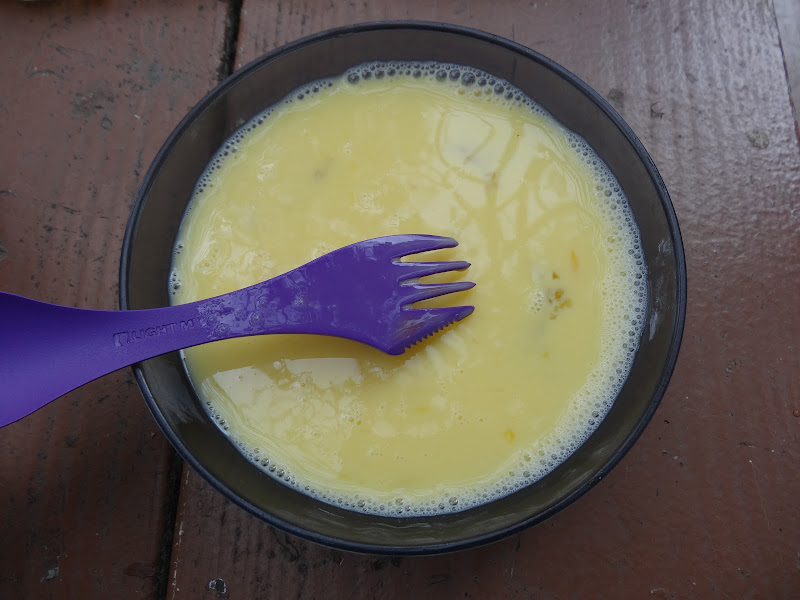
Next, beat the eggs and milk with a fork until well blended.
Beat the eggs and milk to as reasonably uniform a consistency as you can
There are those who say that the whites should be "beaten until stiff" and then the yolks should be "folded" in.  What a lot of unnecessary faffing about!  You want everything blended together in the end.  Go there directly.  "Beating the egg whites until stiff" is the province of those who sit at home and have no appetite!  I like to roam about the countryside in the out-of-doors.  "I'm hungry, let's get on with it!" is my philosophy.

I then pour the blended eggs and milk into my pan which I have already greased with a bit of olive oil and sprinkle in the cheese.
Eggs in our pan with the cheese sprinkled on.
Yes, I add the cheese before I start cooking.  I like my cheese well melted, and I like all my ingredients good and hot out on the trail.

Next, I break up a bit of bacon.  Today I brought bacon cooked earlier that day, but a package of bacon bits from the market works quite well and is generally more practical for the trail.
Bacon, added to the mix
Lastly, a special treat for today, I add some ham.
Ham, added to the mix
There we are!  Now, we're ready to start cooking, so let's set up our little Spider.
The Kovea Spider, legs deployed.
Now, I know what you're thinking:  "How are you going to cook a proper omelette on that little thing?"  Ah, skeptical reader, bear with me, and you shall see.

I like to add a little disc of aluminum underneath.  The aluminum disc will reflect heat upwards and also prevent any scorching of the picnic table I'm set up on.  The disc doesn't come with the stove, but it's easy enough to buy or make one.  The disc I have is from Flat Cat Gear and has a small hole punched out in the very center where the disk folds.  This hole prevents tearing at the crease, which is a nice feature.
An aluminum disk reflects heat up to your pot and protects the surface you're working on.
Next, I enclose the stove in a windscreen.  Here, I'm using a standard MSR windscreen, but any windscreen will do.  Whereas the aluminum disk is pretty much an optional extra, a windscreen is not.  A windscreen will allow you to use less fuel and give you greater control over your cooking, particularly at low flame.  I recommend using a windscreen any time you cook.

Recall also that one of the benefits of using a remote canister stove as opposed to the more typical upright canister stove is that you can use a fully enclosing windscreen.  Use a full windscreen with an upright canister stove and your canister might just overheat and explode.

So!  Eggs on, let's get cooking.
Cooking the omelette
To start, I use a medium heat.  I want the eggs to start bubbling.  Recall that you want the milk to boil.  It is the boiling milk that puts all those little bubbles into your omelette, giving it that light, fluffy texture.
Eggs, just starting to bubble.
However, just as soon as things start to bubble, you want to turn the heat down to very low.  I've got five eggs here in a relatively small pan.  In order to cook things all the way through evenly without having a burnt bottom, I'm going to have to use a very low heat.  Now, this ought to be a good test of the Spider.  Will that little burner head give me a burnt bottom?  Will it give me a ring of blackened eggs in the center of my pan?  Or will it be able to give me a nice, even heat and cook all parts of the omelette properly?  Let's see.

Looks like things are coming along nicely.  The toughest part of the omelette to get to cook properly is the very top.  Here, I've pushed the edge of the omelette in a bit on the left hand side and allowed any remaining liquid eggs to flow into the resultant gap.  Perhaps that's "cheating," but I look at that as being strictly a practical measure to ensure full cooking of that last little bit of liquid egg that always remains on top -- even when I cook omelettes at home.
Almost done now.
There!  Done at last.  And how did we do?  Let's pull it out of the pan and have a look.
The completed omelette.
Looks good!  Let's pull it out of the pan and have a closer look.
Looking at the omelette, edge on.
The omelette is fairly easy to pick up and move, which shows good cohesion -- meaning that it's cooked all the way through.  The edges look good, showing a nice bit of golden brown.  They're done just exactly right.  The eggs have fluffed up nicely; the omelette is a good bit thicker than my thumb.  I'd say our little Spider has passed with flying colors, but let's continue to examine our omelette.

Looking inside, I see that the eggs are fluffy and still moist but are definitely fully cooked.  All of the cheese is fully melted and has made a nice topping.
A very nice omelette indeed!
The omelette slices cleanly yet easily indicating that while it is fully cooked, it is not overdone.
Sliced, the omelette holds a good ege and reveals it's fluffy inner texture.
Let's flip over a piece and have a look at the under side.  Looks nice and golden brown.  No burning on the bottom.  Nice.
Flipping over a section of the bottom, we see a light browning.  Looks good!
And our pan?  Not that there was any question, but:  no burning.
No burnt on food on the pan.
Well, I for one am fully satisfied with the cooking capabilities of the little Kovea Spider.  I've been able to whip up a number of tasty dishes.  I hope this will dispel an idea that the Spider's diminutive size will somehow prevent it from being a good cooking stove.  I find that though the burner head is small, it's well designed and does a proper job on cooking tasks.

Personally, I find that a remote canister stove is a cook's stove, far more than any upright canister stove that I've used, including ones with larger burner heads.  A remote canister stove permits the use of a full windscreen which allows me to use a very low flame without worrying about the flame being blown out.  The windscreen also creates a very hot environment under that pan, and environment that allows me to have a lot more control over the heat of cooking than I would have with a typical upright set up which is open on the sides.  A remote canister set up also gives me a very stable cooking platform with a lower center of gravity than an upright setup.  I really like a remote canister set up if I want to do some real cooking.

Now, if you'll excuse me, I've got some eating to do.

I thank you for joining me on another Adventure in Stoving,

HJ
Time to eat.  (it was most delicious, I assure you)


Saturday, March 2, 2013

The Kovea Spider (KB-1109) Remote Canister Stove

What's this?  A package?  For me?  Why how nice.  You shouldn't have.  I mean really... but I'm so glad you did.
The Kovea Spider's package
And look!  It's the new Kovea Spider, a remote canister stove that is capable of running with the canister inverted (if you're not familiar with the cold weather advantages of running with the canister inverted, you might want to check out my article on Seattle Backpacker's Magazine, Stoves for Cold Weather II).

UPDATE 10 March 2013:  I've added a Cooking report for the Kovea Spider.
UPDATE 7 June 2017:  I added some pics, below, of the orientation necessary to fit a Kovea Spider into an MSR Titan Kettle (850 ml size) along with a 110 g canister of gas.

Why I've been lusting after one of these ever since I saw it in the Kovea catalog.  Aye, and she's a nice one.
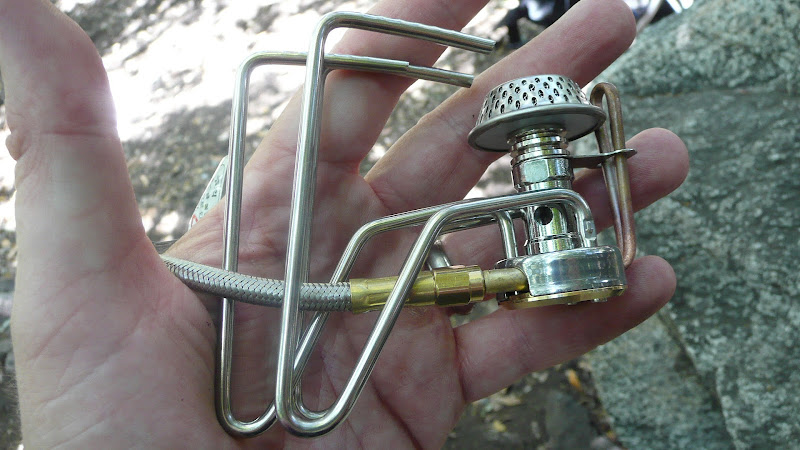
The Kovea Spider
Look how compact that is!  Yes!  What a sweet little stove.  Now, I own a number of stoves that are capable of running on a remote gas canister (Rapidfire, Windpro, Omnifuel, OmniLite Ti, Whisperlite Universal, etc.), but every one of those stoves is essentially a big, white gasoline type stove converted to run on canister gas.  None of them are particularly light or compact.  The lightest remote canister stove that I've got is the Windpro II at 187g/6.6oz.  The Kovea Spider weighs in at 168g/5.9oz which while almost 3/4oz lighter isn't really all that much of a weight savings to be perfectly frank.
A Kovea Spider (right) next to a Monatauk Gnat (left)

But weight's not the whole story, now is it?  Packability ranks very high on my list thank you very much.  I like to be able to put my stove and a canister of gas inside my pot.  It is here, in the packability department that the Kovea Spider shines.  I tried my Kovea Spider in my 780ml Snow Peak Ti pot.  It fit great, along with a 110g Snow Peak canister of gas.  Note:  The 780ml Snow Peak pot has a frying pan lid.  Not all 780ml pots will work.
A Kovea Spider fits easily along with a 110g canister of gas inside a 780ml Snow Peak Ti pot.
I was also able to fit the Kovea Spider into my 850ml Titan kettle, again with a 110g Snow Peak canister of gas.  It's a bit tighter fit even though the Titan kettle has a larger capacity due to the kettle's proportions, but I was able to get it to fit and to close the lid.  Now that's pretty sweet.
The Kovea Spider will fit into an MSR Titan kettle along with a 110g Snow Peak canister of gas.
By comparison, while I can fit the Windpro II into either a Snow Peak 780 or the Titan Kettle, I can't even begin to fit a canister of gas inside when there's a stove in there.
An MSR Windpro II (left) in a 780ml Snow Peak pot.
A Kovea Spider (right) in an 850ml MSR Titan kettle.  With the Spider, there's room for a 110g gas canister!

Now don't get me wrong, I like the Windpro II; it's a good stove.  It's just that I've been wanting something lighter and more packable for some time.  For groups of 3+, I might still choose the Windpro II, but for smaller parties, say from 1 to 3 people, I think the Kovea Spider will do very nicely.

UPDATE 07 June 2017
Here's the orientation necessary for the Kovea Spider and a 110 g canister of gas to both fit into an 850 ml MSR Titan Kettle (see photo, below).  Basically, you coil the hose tightly but without kinking anything.  You then stand the stove upright.  The burner must be up.  The canister must then sit on its side with the concave side toward the stove.  It's tight but it does fit, and I can get the lid on and closed.  You may have to jostle things around in there a bit, but it does fit.  You want to orient things such that no part of the stove presses on the lid.  If any part of the stove is pressing on the lid, the lid won't close fully.


Here's a video where I compare the packability of the Kovea Spider with that of an MSR Windpro II.  In the video, I state that the Windpro II weighs 8 ounces, which is NOT correct.  I must have been thinking about the stuff sack and windscreen or something.  The correct weights are 168g/5.9oz for the Spider and 187g/6.6oz for the Windpro II.


Well, that's very nice that it's a bit lighter and a whole lot more packable, how about the stove itself?

Ah, good question.  And in answer, let me say that I'm suitably impressed by Kovea's workmanship.
The Kovea Spider is very well made
I like the overall build quality and fit.  There are some nice touches like the fold out wire flame control.
The Kovea Spider has a fold out flame adjuster.  Works great with mittens.
Some of the cheap stoves coming out of China have a small knob here which is much harder to work when wearing mittens.  I've also seen the knobs on cheap stoves jam -- and unscrew right off the end of the spindle.

The stove comes with a pre-heat loop, so that you can gain about a 20 Fahrenheit degree (about 10 Celsius degrees) cold weather advantage over conventional upright gas stoves by running with the canister upside down, which causes the stove to be fed liquified gas.
The pre heat loop on a Kovea Spider
Here again is why I prefer an experienced and accomplished stove maker like Kovea over some of the cheap stoves coming out of China.  In inverted canister operation, some Chinese stoves have had particles break off from their hoses (improper materials were used) and still others had a "stutter" caused by liquid fuel reaching the burner even though the stove had a pre-heat loop (bad design).  At least with inverted canister operation, Chinese stoves don't appear to be quite up with their European, Japanese, Korean, and American designed counterparts.

The burner head of the Kovea Spider is small, but this should be nothing new for those who have been using light weight conventional (upright) gas stoves.
The burner head of the Kovea Spider
Now, take a look at the photo below.  Notice the downward pointing arrow on the leg/pot support?  The legs of the stove snap into place with a very positive lock.  No flopping around here.  To release the leg, simply push down as the arrow indicates, and rotate the stove's leg inward for packing.  Nice touch.
The legs of the Kovea Spider click into place for use. 
The legs are then pushed down as indicated by the arrow to release the lock and fold for stowage
In terms of flame characteristics, I found that I could go all the way from a low simmer.
A Kovea Spider simmering
To a very full blast.
A Kovea Spider on high flame.
The Kovea Spider has plenty of power and easily brings water to a full roiling boil.  Notice also, in the photo above, that the flame angles outward from the burner head.  Even though the burner head is relatively small, the flame is well distributed, and you don't get as much hot spotting as you might from other similarly sized burner heads.
A vigorous boil
With a rotating coupler, the Kovea Spider is easy to use in either normal canister or inverted canister mode.
A Kovea Spider with the canister inverted
And of course, since it's a remote canister stove, you can use a full 360 degree windscreen without fear of overheating the canister.
A Kovea Spider in use with a full 360 degree windscreen.  No problem; works great.

In terms of pot sizes, the legs can support a wide variety of pots.  The smallest diameter pot I tried was an MSR Titan kettle, but a smaller pot would be no problem.  However, if you want to fit both the stove and a canister of gas in your pot, you can't go smaller than a Titan kettle.
A Titan kettle on a Kovea Spider
The largest pot I tried on my Kovea Spider was a 1300ml Evernew Ultralight Ti pot.  It worked great, and there's no reason why you couldn't use an even larger pot.
An Evernew 1300ml pot on a Kovea Spider.  Very stable.

The stove comes with a detached piezoelectric ignition.
The Kovea Spider comes with a separate piezoelectric ignition
The ignition is nice, but since I carry a butane lighter on every trip already, I found myself sometimes leaving the piezo ignition at home.  Interestingly, the Kovea lighter appears to be identical in every way to the MSR lighter sold with the MSR MicroRocket, except for the color and brand name.
The Kovea and MSR piezoelectric ignitions appear to be identical

The Kovea Spider is easily my favorite gas stove to have come out in 2012.
Testing the Kovea Spider on the PCT this past summer with my daughter.

Summary
The Spider (KB-1109) remote canister gas stove from Kovea
What's Good about it
  • Compact!
  • Relatively light
  • Capable of inverted canister use for cold weather
  • Compatible with a full 360 degree windscreen
  • The flames from the burner head angle outward which helps prevent "hot spotting"
  • Well made; well designed
  • Very affordable.
What's bad about it
  • At 168g/5.9oz, it's still a little heavy for what it is.  More on that in my concluding remarks.
The Spider (KB-1109) remote canister gas stove from Kovea:  Highly recommended.


Concluding Remarks
I mentioned that I thought the stove was a bit heavy for what it is.  Now, don't take that out of context.  This is a very nice stove and has definitely made it into my "go to" gear bag.  But I think more progress can be made here in future generations of the stove.  The stove should be at least one ounce lighter than it is now and preferably two.  To you Kovea, I throw down the proverbial gauntlet.  If you don't do it, the Chinese will.  I'd like to see you succeed because I know you will make a far better stove.  I sincerely hope that you will take up this challenge.  I want the stove that you will build!

Lastly, the Kovea brand is not available through conventional channels in the United States, but I do see the Kovea Spider being sold on eBay.  The price I see listed is $52.90, which is roughly half of similar stoves from American producers.  The Kovea Spider is not only a darned good stove, it's a darned good deal.  It's my favorite inverted canister stove and my first recommendation to anyone looking for either a remote canister or inverted canister stove.  In case you haven't already figured it out, I really like this stove.

UPDATE 31 October 2014:  The Kovea Spider is now available through several US retailers.  Note:  The links below do not constitute an endorsement of any of these retailers.  I haven't necessarily ever purchased anything from them.  This is just for your information.
Thunder Adventure Company
The Gear House
Camp Saver
Flat Cat Gear

Flat Cat Gear has what may be a most interesting package:   The Bobcat Kovea Cooking System which includes a windscreen and pot that together with the Kovea Spider make for a much more efficient, wind resistant stove set up.  I hope to test the Bobcat Kovea Cooking System from Flat Cat Gear soon.

I thank you for joining me on another Adventure in Stoving,

HJ

Appendix I, Radii of Stoves Featured in this Post

StoveRadius (cm)Radius (In.)
Monatauk Gnat5.52.2
Kovea Spider6.52.6
MSR Windpro II7.22.8
Keep in mind of course that an upright canister stove's burner sits up much higher than that of remote canister stoves like the Spider or Windpro II. Generally, pots are more stable on a remote canister stove if the pot supports are equal in length to an upright canister stove's. If the pot supports are longer, the remote canister stove has an even greater advantage in terms of stability.

Appendix II, Additional Video
I shot a video with my new camera.  I'm still learning the ins and outs of my new camera, so I managed to cut off the video before I was done.  Since it's cut off, I won't put this video in the body of the review, but even though it's cut off, the video should still give you some idea of what the stove is like.