QuietStove.com

Showing posts sorted by relevance for query Kovea. Sort by date Show all posts

Saturday, March 2, 2013

The Kovea Spider (KB-1109) Remote Canister Stove

What's this?  A package?  For me?  Why how nice.  You shouldn't have.  I mean really... but I'm so glad you did.
The Kovea Spider's package
And look!  It's the new Kovea Spider, a remote canister stove that is capable of running with the canister inverted (if you're not familiar with the cold weather advantages of running with the canister inverted, you might want to check out my article on Seattle Backpacker's Magazine, Stoves for Cold Weather II).

UPDATE 10 March 2013:  I've added a Cooking report for the Kovea Spider.
UPDATE 7 June 2017:  I added some pics, below, of the orientation necessary to fit a Kovea Spider into an MSR Titan Kettle (850 ml size) along with a 110 g canister of gas.

Why I've been lusting after one of these ever since I saw it in the Kovea catalog.  Aye, and she's a nice one.
The Kovea Spider
Look how compact that is!  Yes!  What a sweet little stove.  Now, I own a number of stoves that are capable of running on a remote gas canister (Rapidfire, Windpro, Omnifuel, OmniLite Ti, Whisperlite Universal, etc.), but every one of those stoves is essentially a big, white gasoline type stove converted to run on canister gas.  None of them are particularly light or compact.  The lightest remote canister stove that I've got is the Windpro II at 187g/6.6oz.  The Kovea Spider weighs in at 168g/5.9oz which while almost 3/4oz lighter isn't really all that much of a weight savings to be perfectly frank.
A Kovea Spider (right) next to a Monatauk Gnat (left)

But weight's not the whole story, now is it?  Packability ranks very high on my list thank you very much.  I like to be able to put my stove and a canister of gas inside my pot.  It is here, in the packability department that the Kovea Spider shines.  I tried my Kovea Spider in my 780ml Snow Peak Ti pot.  It fit great, along with a 110g Snow Peak canister of gas.  Note:  The 780ml Snow Peak pot has a frying pan lid.  Not all 780ml pots will work.
A Kovea Spider fits easily along with a 110g canister of gas inside a 780ml Snow Peak Ti pot.
I was also able to fit the Kovea Spider into my 850ml Titan kettle, again with a 110g Snow Peak canister of gas.  It's a bit tighter fit even though the Titan kettle has a larger capacity due to the kettle's proportions, but I was able to get it to fit and to close the lid.  Now that's pretty sweet.
The Kovea Spider will fit into an MSR Titan kettle along with a 110g Snow Peak canister of gas.
By comparison, while I can fit the Windpro II into either a Snow Peak 780 or the Titan Kettle, I can't even begin to fit a canister of gas inside when there's a stove in there.
An MSR Windpro II (left) in a 780ml Snow Peak pot.
A Kovea Spider (right) in an 850ml MSR Titan kettle.  With the Spider, there's room for a 110g gas canister!

Now don't get me wrong, I like the Windpro II; it's a good stove.  It's just that I've been wanting something lighter and more packable for some time.  For groups of 3+, I might still choose the Windpro II, but for smaller parties, say from 1 to 3 people, I think the Kovea Spider will do very nicely.

UPDATE 07 June 2017
Here's the orientation necessary for the Kovea Spider and a 110 g canister of gas to both fit into an 850 ml MSR Titan Kettle (see photo, below).  Basically, you coil the hose tightly but without kinking anything.  You then stand the stove upright.  The burner must be up.  The canister must then sit on its side with the concave side toward the stove.  It's tight but it does fit, and I can get the lid on and closed.  You may have to jostle things around in there a bit, but it does fit.  You want to orient things such that no part of the stove presses on the lid.  If any part of the stove is pressing on the lid, the lid won't close fully.


Here's a video where I compare the packability of the Kovea Spider with that of an MSR Windpro II.  In the video, I state that the Windpro II weighs 8 ounces, which is NOT correct.  I must have been thinking about the stuff sack and windscreen or something.  The correct weights are 168g/5.9oz for the Spider and 187g/6.6oz for the Windpro II.


Well, that's very nice that it's a bit lighter and a whole lot more packable, how about the stove itself?

Ah, good question.  And in answer, let me say that I'm suitably impressed by Kovea's workmanship.
The Kovea Spider is very well made
I like the overall build quality and fit.  There are some nice touches like the fold out wire flame control.
The Kovea Spider has a fold out flame adjuster.  Works great with mittens.
Some of the cheap stoves coming out of China have a small knob here which is much harder to work when wearing mittens.  I've also seen the knobs on cheap stoves jam -- and unscrew right off the end of the spindle.

The stove comes with a pre-heat loop, so that you can gain about a 20 Fahrenheit degree (about 10 Celsius degrees) cold weather advantage over conventional upright gas stoves by running with the canister upside down, which causes the stove to be fed liquified gas.
The pre heat loop on a Kovea Spider
Here again is why I prefer an experienced and accomplished stove maker like Kovea over some of the cheap stoves coming out of China.  In inverted canister operation, some Chinese stoves have had particles break off from their hoses (improper materials were used) and still others had a "stutter" caused by liquid fuel reaching the burner even though the stove had a pre-heat loop (bad design).  At least with inverted canister operation, Chinese stoves don't appear to be quite up with their European, Japanese, Korean, and American designed counterparts.

The burner head of the Kovea Spider is small, but this should be nothing new for those who have been using light weight conventional (upright) gas stoves.
The burner head of the Kovea Spider
Now, take a look at the photo below.  Notice the downward pointing arrow on the leg/pot support?  The legs of the stove snap into place with a very positive lock.  No flopping around here.  To release the leg, simply push down as the arrow indicates, and rotate the stove's leg inward for packing.  Nice touch.
The legs of the Kovea Spider click into place for use. 
The legs are then pushed down as indicated by the arrow to release the lock and fold for stowage
In terms of flame characteristics, I found that I could go all the way from a low simmer.
A Kovea Spider simmering
To a very full blast.
A Kovea Spider on high flame.
The Kovea Spider has plenty of power and easily brings water to a full roiling boil.  Notice also, in the photo above, that the flame angles outward from the burner head.  Even though the burner head is relatively small, the flame is well distributed, and you don't get as much hot spotting as you might from other similarly sized burner heads.
A vigorous boil
With a rotating coupler, the Kovea Spider is easy to use in either normal canister or inverted canister mode.
A Kovea Spider with the canister inverted
And of course, since it's a remote canister stove, you can use a full 360 degree windscreen without fear of overheating the canister.
A Kovea Spider in use with a full 360 degree windscreen.  No problem; works great.

In terms of pot sizes, the legs can support a wide variety of pots.  The smallest diameter pot I tried was an MSR Titan kettle, but a smaller pot would be no problem.  However, if you want to fit both the stove and a canister of gas in your pot, you can't go smaller than a Titan kettle.
A Titan kettle on a Kovea Spider
The largest pot I tried on my Kovea Spider was a 1300ml Evernew Ultralight Ti pot.  It worked great, and there's no reason why you couldn't use an even larger pot.
An Evernew 1300ml pot on a Kovea Spider.  Very stable.

The stove comes with a detached piezoelectric ignition.
The Kovea Spider comes with a separate piezoelectric ignition
The ignition is nice, but since I carry a butane lighter on every trip already, I found myself sometimes leaving the piezo ignition at home.  Interestingly, the Kovea lighter appears to be identical in every way to the MSR lighter sold with the MSR MicroRocket, except for the color and brand name.
The Kovea and MSR piezoelectric ignitions appear to be identical

The Kovea Spider is easily my favorite gas stove to have come out in 2012.
Testing the Kovea Spider on the PCT this past summer with my daughter.

Summary
The Spider (KB-1109) remote canister gas stove from Kovea
What's Good about it
  • Compact!
  • Relatively light
  • Capable of inverted canister use for cold weather
  • Compatible with a full 360 degree windscreen
  • The flames from the burner head angle outward which helps prevent "hot spotting"
  • Well made; well designed
  • Very affordable.
What's bad about it
  • At 168g/5.9oz, it's still a little heavy for what it is.  More on that in my concluding remarks.
The Spider (KB-1109) remote canister gas stove from Kovea:  Highly recommended.


Concluding Remarks
I mentioned that I thought the stove was a bit heavy for what it is.  Now, don't take that out of context.  This is a very nice stove and has definitely made it into my "go to" gear bag.  But I think more progress can be made here in future generations of the stove.  The stove should be at least one ounce lighter than it is now and preferably two.  To you Kovea, I throw down the proverbial gauntlet.  If you don't do it, the Chinese will.  I'd like to see you succeed because I know you will make a far better stove.  I sincerely hope that you will take up this challenge.  I want the stove that you will build!

Lastly, the Kovea brand is not available through conventional channels in the United States, but I do see the Kovea Spider being sold on eBay.  The price I see listed is $52.90, which is roughly half of similar stoves from American producers.  The Kovea Spider is not only a darned good stove, it's a darned good deal.  It's my favorite inverted canister stove and my first recommendation to anyone looking for either a remote canister or inverted canister stove.  In case you haven't already figured it out, I really like this stove.

UPDATE 31 October 2014:  The Kovea Spider is now available through several US retailers.  Note:  The links below do not constitute an endorsement of any of these retailers.  I haven't necessarily ever purchased anything from them.  This is just for your information.
Thunder Adventure Company
The Gear House
Camp Saver
Flat Cat Gear

Flat Cat Gear has what may be a most interesting package:   The Bobcat Kovea Cooking System which includes a windscreen and pot that together with the Kovea Spider make for a much more efficient, wind resistant stove set up.  I hope to test the Bobcat Kovea Cooking System from Flat Cat Gear soon.

I thank you for joining me on another Adventure in Stoving,

HJ

Appendix I, Radii of Stoves Featured in this Post

StoveRadius (cm)Radius (In.)
Monatauk Gnat5.52.2
Kovea Spider6.52.6
MSR Windpro II7.22.8
Keep in mind of course that an upright canister stove's burner sits up much higher than that of remote canister stoves like the Spider or Windpro II. Generally, pots are more stable on a remote canister stove if the pot supports are equal in length to an upright canister stove's. If the pot supports are longer, the remote canister stove has an even greater advantage in terms of stability.

Appendix II, Additional Video
I shot a video with my new camera.  I'm still learning the ins and outs of my new camera, so I managed to cut off the video before I was done.  Since it's cut off, I won't put this video in the body of the review, but even though it's cut off, the video should still give you some idea of what the stove is like.

Friday, October 31, 2014

The Kovea Supalite (KB-0707) Gas Stove

People often ask me what stove(s) I like or recommend.  When it comes to the upright canister gas stove category (where the burner screws directly onto the canister), I like the Kovea Supalite.

The Kovea Supalite canister gas stove, screwed into a canister.
Let's go through some of the features of the stove.

Compactness
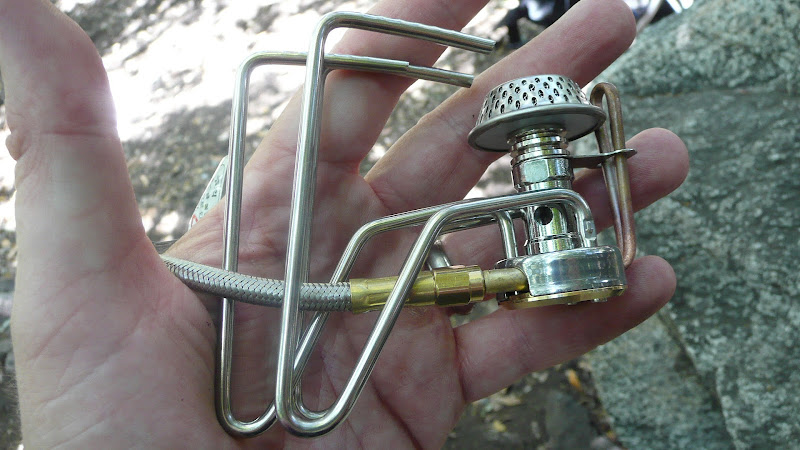
First it's a nicely compact stove.  Here's the stove in the palm of my hand.
The Kovea Supalite in my hand
Just how compact is it?  Well, let's compare it to what may be the most well known stove of this class in the US, the MSR Pocket Rocket.  I'm choosing the Pocket Rocket simply because the stove is so well known.
Kovea Supalite (left); MSR Pocket Rocket (right)
Notice that the MSR Pocket Rocket is quite a bit taller than the Kovea Supalite.  Notice also that the valve handle on the Pocket Rocket folds up but still sticks out a bit.  The Supalite's valve handle folds up around the base.
The Supalite's valve handle folds back around the stove's base.
The Supalite also lies far flatter than the Pocket Rocket.  Note in the photo below how the Pocket Rocket juts up quite a bit higher than the Supalite.
The Supalite packs flatter than the Pocket Rocket.
Now, why might compactness matter?  Well, a lot of people like to pack their stove inside their pot or mug.  The trend these days is to go fairly fast and light.  A lot of people are going with fairly small pots.  A big stove just isn't going to fit in a small pot.  To illustrate this, I grabbed a 250 ml/8 oz titanium Sierra Cup and our two stoves.  Notice that the Pocket Rocket can't fit in the cup, no matter how it is oriented.
A Pocket Rocket cannot be made to fit in a 250 ml/8 oz Sierra Cup.
By contrast, not only does the Supalite fit, it lies flat in the bottom of the cup.  In my book, that's compact.
The Kovea Supalite lies flat in the bottom of a 250 ml/8 oz Sierra Cup.
Pot Stability
"That's all well and fine," you may be thinking, "but a smaller stove is going to have smaller pot supports, my pot's not going to be stable, and my dinner is going to wind up on the ground."  Not so!

Let's compare the pot supports of the two.  If the two stoves are held together with the pot supports touching one another, we see that the span of the pot supports is essentially the same.  The Supalite's pot supports might be just ever so slightly larger in their span, but not to a degree that is significant.
The pot supports of a Pocket Rocket and a Supalite, juxtaposed.
In other words, even though the Supalite is far more compact, it's pot supports are just as wide.  Not only that, but in actual use, I found that the design of the Supalite's supports actually gave it better pot stability compared to the Pocket Rocket.  Note:   The ends of the Supalite's pot supports fold outward.  When screwing on a canister, the pot supports can flip back closed, which is a bit of a nuisance.  I found it easiest to screw on the canister first and then to fully deploy the pot supports.

Here's a photo of the Supalite in use with a 2.1 liter pot.  Now, a 2.1 liter pot is a fairly large pot, but I found no issues with stability.
A Kovea Supalite in use with a 2.1 liter pot.  No stability issues.
In fact, it was so stable I let my five year old daughter help me cook with this set up.  Now, that's stable!
A five year old child cooking with a 2.1 liter pot on a Kovea Supalite stove.
Cooking Ability
Speaking of cooking, how well does the Supalite do?  Well, in order to answer that question, let's look at the flame pattern.  Notice in the photo below that the Supalite's flame is directed outward.  If you're familiar at all with the Pocket Rocket, you know that it's flame is directed upward.
The flame on a Kovea Supalite stove radiates out away from the burner head.
Why might the orientation of the flame matter?  Well, a flame that points outward is more dispersed which minimizes hot spots and lends itself to better cooking.  A flame that points upwards frequently causes hot spots where food tends to burn onto the pot.  In my use of the Supalite, I found that I had very good flame control and that the stove simmered well without hot spots -- and no burnt food.

Now, does the more dispersed flame reduce the power of the stove?  In my testing, I found no indication of a loss of power.  I was able to produce a very vigorous rolling boil.
A vigorous boil from a Kovea Supalite.
Boil Time
Now, some people are going to ask, "well, how long did it take to boil?"  Those who have followed Adventures in Stoving for any length of time know that I don't really think that boil times are a good measure by which to judge a stove.  For one, how much gas are you burning through if you're doing speed boils?  If you've got a "gas guzzler" of a stove, is that what you really want?  Remember, you have to carry all your fuel and you want the fuel to last for an entire trip.  I encourage people to look for stoves that are efficient not hyper fast.  As long as the boil is with in a reasonable time period, I'm satisfied.  I mean, really.  I've hiked multiple hours to get to camp and I'm going to obsess over which stove is 30 seconds faster to boil?  I'm just not.  I cannot for the life of my understand why so much marketing spin is directed towards which stove boils the fastest -- as if that really mattered.

So, with respect to the Supalite (as well as most any other stove), I'm not going to quote boil times. If there's a problem, I'll mention it.  In my testing with the Supalite, there were no such problems.  It was clear that the Supalite was no slouch in terms of putting out the heat.  Boiling occurred in a reasonable time and the stove had reasonable power.

The Supalite certainly did an excellent job on my noodles, and that to me is far more important than any boil time.
Lunch is served!
Kovea, the Company
Regarding Kovea, I've half jokingly referred to Kovea as the "best known stove company that you've never heard of."  Kovea has traditionally made stoves for other companies.  If you've used other upright canister stoves from companies like Markhill, Vaude, MSR, and Snow Peak, there's a good chance that the stove was actually made by Kovea and then sold under another brand name.

The Kovea Supalite vs. The Snow Peak LiteMax
If you look closely at the Kovea Supalite, you can't help but see that it's very nearly the same stove as the Snow Peak LiteMax.  Snow Peak is a Japanese company, but look closely at the box, and you'll see that the LiteMax is made in Korea.  Yes, both stoves are made by Kovea.  They're very nearly the same stove, but there are a few minor cosmetic differences.   In the case of the Supalite vs. the LiteMax (essentially the same stove), the one that says "Kovea" on the side is typically $10 cheaper than the one that says "Snow Peak".  The same stove for $10 less?  Works for me.   Do note that the Snow Peak LiteMax has more of the base machined off and weighs 54 g.  If 6 g in weight savings is worth $10 to you, then you might want to go with the version stamped "Snow Peak."

The Supalite's Weight
There are a couple of different variants out there of the Supalite.  The version I have weighs 56 g/1.98 oz.  The version currently sold in the US weighs 60 g/2.12 oz.  The stove I have has some of the base machined off.  That's the only difference.  It appears that the 56 g version is the "domestic" version for sale within Korea.  The 60 g version is the "export grade" version for export to the US.  If you get a Supalite from an authorized retailer in the US, you should get the 60 g version.  If you get a 56 g version, say through eBay, you're getting a "bootleg" copy that someone is selling directly from Korea on the sly.  You should be aware if you get a "bootleg" copy, you lose any warranty from Kovea.  If you want the Kovea warranty, you need to buy the 60g version through authorized channels.  Note that the version I have is the 56 g version.  I got mine before Kovea started officially selling their stoves in the US.

Other Names/Other Stoves
The Supalite is sometimes advertised as the "Camp 56", typically on eBay.  The Camp 56 and the Supalite are one and the same stove (KB-0707).  The Camp 56 is the "bootleg" version not intended for the US market and carries no warranty from Kovea.

Kovea also makes the "Titanium" stove (KB-0101) which looks very much like the Supalite except that it has a piezoelectric ignition.  The Titanium is actually a different stove (there's more to it than just the addition of a piezoelectric ignition).  I haven't reviewed the Titanium stove, but piezoelectric ignition does not have a good reputation for reliability.  Personally, I'd probably stick with the "plain" (no piezo) Supalite.

Availability
So far, I've only seen the Supalite available on Amazon (authorized version) and eBay (typically unauthorized).  However, if you have read my review of the Kovea Spider there are several Kovea retailers listed (toward the bottom of the review).  You could contact those retailers and see if you can get the Supalite through them.

Summary
The Supalite (KB-0707) upright canister gas stove from Kovea:

What's Good about it
  • Compact
  • Light
  • Excellent pot stability
  • The flames from the burner head angle outward which helps prevent "hot spotting"
  • Well made, well designed
  • Very reasonably priced for an ultralight, titanium stove (note that the base and threads are aluminum)
What's bad about it
  • The pot supports can flip back closed while screwing the burner on to a canister (this is more of a nuisance than a true problem and can be avoided by screwing on the stove first and then deploying the pot supports).
The Supalite (KB-0707) upright canister gas stove from Kovea:  Highly recommended.

As always, I thank you for joining me.

HJ

Disclosures
The Kovea Supalite was provided to me at no charge for the purposes of this review.  I am under no obligation to review this or any other stove.  I am not compensated for my reviews in any fashion other than in some cases I am permitted to keep the item reviewed.  Given that I have well over a 100 backpacking stoves, a free stove frankly isn't going to buy anyone a good review.  Stove companies must measure up if they want a decent review here.  I am an amatuer stove blogger; I make my living elsewhere, in the IT field.  I fit blogging in as time permits.  Inasmuch as my income is derived elsewhere, monetary issues do not influence the reviews on this blog.  Yes, I do have advertisements on the blog.  I typically derive about $1.00 USD per day from the advertisements (last I checked).  This is a mere pittance and does not influence my reviews in the slightest.  Revenue from the advertisements goes toward hosting fees, stove fuel, and the like.  The blog is self supporting in that sense, and my wife is quite happy that I'm not using the family's income to run the blog, particularly given how tough the economy is these days.

Sunday, February 19, 2017

Review – The Kovea Booster+1 Dual Fuel Backpacking Stove.

The Booster+1 from Kovea is a dual fuel backpacking stove designed to work on either canister gas or white gasoline (e.g. MSR Super Fuel, Coleman Fuel, Crown Camp Fuel, etc.).
The Booster+1 dual fuel stove from Kovea.
Kovea is the best known stove company that you've never heard of.  For several major stove brands, who's actually making the stove?  Kovea.  You know their products but not necessarily their name.

Kovea makes either parts or entire stoves for Snow Peak, MSR, Edelrid, and Markill.  I'm sure that there are others.  Now, not every single stove, particularly in the case of MSR which does still make many of their own stoves, but Kovea makes at least some stoves for each of the above brands.

People have noticed that this stove is the exact same stove as a stove formerly sold by Markill.  Kovea has been making the stove all along.  When Markill stopped selling the stove, the Markill Phoenix, Kovea started selling the stove under their own brand as the Booster+1.

Single Jet
One of the really nice things about the Booster+1 is that you don't have to change anything when you change fuels.  You don't have to swap out the jet; neither do you have to change the connector.  Whether you use liquid fuel or gas fuel, the stove remains the same.

Multi fuel or dual fuel?
Kovea refers to the Booster+1 as a "multi" fuel stove, but to my mind a stove should work well with at least three fuels in order to get the "multi fuel" designation.  I mention this because you may read reviews elsewhere that the Booster+1 can run on unleaded automotive gasoline, diesel, kerosene, etc.  I would be very skeptical of such claims.  It can be run on some of those fuels, but the chances of it really running well are low (based on experience), and the chances of clogging the stove are high.

Alternative Fuels
If you're in an area where canister gas and white gasoline are simply unavailable, choose kerosene (1-K grade) if it is available or if you're near an airport Jet A1 or Jet A will work.  Leaded aviation gasoline (for propeller driven planes) and unleaded automotive gasoline should be avoided because of the tendency for the additives in the fuel to clog the stove.  So also diesel should generally be avoided, but special diesel #1 ("winter diesel") can be used in a pinch; just be sure it's the special #1 and not the normal diesel #2.

If you were interested in "alternative" fuels for the Booster+1, I have investigated the use of kerosene here:  The Kovea Booster+1 – Multi Fuel or Just Dual Fuel?   In order to use kerosene, you will need to know the priming and operational techniques discussed in this link.  Again, though, canister gas and white gasoline are the recommended fuels.  While you can use kerosene, the Booster+1 will not run as well on kerosene as it will on the fuels for which it was designed.

If they were cheaper and you wanted to use them, you could use "panel wipe" (common in the UK) or "environmental" gasoline (gasoline without automotive engine additives) without a problem.  "Sweet, light" naphtha should work also.

Paint thinner, which is somewhere in between gasoline and kerosene in terms of its properties should also work, but I have not tried it.  I mention some of these fuels not as a recommendation but rather as possible options for use in a pinch when more conventional stove fuels are unavailable.
The Kovea Booster+1 running on kerosene.  You can make do with kerosene in a pinch.
See the above link for tips and appropriate technique.
Boxed Set
The Booster+1 comes in a nice boxed set.  There are two versions, one with a fuel bottle included, and one without.  Make sure you know which one you are getting.  You will need a fuel bottle if you plan to use white gasoline.  If you only plan to use canister gas, then you're all set, and you don't need to buy a fuel bottle.  Either set includes a windscreen.
A Kovea Booster+1 boxed set.  This is the version that does not include a fuel bottle.

What's in the Box?
Inside the box is a nice zippered nylon case.  Inside the case is the stove.  One can also place the supplied maintenance tool inside the case, but there is not room for the pump.  However, I don't get too excited about this.  Just keep the pump in the bottle.  The fuel bottle will protect the threads and underside of the pump, and the pump will take up far less space.  When the bottle is empty, don't screw down the pump tightly so that you don't wear out the gasket.

The zippered nylon case of the Kovea Booster+1 has room for the stove, maintenance tool, and the spares kit.
There isn't enough room for the pump, but who cares?  Just keep the pump on the fuel bottle.
Speaking of the pump, I regard the Kovea pump as a high quality fuel pump.  The fuel pump has some nice features like a knob that is turned so that one can screw on the connector.  See my review of the Kovea Hydra for details of this feature and further commentary on the pump.  Since the Booster+1's pump is the same pump as the Kovea Hydra, I will not repeat all of my earlier review here.
The high quality Kovea fuel pump.
As I mentioned, the Booster+1 comes with a spares kit which includes things like "O" rings, a spare jet, lubricant, and a spare pump cup.
The spares kit of the Booster+1
It's a nice little kit, and along with the maintenance tool, should be able to handle routine maintenance as well as trouble shooting in the field.
The maintenance tool for the Kovea Booster+1.
Note the wire "pricker" for cleaning the jet at the end of the tool.
The maintenance tool is a little on the heavy side in my opinion, but it certainly will get the job done.  It would be nice to see a few grams shaved off – so long as it didn't diminish the effectiveness of the tool.
The Kovea Booster+1 duel fuel backpacking stove (in folded configuration).

The Stove Review
The stove itself can only be described as beefy.  I mean this thing is strong.  This might be a great stove for scouts and for, say, college outdoor clubs and the like where gear tends to take a beating.  Also, a number of expedition type users have reported very good results with the stove.  This is a very robust, heavy duty, reliable stove that is very field maintainable.  There is a cable threaded through the generator that can be pulled out and re-inserted like a pipe cleaner should the generator gum up due to poor quality fuels of the type found in remote places.

The legs are very strong steel.  The pot supports have a very wide span and will accommodate heavy pots for large groups or for snow melting.  There is little I would worry about failing on this stove; it is strong.  However, there's always a trade off on such things.  Yes, the stove is extremely strong, but it is therefore consequently also fairly heavy, weighing in at 310 g/11 oz for the stove, 116 g/4 oz for the pump, and 43 g/1.5 oz for the tool.  You don't absolutely have to carry the tool, and many people will just throw the stove in their pot (and leave the case at home), so let's say the minimum weight is 426 g/15 oz for just the stove and pump.  Of course you'll need a bottle, but the size and brand you carry will vary, so I'm not going to try to estimate the weight here.

The fuel line of the Booster+1 sticks out, rigidly, at a bit of an odd angle.
There is one thing here that I find slightly irritating.  It's minor, but the fuel line sticks out at a kind of funny angle, and, since the fuel line here is rigid, the stove winds up taking more space than it really needs to.  It's a fairly large stove.  I don't think it will be able to fit into a pot of less than about 1 liter in size.

However, that's not to say that there aren't some smart features here.  For example, there's a bend in the fuel line such that one can clean the jet without disassembling anything, er, well, you do have to pop off the flame spreader, but that's not exactly disassembling a stove.  I mean putting on and off the flame spreader is about as difficult as opening and closing a bottle of water.
There's a nicely designed bend in the fuel line so that one can access the jet easily.
The Booster+1 attaches to both it's fuel pump and to a canister of gas by means of a standard 7/16ths UNEF threaded connector.
The Booster+1 uses a standard threaded connector to attach to a) its fuel pump or b) standard threaded canisters.
The Booster+1 is compatible therefore with standard threaded brands of canisters, for example, MSR, Jetboil, Coleman, Primus, Optimus, Brunton, Snow Peak, etc.
The connector of a Booster+1 attached to an MSR brand canister

Cold Weather Canister Gas Operation
Note that in the photo above, I am running the stove with the canister upside down.  Not all stoves can handle this kind of operation, but those stoves that can operate this way gain a roughly 20 Fahrenheit degree (10 Celsius degrees) advantage over stoves in cold weather.  See my article Gas Stoves in Cold Weather – Regulator Valves and Inverted Canisters for further information on cold weather and canister gas.

Fuel line and rotating coupler
The fuel line is nice and flexible, and it's long enough that you can stand the bottle up as you pump, letting gravity help you with your work.  I find this to be a huge plus.

In addition the coupler fully rotates.  There's a big advantage here:  One can turn the fuel bottle upside down such that the fuel intake is 180 degrees opposite it's normal direction.  In other words, instead of dipping down into the fuel, the fuel intake is in the air space inside the bottle.  What's the big deal?  Well, there are two advantages to this:

  1. Purging the fuel line.  If you turn the fuel bottle over while the valve is still open, air will start coming down the fuel hose instead of fuel.  This cleans out the fuel line so that you won't have fuel drying inside the hose leaving potentially clogging deposits behind.
  2. Clean hands.  If you let all the air out by turning the fuel bottle upside down, then there's no pressure bursting out when you unscrew the pump from the bottle.  With some stoves, the only way to release the pressure is to unscrew the pump while still pressurized which inevitably means that your hands are going to get sprayed with fuel as the pressure is released.

The fuel line is nice and flexible which allows one to stand the bottle upright while pumping.
Note that I use alcohol for priming which burns much cleaner than white gasoline and is less prone to fireballing.
The fuel bottle in the photo is a Sigg brand bottle. The Booster+1 is compatible with standard Sigg type threads.
At the base of each leg, there is a nice non-slip rubber pad.  I found the Booster+1 to be extremely stable.  Extremely.
The Booster+1 is well thought out with nice features like this non-slip rubber pad on the end of each leg.
The Booster+1 vs. the Hydra
Here is a photo of the Kovea Booster+1 alongside another stove I recently reviewed, the Kovea Hydra.
The Kovea Booster+1, left, and the Kovea Hydra, right.
Whereas the Kovea Hydra is a study in compactness, the Kovea Booster+1 is not.  Indeed, if one were to compare the two stoves, one might describe them as opposites.
Stove Bulk Strength Noise Maintenance Wind Resistance
Booster+1 Bulky Very strong Loud Easy High
Hydra Compact Adequate with care Unusually quiet A bit trickier Low*
*It is important to use a properly sized windscreen with the Kovea Hydra.  See my review of the Hydra.

The Booster+1 is built like a tank and will take a lot of abuse.  With the Hydra, one has to be a bit more gentle.  The Booster+1 is a much larger, beefier, and more powerful stove (see below chart), but it's a bit loud.  The Hydra is probably the quietest liquid fueled stove that I have ever used.
Stove Weight BTU/hr - Upright Canister BTU/hr - White Gasoline BTU/hr - Inverted Canister*
Booster+1 310 g 7000 9600 10,500
Hydra 308 g 6100 7400 8500
*Estimated.

Here's a photo of a 2.6 L pot on the Booster+1.  Note that the pot supports extend beyond the edges of the pot even though this is a fairly big pot.  The Booster+1 can take some pretty big pots.
A 2.6 liter pot on the Kovea Booster+1.
Note how the pot supports still have more length out beyond the edges of the pot.
One can put some pretty big cookware on a Booster+1.
Flame Control

  • Flame control when using an upright canister of gas is excellent.  A very low simmer can be easily maintained.  
  • Flame control when using an inverted canister of gas is very good but a bit trickier.  A reasonably good simmer can be maintained.  
  • Flame control on white gasoline is good but not great.  If one gets the stove good and hot (as would normally occur when bringing water to a boil), one can get a pretty good simmer.  However, eventually the stove cools down, and the flame starts to sputter.  The simmering lasts for a pretty good amount of time though and is generally better than a lot of comparable stoves that only have an at-the-bottle valve.
  • Flame control on kerosene is poor.  One cannot get a decent simmer, and one cannot turn up the stove very high.  Only on moderate settings was the flame stable

Standard Fuel Bottles
The good news about the fuel bottle, is that Kovea uses "standard" fuel bottle threads.  That is, Kovea uses the same threads as Sigg, MSR, Primus, Optimus, Snow Peak, etc. use in their fuel bottles.  So, if you already have one of those brands, you should be able to use the fuel bottle you already have.  HOWEVER, check to see if everything works before you head out on the trail.  One time I had a Primus bottle whose threads were the same size as all of my other fuel bottles, but my MSR pump couldn't be screwed into that particular bottle.  The threads on that particular bottle started too far down the neck of the bottle, and the threaded portion of my MSR pump couldn't quite attach to them.

Also, make sure the fuel bottle you intend to use is long enough to accommodate the Kovea pump.  As I say, hook everything up at home and test it before you head out on the trail.
A Kovea fuel bottle, left. An MSR fuel bottle, right.
The Kovea fuel bottle is an excellent fuel bottle, but Kovea liquid fueled stoves can use any standard threaded fuel bottle.

Snow Melting
In terms of power, the stove has plenty.  I found it to be a good snow melter on liquid fuel.  The Booster+1 is rated at 9600 BTU/hr on white gasoline which is about the same as an MSR Whisperlite Universal.  The output on canister gas with the canister right side up (i.e. vapor feed) is considerably less, 7400 BTU/hr.  However, if you invert the canister (i.e. liquid feed), BTU output will go up and will typically be higher than on white gasoline.  Kovea does not provide figures for inverted canister operation, but assuming that the Booster+1 follows along the lines of other similar stoves, the rating should be about 10,500 BTU/hr.

Melting snow on a Kovea Booster+1.

Uh, but of course in snow, you'll want to use some kind of base lest your stove sink into the snow – and your dinner into the same.

The Booster+1 needs to be used with some kind of pad or platform when in snow (just about all stoves do).

Beware of Imitations!
I've seen stoves that look similar to a real Booster+1, stoves that even come in a box with the same color scheme and say "Booster+1" on the side.
An outrageous fake Booster+1 as seen on Amazon.com
Just look at the legs.  This is NOT a real Booster+1
Beware of cheap clones.  Such clones are not up to mainstream manufacturing and safety standards and have been banned by several countries.  Clones can be very dangerous.  Recall that stove fuels are highly flammable and that there is always the risk of an explosion.  Saving a few dollars is not worth it when you're risking a trip to the burn ward of a hospital – or worse.

Check your source carefully and examine photos closely.  My recommendation is that you buy from an authorized dealer so that you a) know that you're getting the real thing and b) have a warranty.  Stoves bought on e-Bay, even if authentic, do not have a warranty.  Only stoves bought from an authorized dealer have a warranty.  I know that Campsaver.com carries the Booster+1, and I believe that Mass Drop occasionally offers the Booster+1 in it's "drops" (group buys), but check around.  I'm sure there are other legitimate outlets for the stove.  If you see it on e-Bay or Alibaba, it's not an authorized outlet, and you may not even be getting the real thing.

Cost
MSRP is $170 USD, but shop around.  A careful shopper need not pay full price.  As I mentioned earlier, Mass Drop organizes group buys where an individual (such as yourself) can get in with a group and thereby get a group discount from the manufacturer.  Similarly, many on-line retailers will sell for less than MSRP.  Camp Saver had the Booster+1 for $30 off as of 21 February 2017.  Word to the wise:  Shop around.

Summary
The Kovea Booster+1
What's good about it
  • Field maintainable
  • Solid, beefy, built like a tank
  • No jet change when changing fuels
  • Rotating coupler allows one to purge the fuel line AND keeps hands clean
What's not so good about it
  • Heavy
  • A bit on the bulky side
  • Loud, but not exceptionally so.  Normal for this type of design.
Recommendations for improvement
  • Work with a native speaker of English and re-write the instructions.  The current instructions are in poor English and are difficult to understand.
  • Lighten the stove by at least 50 grams (about 2 ounces) and preferably 75 grams.  The Hexon is in this weight class, so I know that Kovea can do it.
  • Bring the fuel line in closer to the body so that the stove is more compact
  • Change the red cap on the fuel connector threads such that it has a lanyard attaching it to the pump
  • Make the stove fully kerosene compatible by:
    • Supplying a smaller aperture jet for those who really need to use kerosene.  Yes, not having to change jets is wonderful, but in some areas kerosene is all that is going to be available, and it wouldn't take much to supply a smaller aperture jet.  People who need to use kerosene are just going to have to accept the need for a jet change
    • Increase thermal feedback to the generator for improved vaporization for kerosene.  The current level of thermal absorption from the flame is inadequate for kerosene.  A brass sleeve around and bonded to the generator might be all that is needed.
The Kovea Booster+1:  Highly recommended


I hope that the preceding text and photos will give you a good sense of the stove.  By all means feel free to ask questions and make comments in the comments section, below.

I thank you for joining me,

HJ

Manufacturer and Technical Data
Date Available:  Currently available.
Manufacturer:  Kovea
Manufacturer's Website:  http://kovea.com
MSRP:  $170
Weight (measured):  310 g/10.9 oz
Materials:  Primarily steel
Colors available:  See photos.
Requirements:   Either a) A standard threaded canister of gas, sold separately, or b) a fuel bottle of white gasoline with compatible threads.  (and a pot of course, sold separately)
Warranty Information:  Contact Kovea through their website (see above).

Disclosures

  1. The stove used in this review was provided at no cost to me by Kovea.  I receive no remuneration from Kovea for my review other than I typically get to keep the stoves I review.  After the first hundred stoves or so (I'm probably up to a couple hundred now), yet another stove isn't much of a big deal and has no bearing on how I write my reviews.
  2. I receive no remuneration from any seller (Mass Drop, Camp Saver, or any other) of this stove.  Indeed, I have no financial relationships with any retailers of stoves.  I however have purchased items as a regular member of the buying public from many retailers, just like anyone else.  I mention the sellers that are herein named simply because I'm trying to tip you off on a good deal.  I don't get any kick backs or anything, so it's not like I really care where you buy your stove.  However, I'd feel bad if people went off and paid a high dollar amount simply because I listed said high dollar amount as the MSRP.  Do NOT feel obligated to pay the MSRP listed in this review.  Don't be a dunce!  Shop around!