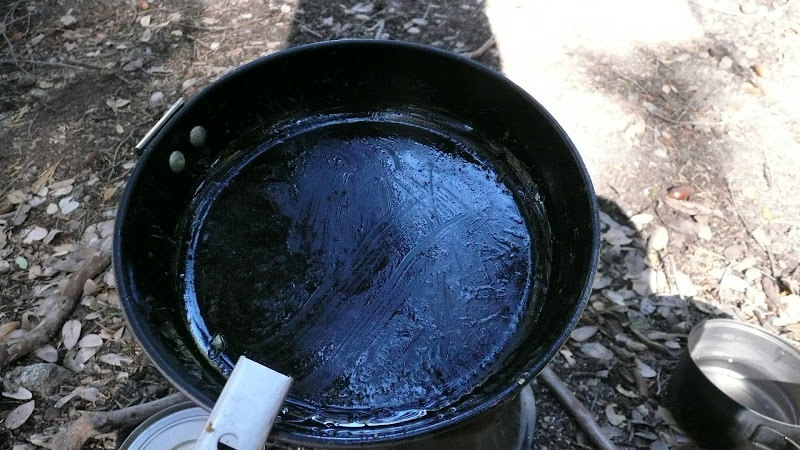
It can be tough to do real cooking on a wood fire in the backcountry. Sure, there are guys who can do it, but it's not all that easy, even for the experienced. Is there a way we can make cooking on a wood fire a little more accessible? As a matter of fact, there is: A wood burning stove.
If you've been following my blog, you know I've been evaluating a Sidewinder version of the Ti-Tri Caldera Cone.
Other blog posts on the Ti-Tri Caldera Cone:
As I've used the titanium version of the Caldera Cone, I've become convinced that this would be a comparatively easy way to cook real food on a wood fire. So I thought I'd try it out.
For today's hike, I took the beautiful Kenyon Devore Trail from Mount Wilson.
 |
| The Kenyon Devore Trail |
It's a really beautiful area, maybe an hour's drive from downtown Los Angeles.
 |
| The forest as seen from the Kenyon Devore Trail |
Beautiful, until you descend a little farther and get into the burn zone from the 2009 Station Fire, the largest fire in the history of Los Angeles County. The fire was human in origin.
 |
| The Kenyon Devore Trail passes through the burn zone from the 2009 Station Fire |
The Station Fire burned an area of about 251 square mi/650 square km in size. How big is 251 square mi/650 square km? Well, Washington, DC, the capital of the United States is 68.3 square mi/177 square km. In other words, the Station Fire burned an area over 3.5 times the area of the capital of the United States. That's a pretty big fire.
There are miles and miles of this:
 |
| Burn area from the 2009 Station Fire |
If you look at the above two photos, I think you'll see a powerful argument for something like a Ti-Tri Caldera Cone: fire safety. Will using a Ti-Tri Caldera Cone (or any wood stove) eliminate the danger of a wildfire? No, of course not. But a small, contained fire that is comparatively easy to extinguish is safer than a traditional open fire. Regardless of whether you use a wood stove or not, I encourage you to be safe with fire. Again, look at the above two photos, taken about 2.5 years after the fire. Fires can be truly devastating. When you leave a campsite, please make sure your campfire is out, dead out.
OK, Hikin' Jim will now get off his soapbox. :)
Hey, HJ, how about some cooking?
Ah, yes, well that is the subject of today's blog post isn't it? Well, let's have a look. First, I set my Ti-Tri Caldera Cone up, fill it with wood, and fire it up.
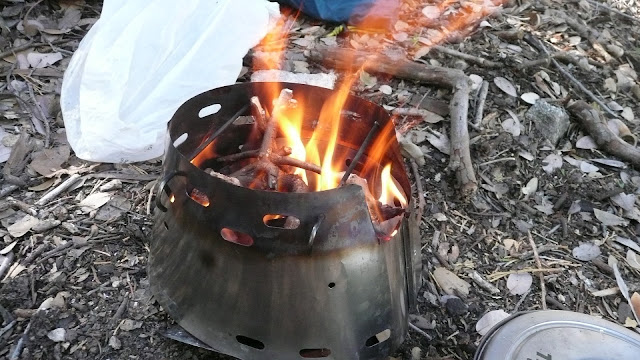 |
| A Sidewinder type Ti-Tri Caldera Cone in use with wood |
By the way, you'll notice a lot of leaf litter on the forest floor. By all rights, I should have cleared it better than I did. You can't tell here, but I'm on the banks of the W Fork of the San Gabriel River, and everything is a bit damp. With all that water, I wasn't too worried about a fire spreading, but still I probably should have cleared it. Mea culpa.
Today, I want to cook some "real" food. For that I'll need the steady heat of mostly coals not the intensity of burning flames. But no need to waste the wood, let's put a pot of water on. A little tea while we cook won't hurt anyone, now will it?
 |
| A pot of boiling water on Ti-Tri Caldera Cone |
Once things have burned down a bit, let's try some real cooking. Let's try something fairly easy: scrambled eggs. In go the eggs:
 |
| Starting scrambled eggs |
Now, before I go on, let me be clear: I'm doing a bit of kludging. Every Caldera Cone is sized to fit a particular pot. The Cone I'm using is sized for a 1300ml Evernew pot. My pan is bigger than a 1300ml Evernew pot. How did I cook with my pan? Very carefully. :)
All kidding aside, I placed the pan on the rim of the Caldera Cone. In terms of stability, it worked OK, but not great. Please note that I was using a very lightweight aluminum pan with two eggs. In other words, I wasn't putting a lot of weight on the edge of the cone. I'm not saying this is an approved or recommended method. Really, I just wanted to see if I could cook real food on a wood fired Caldera Cone and whether or not it might be easier than using an open fire.
And indeed one can cook real food on a Caldera Cone. Our scrambled eggs are coming along nicely.
 |
| Scrambled eggs in progress on a wood fired Caldera Cone |
And now, the finished product:
 |
| Scrambled eggs! |
I have to say that these turned out about as well as if I had cooked them at home, and this was on a fairly cheap lightweight aluminum pan. I was quite pleased with the results. And the taste. :)
Next, I thought I'd try something just a bit harder: Eggs over easy. Other than the fact that I broke one of the yolks when I cracked the egg, I'd say they turned out rather nicely.
 |
| Eggs, over easy. Yum! |
You know, for backcountry wood fired cooking, those are some pretty good looking eggs. I was very pleased with how they turned out. And the pan? No burnt spots, and no sticking. I was very pleased.
 |
| No burned food and no sticking |
Now, is my sort of kludge of balancing pan on the rim of a Caldera Cone the best set up? No, probably not. Better would be to find a pan the same diameter as the pot so that you could rest the pan on the stove proper and not just the rim of the cone. Still, this does work, and it works really quite well.
Overall, it's far easier to cook real food on a wood fire with a Caldera Cone than on an open fire -- even if you have to kludge a bit. With the Cone, it's much easier control the amount of heat and to focus the heat. If nothing else, focused heat means your pan gets hot but the pan's handles stay cool. Sometimes getting a pan in and out of an open fire can be quite a trick!
I found cooking with a wood fire with a Caldera Cone was surprisingly easy. I was very, very pleased with the results, and I plan on doing more cooking of real food on a wood fired Caldera Cone.
Thanks for joining me on another Adventure in Stoving,
HJ
Other wood fired backpacking stove posts:
Other posts on the Caldera Cone: