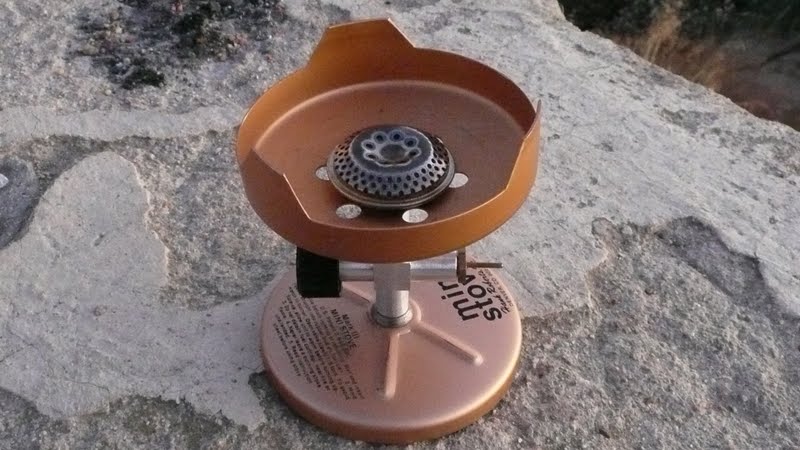
What's one of the most enduring designs of gas stoves? The Hank Roberts mini stove. It's compact design truly makes it a pocket stove. I typically carry mine in a Ziploc sandwich bag, and it really does fit in my shirt pocket.
 |
| A Hank Roberts Mini Stove |
The stove was designed in the late 1960's -- the late 1960's for crying out loud -- but still has a loyal following today. The stove was made by EFI and marketed under a variety of names, the most well known of which were probably the Hank Roberts stove and the Gerry stove.
Now, if we were to separate the two halves of the "clamshell" that forms the stove, what might we find inside?
 |
| Inside the "clamshell" is the burner head and the valve assembly. |
Cleverly tucked inside is a burner and valve assembly. I've added a couple of napkins to prevent rattling, but the napkins are not strictly necessary. The smaller, longer threaded piece (dark colored) seen above screws into the top half of the clamshell, forming a stand. The bottom half of the clamshell slips over the wider shorter threads (silver colored) to form a windshield/pot stand. The burner then screws in place over the top and holds the wind screen/pot stand in place.
When assembled, the stove looks something like this:
 |
| An assembled Hank Roberts Stove |
A few months ago, I published a blog post on how to use
the Hank Roberts stove with an adapter that will allow you to use a modern threaded gas canister.
Today, I thought I'd go fully retro and show you how to use one of the original type canisters.
 |
| A canister of the type used by a Hank Roberts stove. This particular canister is an Optimus 702 canister. |
Canisters of this type were marketed under a variety of brands including Optimus, Hank Roberts, Prepo, Thermos, and Coleman. There were were some minor variations among the various brands, but most had a rubber fitting typically referred to as a "rosebud" that looked something like this:
 |
| The "rosebud" on a canister of the type used by a Hank Roberts stove. |
The canisters of the type used by a Hank Roberts stove were used by a variety of stoves back in the day. The canister I'm showing here is an Optimus 702 canister which was intended for the Optimus 731 "Mousetrap" stove.
These canisters all contained 100% butane. Butane is a fairly easy gas to work with in that it has a fairly moderate vapor pressure. Gasses like propane require much heavier canisters and fittings because propane has a much higher vapor pressure. Of course, the one problem with butane is that butane doesn't work very well in cold weather. Butane vaporizes at 31F/-0.5C (at sea level), which isn't all that cold, particularly for "shoulder season" (early spring, late fall) or winter hikes. Add to that the fact that canisters typically get colder as you use them, and you soon realize that 100% butane typically needs weather above 50F/10C to really work well. 50F/10C? That's pretty limiting.
But not the Hank Roberts. You see the canister had a very special feature. The canister when used with a Hank Roberts stove lay on its side. Inside the canister was a wick, a wick that would conduct
liquefied butane to the burner. Then the heat of the burner would turn the liquid butane into a vapor which can be burned by the stove. Gas stoves do not work properly when the fuel is still liquid.
 |
| A gas canister attached to a Hank Roberts stove. Note how the canister lies on its side. |
Since the fuel is fed in as a liquid, all you really need is just a smidge of vapor pressure to get the liquid to wick into the valve assembly of the stove. Whereas modern vapor feed canisters require that the fuel be at about 10 Fahrenheit degrees above the vaporization point of the fuel (about 5 Celsius degrees) for there to be enough pressure, a Hank Roberts stove can operate when the fuel's temperature is only a few degrees above the vaporization point. And, since the fuel feed is in liquid form, you don't get the same degree of canister chilling that you get with vapor feed.
Of course, there's just one itsy bitsy little problem. The burner assembly isn't hot when you first fire up the stove. Since the burner assembly isn't hot, the fuel doesn't get fully vaporized, and your stove will flare until it warms up.
 |
| A cold Hank Roberts stove flaring on start up. |
The trick with a Hank Roberts stove is to turn the gas down low at first and let the stove warm up before you turn the gas up. On a cold day, it can take some time for the stove to warm up. One has to be very patient when starting the stove on a cold day. On the day these photos were taken, it was cold and gray, and a hail storm passed through. It was quite chilly, and it took several minutes for the very cold stove to warm up enough to fully vaporize the fuel.
But warm up it did, and the yellow flames as seen above quickly settled down to nice well-behaved blue flames.
 |
| Blue flames from a fully warmed up Hank Roberts stove |
Now, let's back up a minute. Modern canisters are threaded. How do Hank Roberts type canisters work?
Well, if you'll recall from the photo where I showed the interior of the clamshell, our burner assembly has a "needle" on it.
 |
| Note the needle on the right hand side of this photo of the Hank Roberts stove's valve assembly |
That needle works much like the needle used to pump air into a basketball, soccer ball, or football. On a ball, the needle is pushed into a "rosebud" like fitting on the ball to be inflated. Once connected, air is transferred from a pump to the ball. On a Hank Roberts stove, the needle is pushed into the "rosebud" on the canister until the rosebud pushes up against the base piece of the needle.
 |
| A Hank Roberts stove with the needle fully inserted into a canister |
When fully inserted, the needle depresses a valve, allowing liquid butane to flow into the stove. Nowdays, canisters typically have valves, but the Hank Roberts type canisters with valves were a real innovation for their day.
Well, now that we're all hooked up and warmed up, we'd better put the kettle on to boil now hadn't we? A cup of hot tea on a gray day is just what the doctor ordered!
 |
| A kettle fresh dunked in the stream, set to boil on a Hank Roberts stove |
The Hank Roberts Stove is my absolute favorite out of all my old gas stoves. I highly recommend them if you can find one on eBay or a garage sale or something and can find either some old canisters or get an adapter to run the stove on modern canisters.
The Hank Roberts Stove: Highly Recommended.
Thanks for joining me on another Adventure in Stoving,
HJ
Technical Appendix
Hank Roberts Mini Stove, Mark III
Weight 209g/7.37oz
Hank Roberts Stove -- Related Posts