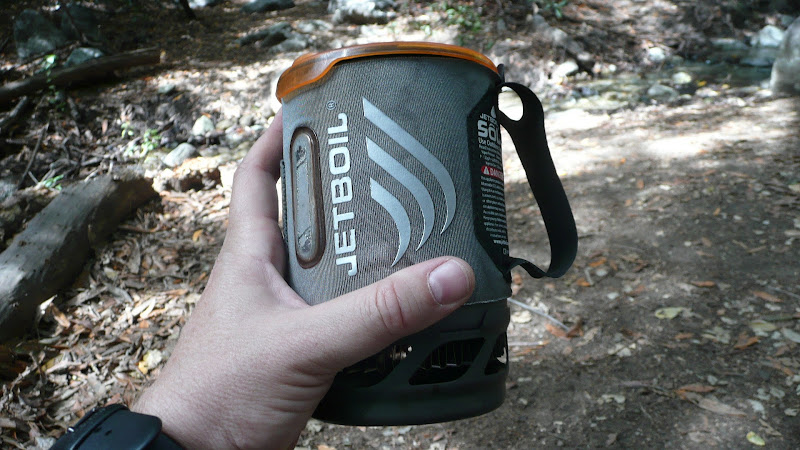
Investigations into and adventures with backpacking stoves including solid fuel (e.g. ESBIT), alcohol, gas, "white" gas (Coleman type fuel), wood, and kerosene.
In 2004, backpacking stoves experienced something of a revolution: The Jetboil PCS was introduced. The Jetboil PCS is the very definition of a "game changer" -- The Jetboil PCS really shook up the backpacking stove world (in a good way, I might add).
Has Jetboil rested on its laurels? No, indeed not. Jetboil is now on what I would consider its third generation of stoves, the new, high-tech Jetboil Sol.
The new, compact, lightweight Jetboil Sol
I've now completed my review of the Jetboil Sol. Below, I'll list all the blog posts I did in the process of reviewing the stove as well as a to my final review which is hosted on Seattle Backpackers Magazine. Below the links, I'll include a few items that I didn't have space for in the magazine article.
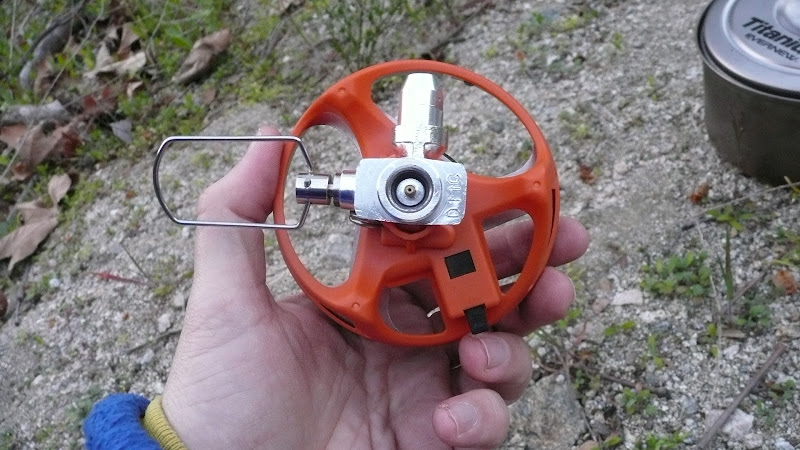
The new version of the Jetboil has a significantly lightened up burner consisting of far less material.
The new burner of the Jetboil Sol
The new burner includes a much improved piezoelectric ignition system.
The improved piezoelectric ignition of the Jetboil Sol (upper left of burner head)
Included with the pot and burner are the canister legs (stabilizer) and universal pot support. With the first generation of Jetboils, these items had to be purchased separately.
Universal pot support (top) and folded up canister legs (bottom)
Notice in the below photo that the ground is sloping. With the high center of gravity of a narrow pot like on a Jetboil, one might be worried about the stove tipping over.
The canister legs help prevent the stove from tipping over
The canister legs make the stove significantly more stable on sloping or uneven ground.
The universal pot support locks securely into place. This isn't just some cheesey little metal thing that rests up on top of the burner just waiting to be knocked off. No, when rotated and locked into place, I found that I could suspend the stove from the universal pot support. Now, that is a solid connection!
You can hold the stove up by the pot supports -- when they're locked in place.
With the universal pot supports, you can use any pot from any manufacturer (within reasonable size and weight restrictions)
A Jetboil Sol with an Evernew 1300ml pot on top
The Jetboil Sol has a lot of nice features, including the ability to do some real cooking (if you're willing to fiddle with the valve a bit -- it's tricky in the lower range of the stove).
Preparing to do some real cooking on a Jetboil Sol
I really like what I see in this the third generation of products from Jetboil. If a person wanted to get just one stove that would do pretty much everything for three season cooking, the Jetboil Sol will do you. For temperatures below about 20F (at sea level), I think another stove system might better serve.
I thank you for joining me on another Adventure in Stoving,
I did some fancier cooking in Cooking Report #1 and Cooking Report #2 -- but I didn't use the Jetboil Sol's "cup." I used a nice MSR Blacklite fry pan.
So, what about the Jetboil Sol's cup? Is it only good for boiling water? Or can it do a little more?
I thought I'd find out.
An aluminum JetBoil Sol cup
So, time to try one of my old standard trail meals, ramen noodles with dried veggies. For today's cooking, I'll be using an aluminum Jetboil Sol cup.
One of my typical trail meals, "Sapporo Ichiban" ramen noodles with dried veggies.
OK, so I'll spare you the part about boiling the water. It's safe to say that the Jetboil does just fine there.
Now, the instructions on these noodles say to first boil the water, then add the noodles, and then to cook these noodles over low heat for three minutes. Low heat for three minutes? Can the Jetboil do it? Let's try.
OK, so in go our noodles.
Noodles simmering in a Jetboil Sol
Then let's mix in our dried veggies.
Noodles with veggies added
And then, let's cover and simmer for a while. Getting a low flame on a Jetboil Sol is a bit of a trick, but it can be done.
Low flame on a Jetboil Sol
And three minutes later?
Nicely re-hydrated noodles and vegetables. Yum!
Say, now that's not bad at all! Why those noodles and vegetables are positively fluffy. Nice!
And, best of all,
I encountered no burnt on food when simmering noodles for multiple minutes in a Jetboil Sol cup
No burning or sticking. Nice! :)
So, is the Jetboil Sol's cup able to be used for more than just boiling water?
Noodles prepared on a Jetboil Sol
Yes, I'd say the Jetboil Sol is up to the task.
Again, please note that I used the aluminum Jetboil Sol cup. This report does not cover the titanium version.
Thanks for joining me on another Adventure in Stoving.
I'm in the process of reviewing the new Sol cooking system from JetBoil. I'm reviewing the aluminum version. There is also a titanium version, but I will not be covering the titanium version at this time.
So, let's take a look. Here, the Adventures In Stoving spokesmodel shows us what a JetBoil Sol looks like.
Spokesmodel Joyce shows us the aluminum version of the JetBoil Sol
That's fresh out of my backpack. I had been using it the evening prior for what the JetBoil is famous for: boiling water, a task for which it is exceptionally well suited.
However, today I'd like to try my hand at a little cooking. Rumor has it that you can't get a decent low flame out of the thing. Let's see.
A low to moderate flame on a JetBoil Sol
Now, let's turn it down a bit.
A yellow flame resulted when I really turned down a JetBoil Sol
When I really turned down the Sol, I got a yellow flame. Not good. BUT that flame is so low, it's not really a flame I'd cook with. The real question is whether I can get a low flame that is practical for cooking.
A low flame on a Jetboil Sol
There! Now thats a little better. A flame that is low yet not absurdly so. That's a practical cooking flame. Note that there's no yellow in the flame.
So let's try some cooking. One of the exceptionally wonderful things about the JetBoil is that it comes with an attachment that allows one to use any pot or pan that they might like. So, you can either use the wonderfully efficient pot that comes with the burner that integrates so well, or you can use just about any other pot, pan, or kettle you might have on hand (within reason given the burner's size of course).
The JetBoil Sol comes with an adapter (shown here) that allows one to use any pot or pan.
The adapter has a neat feature. Turn clockwise, and the adapter locks in place. In other words, that adapter isn't just resting on top of the rim of the burner, just waiting to be knocked off. That adapter has a good solid connection to the burner and isn't going to be easily knocked around. Very nicely done, Jetboil.
For today's cooking, I'll be using my favorite backpacking type pan, my MSR Blacklite pan. JetBoil does make a fry pan, but I've never used the JetBoil pan, so I won't cover the JetBoil pan in this cooking report.
An MSR Blacklite pan atop a JetBoil Sol
A little butter to grease the pan, and we're off! Today's menu? A salami and cheese four egg omelet.
Why four eggs? Well, I've got three mouths to feed, so four eggs is about right, and four eggs is a really great test for this size of pan. If I can't control the flame properly, I'll get an omelet that's scorched on one side and raw on another. A good omelet requires steady low heat. Not ultra-low, but you don't want to crank the heat up or you'll be eating charcoal briquettes not an omelet.
So, how'd it go?
A nice, fluffy omelet cooked on a JetBoil Sol
Pretty good in my opinion. My daughter's comment was "more." (My daughter is two). I think that means she liked it. :)
Evenly done, fluffy, cheese fully melted. Yum!
Seriously though, it tasted great, and the eggs turned out nice and fluffy, just the way I like them. The cheese was fully melted, and the salami was nice and hot.
There was some normal browning (from cooking with butter) on the bottom, but definitely no burnt spots.
Nice browning on the underside, but no burning.
And no sticking to the pan.
Absolutely no sticking on the pan.
I'd say that was a successful omelet. :)
Now, lest I make it look all together too easy, let's realize that I was cooking indoors. Cooking outdoors is another matter. I feel like the stove has enough stability in the flame to cook outdoors, but I need to give that a test before I pronounce the matter settled.
Also, flame adjustment is tricky at low flame. Sometimes, I'd turn the flame adjuster up, but the flame would get smaller??!? Hunh? I think this has to do with the regulator valve, but suffice it to say that flame adjustment is a little tricky in the lower range of the stove. Still, I was able to get good, steady flame without any yellow, a flame that I think will work for me outdoors. I'll be posting another report soon on just that very subject.
Thanks for joining me on another Adventure in Stoving,
The titanium version of the JetBoil Sol might have an occasional* problem. The problem appears to be fairly limited, and many people have used the titanium version of the JetBoil Sol without problems and are completely satisfied with the product.
Please note that my concerns pertain to the titanium version of the JetBoil Sol only.
There have been a few failures noted in the aluminum "flux ring" (heat exchanger) that is joined to the bottom of the titanium pot. Typically (I'll get to the more extreme cases in a minute), what appears to be happening is that someone is heating something other than just water in their JetBoil. Heat builds up in the aluminum heat exchanger, more heat than the heat exchanger can handle, and the heat exchanger becomes damaged. The damage typically appears to be a melting of the heat exchanger. It's possible that the aluminum could be undergoing combustion. Whether melting or combustion, the heat exchanger is damaged.
A damaged aluminum "flux ring" (heat exchanger) on a titanium JetBoil Sol. Photo courtesy of John Abela of HikeLighter.com. Used by permission.
So, caution number one: If you screw up while cooking with the titanium version of the JetBoil Sol, you might really damage your heat exchanger.
What are some ways to minimize the risk of damaging the heat exchanger?
1. Only boil water. Water typically does not exceed 212F/100C in temperature. Yes, salts and minerals in the water may raise the boiling point a bit, but it will still be somewhere near the typical boiling point. Water makes a very effective way of putting an upper bound on the amount of heat the pot and heat exchanger is subjected to.
2. Moderate your flame. Yes, I know, you bought your JetBoil because it's faster than a speeding bullet, but really, will a moderate flame make that much difference? What, 30 seconds more? How much is an undamaged heat exchanger worth? A few more seconds wait is well worth it if you save your heat exchanger. The titanium version of the JetBoil Sol isn't cheap, now is it? So slow it down a bit, yes?
3. If you do heat up something that's a bit more than water, stir it continuously. If you burn something to the bottom of the pot, it could form an insulating layer. That insulating layer will act as a barrier and not allow heat to be transferred from the exchanger into contents of the pot. You do NOT want anything to block the normal heat transfer. If the heat builds up in the fairly thin aluminum of the heat exchanger, that's when damage is most likely to occur.
4. Don't heat up something with a low moisture content. The JetBoil's instructions (see appendices, below) state as much. Personally, I wouldn't heat up anything thicker than the slurry formed by adding water to a freeze dried meal, but whatever you heat up, make sure it has a lot of water content.
Now, for the above, I said "typical case." By that I mean typical case where there has been some type of problem. Of course 99+ percent of the time there is no problem.
Also, here's a YouTube video where the heat exchanger becomes separated from the pot:
What happened? Well, we can't tell exactly from this video, but we do know that aluminum and titanium are rather dissimilar metals. The rates of expansion and contraction during heating and cooling between the two metals are quite different. Every time you heat or cool the two metals, the two metals will be pulling on whatever joins them, presumably a weld in this case. Given that the above happened in cold weather, the two metals may have been put through quite a temperature range, causing the weld to separate. I'm speculating of course, and this is the only reported case I've seen of this type, so I wouldn't read too much into it. However, neither would I plunge a hot titanium JetBoil Sol into an ice bath.
So, caution two: Rapid swings in temperature might cause problems with the heat exchanger. Taking steps to moderate the rate of temperature increases and decreases is only prudent.
Now, one last case, and this one a bit more troubling. But, while troubling, this is only one case out of the presumably thousands of titanium JetBoil Sols out there.
Let's go back to the JetBoil Sol Ti originally shown in the first photo above.
A melted aluminum heat exchanger on a titanium JetBoil Sol. Photo courtesy of John Abela of HikeLighter.com. Used by permision
Let me include the original post that I saw on the internet which prompted me to issue my "caution:"
I looked over at my jetboil and all I saw was this massive flame. The flames were probably three feet in the air. I ran over and dumped the last of my water on it (and thus went that night and the next morning w/o water) and when everything cooled down, there was evidences of some serious super heating. The little 'flux rings' ended up super heating and they were just going ballistic. The flux ring material got so hot that it started dripping down onto the ground (which did not go out when my threw my water on it, that stuff was crazy hot) and the drops of super heated metal were all over the canister - which scared me the most. A few of them actually melted/welded onto the canister of gas. The stupid orange thing was completely melted (I had to take a dremel to cut it off when I got back home - which is where I learned how easy it was to take them off). The bottom of the pot (not the flux, the bottom) as you can see in the photos above suffered major heat damage - and remember, titanium has a melting point of 3034(F).
I honestly can't see any heat damage on the titanium pot other than normal "rainbow" discoloration, but if there were three foot flames and temperatures hot enough to melt aluminum, that's very serious, and that kind of heat could potentially cause a canister explosion. What we don't know here is what led to that flame. Did the water boil over onto the canister? If water did boil over, as on all canister stoves, the boiling water could cause the internal pressure within the canister to dramatically increase which might cause a flare which might lead to the kind of flame and damage reported above.
Therefore, caution three: As with all canister stoves (this certainly isn't unique to the titanium JetBoil Sol), avoid boil overs. The JetBoil is a very powerful stove. Do not leave the stove unattended.
And, yes, I've left various stoves unattended before; we probably all have. Maybe with a stove as powerful as a JetBoil that's not something you want to do.
If you saw earlier versions of this post, my earlier caution indicated that you might want to a) hold off on buying a titanium version of the JetBoil Sol until more was known and b) if you've already got one that you might want to set your titanium JetBol Sol aside for a bit, again until more is known. I made those recommendations in light of the potentially serious incident with the three foot flames. With such potentially serious consequences, I felt such a caution was warranted.
Now, after gathering more facts, conferring with others, and analyzing in greater detail the available cases, I don't think such measures are necessary. Far more people have come forward saying that their titanium JetBol Sol works perfectly fine than people who have had a problem, and the one severe problem may have been caused by a boil over, not a product defect. A boil over would affect any canister stove, not just a JetBoil. Therefore: I see no inordinate danger in the titanium JetBoil Sol at this time.
Do, however, see the above three cautions, and heed them. You should also follow the directions provided by JetBoil, excerpts from which are included in the appendices, below.
Stoving. Sometimes it's a whole lot more Adventurous than we expect. :) But then that's why you read this blog. I thank you for joining me.
HJ
P.S. JetBoil, if you're reading this, I would love to have any additional insight or advice that you might be able to provide. You can reach me at hikin dot jim3 at gmail dot com (replace the word "dot" with a "." and the word "at" with an "@"). I would be happy to add your input to my blog.
*By "occasional" I mean that very few units seem to have been impacted. I do not mean that all units will occasionally have a problem!
Appendix I -- JetBoil Sol Instructions -- Excerpts
The following are excerpts from the instructions for the JetBoil Sol. All of them appear to be sound advice. Note that they stress how important it is to avoid a boil over. Update 2 Mar 2012: I've added photos of the actual instructions that come with the JetBoil Sol Ti in Appendix IV.
OPERATION WARNINGS
Do not leave Jetboil SOL unattended while in use.
DO NOT fry or cook foods with low moisture content. Use low flame settings when heating liquid foods to avoid boil over. If heating liquids near maximum capacity, use only low flame settings and exercise caution to prevent boil over.
OPERATING INSTRUCTIONS
If you overheat the canister, it will explode. Ignite burner before placing pot or cup on burner.
DO NOT HEAT EMPTY COOKING CUP. Add liquid or liquid food to the cooking cup. Use low heat when filling above 0.5L, boil over can result.
Appendix II -- Melting Points
Aluminum melts at 1220.666° F/660.37° C.
Appendix III -- Disclosures
I own several JetBoil stoves including the aluminum version of the JetBoil Sol, but I do not own a titanium JetBoil Sol. I am very happy with the JetBoil products I own. I have used JetBoil stoves at altitudes up to and above 11,000 ft/3300m without problems (well, except for the piezoelectric ignition, but that's a known and pretty minor issue). I believe JetBoil is a good company with a good product.
Appendix IV -- Photos of the JetBoil Sol Ti's Instructions Added 2 Mar 2012