
There are some really nice expedition class stoves out there on the market right now. One of the really nice features that's come out in the last couple of years is the "hybrid" stove, a stove that can burn not only liquid fuels like gasoline and kerosene but also nice, clean, no-priming-needed canister gas. Perhaps the two best known stoves in this category are the Primus Omnifuel and the MSR Whisperlite Universal. I thought I'd do a brief comparison of the two.
For more information on the individual stoves themselves, please see the following reviews:
First, travel mode. Both come with nice stuff sacks. Both stuff sacks have a nice zipper pouch so you don't lose any small parts.
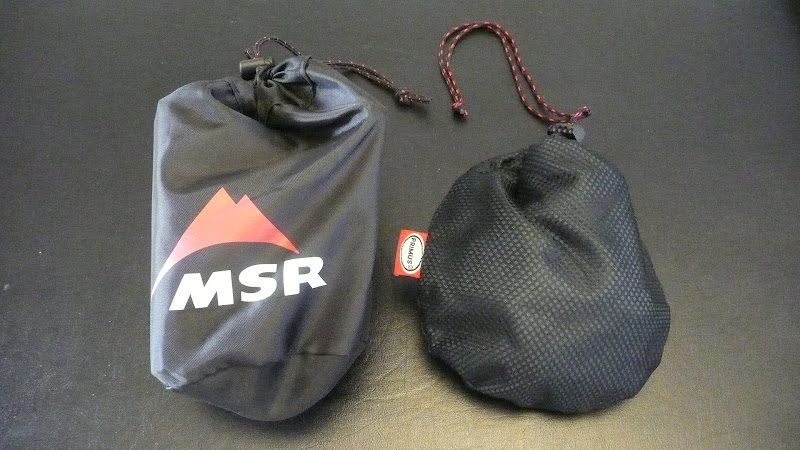 |
The MSR Whisperlite Universal (left) and the Primus Omnifuel (right) |
Note that the Whisperlite Universal makes a little bigger package than the Omnifuel. This is because a) the Whisperlite Universal is the bulkier of the two and b) you get more items included with the Whisperlite Universal.
Here are the major components that come with the Whisperlite Universal:
 |
The major components that come with a Whisperlite Universal. Back row (L to R): Heat reflector, inverted canister stand, and windscreen. Front row (L to R): burner, fuel pump |
The major components are listed in the caption above. Of course you also get a stuff sack, a liquid fuel adapter, and a little parts baggie with spare jets, a wrench/tool, and lubricant.
By contrast, the Omnifuel:
 |
The components that come with an Omnifuel |
Basically, you just get the burner and the fuel pump (and of course the stuff sack with the wrench/tool, spare jets, and lubricant). You (typically) don't get a heat reflector, windscreen, or inverted canister stand. Note: There are a lot of package deals out there with the Omnifuel; shop around. Some packages even include a fuel bottle. The Whisperlite Universal is typically sold separately from a fuel bottle.
The MSRP of the Whisperlite Universal is $140. The MSRP of the Omnifuel is $160. However, always look for deals. I've seen all sorts of special packages and deals out there on the Omnifuel. Be sure to shop around.
Value for the Dollar
Generally though, I'd say the Whisperlite wins on a value for the dollar basis. There's just more included with a Whisperlite. A windscreen is really important. It's included with the Whisperlite Universal. You've got to buy it separately with the Omnifuel. I've read that there's a "built in windscreen" with the Omnifuel. I don't buy that. You need an external windscreen for anything more than a breeze.
Also, that little canister stand that comes with the Whisperlite Universal is actually pretty handy.
 |
The inverted canister stand of a Whisperlite Universal |
Convenience in cold weather operation
What does the canister stand buy you? Convenience in cold weather operation with canister gas. Yes, you could just switch to liquid fuel for cold weather operation, but there are advantages to gas like improved simmering, greater mechanical reliability, and the elimination of priming. With the stand, you can easily invert a canister for improved cold weather operation. Generally, inverting the canister means you can operate your stove in weather that is 20F/10C colder than you could if the canister were right side up.
 |
The really nice inverted canister stand of the Whisperlite Universal |
Notice the Omnifuel's connector just to the left of the Whisperlite Universal's canister stand. Not only does the Omnifuel not come with a stand, but the control knob makes it hard to keep a canister inverted. Sure, you can DIY something, but the nice, professional stand that MSR gives you is really pretty nice.
Convenience in switching between gas and liquid fuels
In terms of switching between gas and liquid fuels, the Omnfuel wins, hands down. On the Whisperlite Universal, you have to change adapters on the end of the fuel line, and you have to change the jet. On the Omnifuel, there's no adapter to change; you just change the jet. Whether gas or liquid, the end of the fuel line stays the same with the Omnifuel.
Overall Build Quality
The Primus Omnifuel is a thing of beauty. It's precision engineering at it's best. It's almost more work of art than stove. It's hard to sum up the difference in a photo or two, but let's take a quick look at the respective pumps.
 |
| Top: The MSR standard pump. Bottom: The Primus Ergopump. |
Now, the plastic MSR pump is a perfectly serviceable pump, but there's just no comparison to the engineering marvel that is the Primus Ergopump. The smooth, precise stroke of the Primus pump is such a pleasure. The MSR pump feels a bit tinny by comparison. Don't get me wrong. I think they're both good stoves, but if you like precise Swiss watch-like engineering, the Omnifuel is for you.
Simmering
The Omnifuel has a valve at the burner, and is the better simmerer, particularly on liquid fuel. With the Omnifuel, it's easy to simmer, and anybody, even the rankest newbie, can do it. However, the Whisperlites are the best non-valve-at-the-burner simmering stoves that MSR makes and are a huge improvement over previous generations of the Whisperlite. Simmering with the Whisperlite Universal takes a few tricks, like leaving a lot of air space in the fuel bottle and only pumping up the bottle with about 1/4 the normal amount of pump strokes. With a bit of practice, the Whisperlite Universal really can simmer, but it's not as easy nor as automatic as with the Omnifuel. The Whisperlite Universal does have a large burner head which distributes the flame well which reduces the chances of hot spotting.
Compactness
The Omnifuel has a real advantage here. The Whisperlite Universal has a larger burner head in the first place, and for whatever reason MSR decided to go with a really stiff fuel line, a fuel line that's a real pain in the neck to pack up.
 |
| The Primus Omnifuel is far more compact than the Whisperlite Universal |
Note how in the below photo that the hose on the Whisperlite Universal sticks up in the air, supporting not only its own weight but also the weight of the canister adapter at its tip. Now that is a stiff hose.
 |
| The Whisperlite Universal has a very stiff fuel hose, so stiff that it will stick into the air, unsupported |
By contrast, the Omnifuel's hose wraps easily around the body of the stove. NICE.
 |
| The flexible hose of the Omnifuel is easily wrapped around the stove and tucked into the folded pot supports. |
Noise
The Omnifuel is just plain loud. It's not the loudest I've ever heard, but it's definitely not going to enhance the peace of the wilderness.
 |
| The Omnifuel with a roarer burner (left) and the Whisperlite with a ported (or baffled) burner (right) |
The Omnifuel has a "roarer" type burner, and roar it does. Now, the good thing about a roarer burner is that it's easy to clean and handles wind well. But it is loud. The Whisperlite, as one might surmise from its name, is far quieter.
There is however a solution to the noise problem of the Omnifuel: You can get an after market silent cap. The best cap I've seen is the OmniDawg silent cap from Bluewater Stove Restoration. It's a wonderfully quiet solution that also reduces the carbon monoxide emissions of the stove, but it's typically pricey.
 |
| An OmniDawg silent cap shown between a Primus Omnifuel (left) and an MSR Whisperlite Universal (right). |
See my Omnifuel review for more information including videos on the OmniDawg silent cap. OmniDawg silent caps are only sold through "BernieDawg's Store" on eBay.
Disclosure: I am not affiliated with Bluewater stove restoration or "BernieDawg's Store." I am merely a satisfied customer. I cannot help you obtain a silent cap. Please use eBay if you would like a silent cap for your stove.
Disclosure: I am not affiliated with Bluewater stove restoration or "BernieDawg's Store." I am merely a satisfied customer. I cannot help you obtain a silent cap. Please use eBay if you would like a silent cap for your stove.
Pot Stability
I'd say the Whisperlite Universal has the edge on pot stability. I tested the Whisperlite Universal with an enormous (in backpacking terms) one gallon (3.8L) tea kettle. Steady as a rock. The pot supports on the Whisperlite Universal have a radius of approximately 94mm. That's a pretty good sized pot support! That's larger than the previous generation of Whisperlites which already had great pot stability. With pot supports like that, you can use large pots for snow melting, an essential expedition task.
Now, that's not to say that the Omnifuel has poor pot stability -- far from it, but the Whisperlite Universal has the edge here. The Omnifuel has pot supports with a radius of approximately 84mm.
Pot Compatibility
On pot compatibility, the roles are a bit reversed, at least with smaller pots. The Whisperlite Universal with it's big burner head has trouble with smaller pots. There is a gap of approximately 42mm from the center of the Whisperlite Universal's burner to the inner end of the pot supports. In other words, your pot has to be wider than 84mm in order to be used on a Whisperlite Universal. Obviously, the Whisperlite Universal wasn't meant for small, solo style mug type pots. Unless you've got something like an MSR Espresso Star, which spans pot supports so that you can use a small pot or espresso maker, stick with a bigger pot.
 |
| An MSR Espresso Star on a Whisperlite Universal |
Weight
Here's where I think the Whisperlite Universal really shines, particularly on liquid fuel. Let's take a look at the numbers.
Canister Gas
Primus Omnifuel 427g/15.06oz
Whisperlite Universal 315g/11.11oz
Liquid Fuel
Primus Omnifuel 530g/18.70oz
Whisperlite Universal 369g/13.02oz
Basically, on canister gas, the Whisperlite Universal is about 112g/4oz lighter than the Omnifuel, and on liquid fuel, the Whisperlite Universal is about 161g/5.7oz lighter than the Omnifuel. Yes, the Omnifuel has a beautiful metal pump, but you pay for it in the weight department. Whether on canister gas or on liquid fuel, you save at least a quarter pound with the Whisperlite, and your weight savigs go up to almost 3/8th of a pound when using liquid fuel.
Note: For the purposes of comparison, I did not include the windscreen, heat reflector, or canister stand since those only come with one of the stoves. I wanted an "apples to apples" comparison. Included are the stuff sacks, one jet, spare parts and tools, stove, and pump (for liquid fuel only obviously). On the Whisperlite Universal, the appropriate adapter on the end of the fuel hose was included.
Concluding Remarks
So, which is the better stove overall? You tell me. :)
Seriously, it's up to you. Take a look at the various categories I've laid out above. It's up to you to decide which mix of price, weight, and features matter to you. Some people won't get an Omnifuel just because it's loud. Others won't go with the Whisperlite Universal simply because it has a plastic pump. I can't decide for you which categories matter to you and in what way, but I hope that by laying out some facts, figures, and thoughts, this post will help you get a better understanding of which stove might better suit your needs.
Seriously, it's up to you. Take a look at the various categories I've laid out above. It's up to you to decide which mix of price, weight, and features matter to you. Some people won't get an Omnifuel just because it's loud. Others won't go with the Whisperlite Universal simply because it has a plastic pump. I can't decide for you which categories matter to you and in what way, but I hope that by laying out some facts, figures, and thoughts, this post will help you get a better understanding of which stove might better suit your needs.
Special thanks to Martin C. who helped me recover this post after it was obliterated in a Blogger error.
As always, I thank you for joining me on another Adventure in Stoving,
HJ
Technical Appendix -- Detail Weights
Whisperlite Universal Weights
| Item | Grams | Include? | Grams | Ounces | Pounds | |
| 1 | Stove | 232 | Y | 232 | 8.18 | 0.51 |
| 2 | Pump | 65 | Y | 65 | 2.29 | 0.14 |
| 3 | Windscreen | 60 | N | 0 | 0.00 | 0.00 |
| 4 | Manual | 57 | N | 0 | 0.00 | 0.00 |
| 5 | Stuff Sack | 35 | Y | 35 | 1.23 | 0.08 |
| 6 | Canister Adapter | 31 | N | 0 | 0.00 | 0.00 |
| 7 | Liquid Fuel Adapter | 22 | Y | 22 | 0.78 | 0.05 |
| 8 | Reflector | 17 | N | 0 | 0.00 | 0.00 |
| 9 | Canister Stand | 14 | N | 0 | 0.00 | 0.00 |
| 10 | Spare Parts Kit | 12 | Y | 12 | 0.42 | 0.03 |
| 11 | Canister Gas Jet | 5 | N | 0 | 0.00 | 0.00 |
| 12 | Kerosene Jet | 3 | Y | 3 | 0.11 | 0.01 |
| 13 | Gasoline Jet | 3 | N | 0 | 0.00 | 0.00 |
| TOTAL | 369 | 13.02 | 0.81 | |||
| Upright Gas | 315 | 11.11 | 0.69 | |||
| Inverted Gas | 329 | 11.61 | 0.73 | |||
| Liquid Fuel | 369 | 13.02 | 0.81 |
Primus Omnifuel Weights
| Item | Grams | Include? | Grams | Ounces | Pounds | |
| 1 | Stove | 348 | Y | 348 | 12.28 | 0.77 |
| 2 | Pump | 103 | Y | 103 | 3.63 | 0.23 |
| 3 | Tool | 42 | Y | 42 | 1.48 | 0.09 |
| 4 | Stuff Sack | 30 | Y | 30 | 1.06 | 0.07 |
| 5 | Lubricant | 5 | Y | 5 | 0.18 | 0.01 |
| 6 | Canister Gas Jet | 2 | N | 0 | 0.00 | 0.00 |
| 7 | Kerosene Jet | 2 | N | 0 | 0.00 | 0.00 |
| 8 | Gasoline Jet | 2 | Y | 2 | 0.07 | 0.00 |
| TOTAL | 530 | 18.70 | 1.17 | |||
| Upright Gas | 427 | 15.06 | 0.94 | |||
| Inverted Gas | 427 | 15.06 | 0.94 | |||
| Liquid Fuel | 530 | 18.70 | 1.17 |


