This is an installment in my series on the new MicroRocket stove from MSR. Other installments in the series include:
Well, it's a beautiful morning. Looks like it's time to hit the trail.
 |
| The trail to Waterman Mountain on 2 Jan 2012 |
It's also time to do some more testing on the new MSR MicroRocket.
 |
| Testing the new MSR MicroRocket |
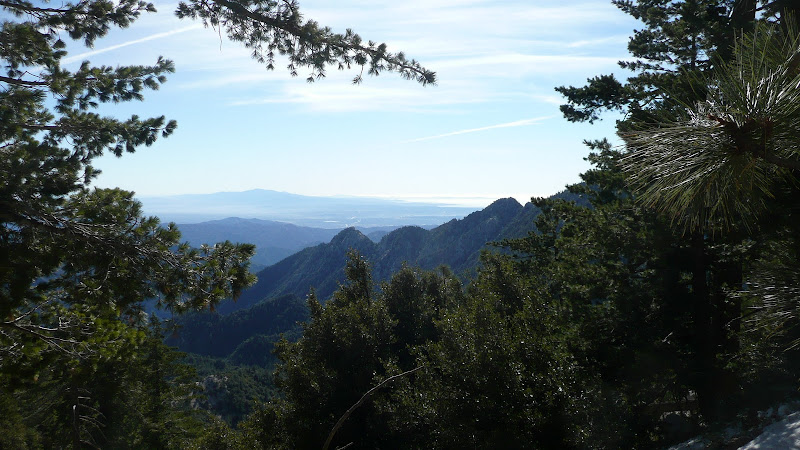
It's remarkably clear here in Southern California today. I can see all the way to the coast.
 |
| Looking out onto the coastal plain from the mountains of Southern California |
Today's destination? Waterman Mountain (8038'/2450m).
 |
| Approaching the summit of Waterman Mountain |
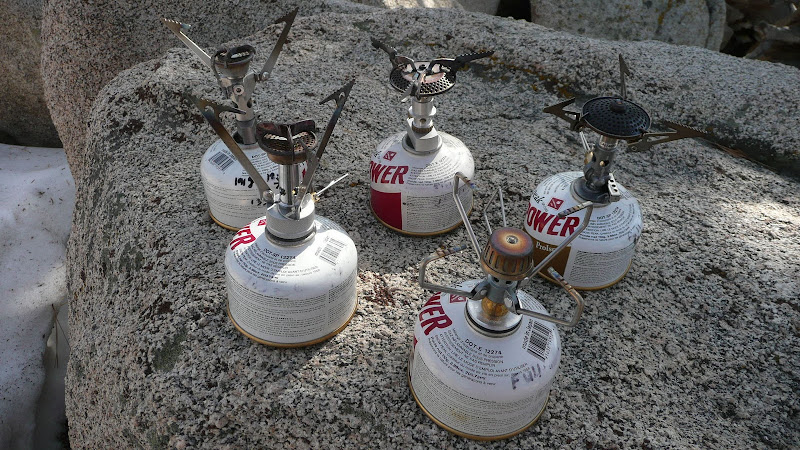
Naturally, I brought along a few stoves.
 |
| Rear row, left to right: MSR MicroRocket, Optimus Crux, Soto MicroRegulator, MSR PocketRocket, Snow Peak GigaPower (GST-100) |
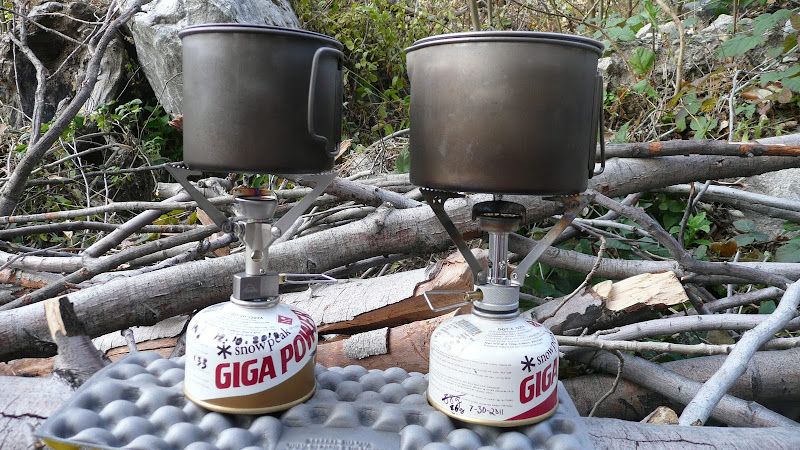
One of the things I wanted to do today was to get a sense of the stability of the new MicroRocket. There aren't really any objective measures of pot stability, so I brought along a few other stoves for comparative purposes. I'll describe what I did to try to get a sense of pot stability. Every test I conducted was admittedly subjective. The pot used for these tests was a 1000ml Snow Peak titanium pot.
First Test: The "Dump the Dinner" test. I put a 1000ml pot full of snow on top of the various stoves tested. I then moved the stove around while the pot was on the stove. I tried to get a sense of how stable a pot is on the stove.
 |
| A "dumped dinner" (a pot that has fallen off the stove) |
Second test: The "bump and drag" test. I put the same pot of snow on each of the stoves. I would drag the pot around on top of the stove or bump the pot trying to get a sense of how easy it was to knock a pot off of the particular stove. The canister and stove were not themselves moved during this type of testing.
One thing I noticed during the "bump and drag" test was that the comparatively thin pot supports of the MSR PocketRocket "chattered" as I dragged a pot across the top of the burner. In other words, the thin pot supports would vibrate as a result of the movement of the pot. The MSR MicroRocket on the other hand was rock solid.
Based on these two highly subjective tests, I would rate the MSR MicroRocket's pot stability as "very good" whereas I can only rate the PocketRocket as "good."
This review is for the MSR MicroRocket, but while I'm at it I suppose it wouldn't hurt to mention how all of the stoves fared with respect to pot stability. My rating system for pot stability is as follows (from best to worst): Excellent, Very Good, Good, Fair, Poor, Bad. Stoves are shown in alphabetical order. All ratings are my opinion. YMMV.
Stove Rating
MSR MicroRocket Very good
MSR PocketRocket Good
Optimus Crux Fair
Snow Peak GST-100 Excellent
Soto MicroRegulator Fair to Poor
In this category, pot stability, the GST-100 was the clear winner, but the MSR MicroRocket did very well and was clearly an improvement over the older PocketRocket.
Speaking of pot stability, let's look at the pot supports themselves. First, the PocketRocket.
 |
| A close up of the pot supports of a PocketRocket |
Do you see the piece of the pot support just below the rivet? There is a portion that is flat to the base of the stove and then the remainder bends upward at a 90 degree angle towards the rivet. It is here that I have seen the pot supports of a PocketRocket bend. Note that the pot support that bent was damaged as a result of the stove being knocked over, not normal use of the stove.
Now, by contrast, let's look at the MicroRocket. Can you say "beefy?"
 |
| A close up of the pot supports of an MSR MicroRocket |
The whole assembly has "solid" written all over it. The supports themselves are a little thicker, the point where the supports join the body is really strong, the tolerances are tighter, and the general build quality is noticeably superior. These supports are a definite improvement.
Today, I just tested using a 1000ml Snow Peak pot. In the testing done in my previous Trail Report, I used a BPL Firelite 550 mug pot (550ml) and an MSR Titan Kettle (850ml). In all cases, I would rate the MicroRocket's pot stability as "very good."
OK, so that's it on pot stability. Now, on to simmering. Remember that pot of snow in previous photos? Let's melt that snow.
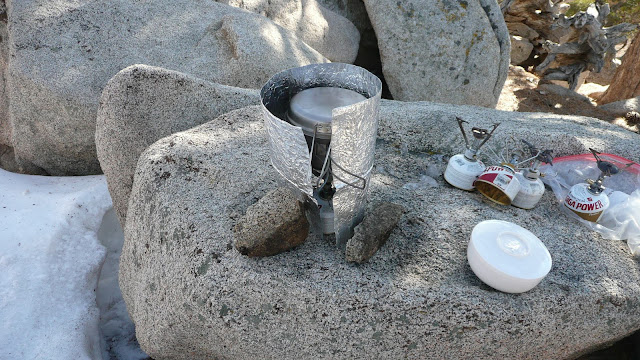 |
| Melting snow on the summit of Waterman Mountain. The windscreen is a homemade one constructed of household aluminum foil. |
There. Snow's melted. Now, notice something. There are three distinct discolorations of the blue sort that are typical of titanium pots.
Remember what the bottom of the pot looks like. We'll refer back to this.
 |
| Melted snow. Note the tripartite heat discolorations. |
OK, so let's bring the water to a boil, which the MicroRocket does with no problem.
 |
| Boiling water atop an MSR MicroRocket |
Now, let's turn the flame down and add noodles.
 |
| Simmering noodles in atop an MSR MicroRocket |
Now, of course it would make more sense to shut off the flame entirely and put the pot into a cozy and just let things steep, but we're here to test the simmering capabilities of the stove, so we'll leave the stove on and just adjust the flame. Let's have a look.
 |
| A fairly low flame on an MSR MicroRocket |
We'll that's not bad certainly, but nothing to write home about. Note how red the color of the little wind deflector is. Can we go lower?
 |
| A very low flame on an MSR MicroRocket |
Indeed we can. Now,
that is what I call a low flame. It's barely there. I was able to hold the water
below a boil. Take a look at the little wind deflector. It is no longer red hot. I had to put my finger in there just to make sure it was still on. It was on, and better still, it was
stable. Note that I did use a windscreen.
 |
| Simmering noodles atop an MSR MicroRocket. Note that the water is not boiling. |
OK, now let's do something stupid. Let's cover the pot. Sure, maybe the stove can stay below a boil if you don't have the lid on, but what about if you put the lid on? And, just to compound the stupidity, let's walk away and do some photography.
Wait a minute. You're going to leave the pot on the stove with the flame still going with the pot covered, and you're using
titanium cookware? What are you, nuts or something? You're going to have charcoal for lunch.
Maybe. Let's see. But about those photos. I've lived in the Los Angeles area for the majority of my life. Rarely have I seen a day so clear. Here's the view from my lunch spot. Remember, I'm at 8,038 feet/2450m above sea level.
 |
| Greater Los Angeles, the Pacific Ocean, and some islands off the coast. |
Not only can I see ships at sea, I can see the
wake from the ships. I can see the arms of the dockside cranes. It would take me at least two hours to drive there, yet I can see things with startling clarity. The large island that you see is Santa Catalina Island. Now look over to the far left of the frame. There's another island there. Can you see it?
 |
| San Clemente Island (far distance), Santa Catalina Island (middle distance), and Long Beach Harbor |
That is San Clemente Island. I cannot remember any time that I have ever seen San Clemente Island so clearly. San Clemente Island is closer to San Diego, California, than it is to Los Angeles. It's a fabulous day; no doubt about it.
Well, look at the time. Now, all the while, our noodles have been on the stove. Probably nothing left but some charred remains. Sure hope I brought some extra food. But let's have a look anyway.
 |
| Noodles after simmering for a considerable length of time |
Not only not charred, but
perfect and still not boiling. And the bottom of the pot?
 |
| The bottom of my Snow Peak 1000ml pot after extended simmering. |
The typical blue titanium discolorations that we saw in the photo above are still there, but there are no burnt remains in the bottom of the pot. I did give it the traditional mountaineer's "snow scrub" -- but just to get the spices and stuff out of the way. Nothing burned.
I cannot adequately describe how pleased I am with the controllable nature of the flame of the MicroRocket. I rate the MSR MicroRocket stove as
Excellent in the simmering category.
Um, Jim, that's all very nice, but did you really have to climb a mountain just to not burn noodles?
Oh, yes, that. Well, there is a method to my madness. I wanted to go to a relatively high elevation in order to test the piezoelectric ignition system. I've had hand held piezoelectric butane lighters fail atop Waterman Mountain before. Just for reference, my Soto Pocket Torch butane lighter with piezoelectric ignition is meant to be used at or below 5000 feet/1500m according to the REI website. Waterman Mountain is 8038'/2450m. A test here should give us some idea of how the MicroRocket's ignition will do at elevation.
And how did the MicroRocket's ignition system do? The ignition system of the MicroRocket passed with flying colors. I did notice that I had to turn up the gas a little more than I did when I tested at 3,000 feet/915m, but it was no big deal.
Just for fun, I also tested the MicroRocket's ignition on all of the other stoves I brought. No reason why you can't use that ignition on every stove you own including your car camping stove, right? Here are my results:
Stove Ease of Ignition
MSR MicroRocket Very easy
MSR PocketRocket Very easy
Optimus Crux Difficult
Snow Peak GST-100 Moderately Tricky
Soto MicroRegulator Difficult
I believe the wide, distributed head made the Crux and the Microregulator difficult to ignite. I did notice that if I tilted the stove's burner down on one side and applied the piezoelectric ignition to the
lower side, I could get the stove to ignite.
One last thing I tested:
Thermal Conductivity. Now why might I want to know whether or not the MSR MicroRocket conducts heat? Cold weather. If a stove conducts heat, it will warm the canister. In cold weather, a warm canister means your stove works. A cold canister means your stove doesn't work. In order to test the how much heat the stove conducts, I'm going to run the stove on high for an extended period.
Now, a word of warning. If you overheat a canister, you could blow yourself sky high. I did this test without a windscreen (although I did use the windscreen as a partial windblock as you will see in the below photo), and I used a remote stove stand so that the canister was kept far away from the heat source. Guys, I have a pretty good idea of what I'm doing. If you're going to experiment with thermal conduction with your stove, be really careful. If you screw up, you might wind up cooking a lot more than your dinner -- if you know what I mean. A canister explosion really could ruin your entire life. Just be careful; fair enough? OK, warnings out of the way, let's have a look.
 |
| Testing how hot a MicroRocket is after an extended burn. |
After running the stove for an extended period, the stove was not hot to the touch. If any appreciable thermal conduction had occurred, I should have jerked my hand away with burnt finger tips. The stove wasn't even warm. If you're looking for a stove that conducts a bit of heat back to the canister for improved cold weather performance, this would not be the stove.
OK, that's it for me. That was a lot to pack into a single post. Thanks for bearing with me.
I hope you've enjoyed this Adventure in Stoving.
HJ
Technical Appendix
Selected Gas Stoves, order by weight
Stove Name Weight Pot Support Radius
Monatauk Gnat 48g 3x54mm
Soto MicroRegulator 70g 3x57mm
MSR MicroRocket 73g 3x64mm
MSR PocketRocket 87g 3x60mm
Snow Peak GS-100 87g 4x51mm
Optimus Crux 89g 3x54mm
MSR SuperFly 132g 4x60mm
All weights were measured in grams on my Chefmate scale. All lengths were measured with a hand held steel ruler. All measurements are approximate. Manufacturer's specifications may vary.