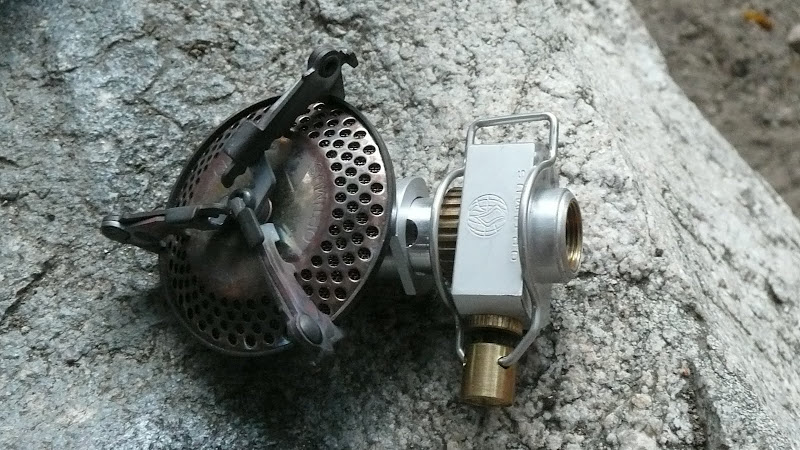
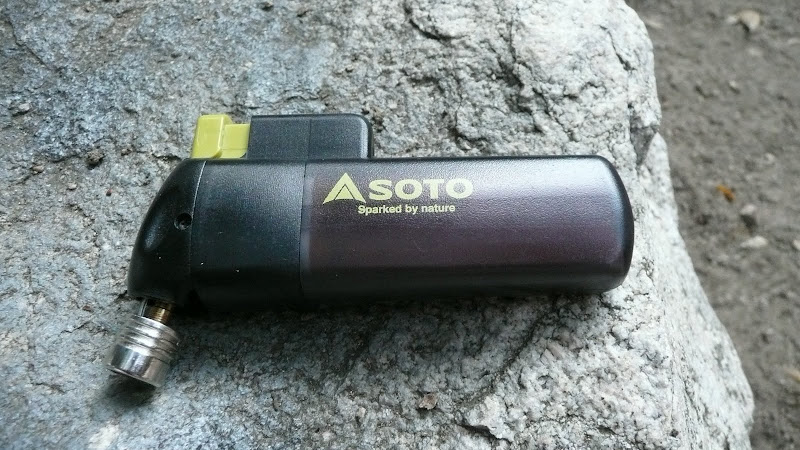
Investigations into and adventures with backpacking stoves including solid fuel (e.g. ESBIT), alcohol, gas, "white" gas (Coleman type fuel), wood, and kerosene.
People have asked, just how packable is the new MicroRocket?
A 110g canister, a MicroRocket, and a piezo ignition will all fit into a 550ml mug type pot -- but the lid won't fully close.
In order to answer that question, I thought I'd compare five reasonably well known upright canister stoves:
MSR MicroRocket
MSR PocketRocket
Optimus Crux
Snow Peak GigaPower (GS-100)
Soto MicroRegulator (OD-1R)
Hopefully, once you've seen the photos, you'll have a better sense of just how packable the MicroRocket is.
The MicroRocket folds down smaller than most. Is it significant? That depends on exactly which pot you're using. With some, it will make a difference.
Here's a photo of a GS-100 in a BPL Firelite 550 pot with a 110g Snow Peak canister. Note the position of the lid.
A Snow Peak GS-100 stove and a 110g Snow Peak canister in a 550ml mug type pot
Now contrast that to this photo with a MicroRocket.
An MSR MicroRocket stove and a 110g Snow Peak canister in a 550ml mug type pot
Neither closes fully, but the MicroRocket is a better fit. If this was a 575ml or 600ml pot, you might be able to fully close the pot with a MicroRocket whereas you might not with a GS-100.
UPDATE, 27 Jan 2012 2256 Hrs:
I just took my GS-100 stove out. I thought I'd try one more thing, and... I'm going to have to amend my report (above) just a bit.
The reason that the GS-100 doesn't fit quite as well as a MicroRocket in a 550ml mug type pot is that the valve adjustment wire on the GS-100 is very springy. The wire forces the GS-100 over to one side which causes it to fit poorly.
If one undoes the wire and flips the wire out of the way, the GS-100 fits ever so slightly better than the MicroRocket. However, there's no material difference between the two in a BPL Firelite 550 pot.
So, if one doesn't mind a very minor bit of fiddling, the GS-100 is equal to the MicroRocket in terms of its width and how it fits in that particular pot.
The MicroRocket is a few mm shorter overall than the GS-100. In a BPL Firelite 550, this has no practical impact, but for some applications, perhaps that might matter.
The very best fit was perhaps the Optimus Crux, but I found no practical difference between the compactness of the Crux vs. the MicroRocket. Both are tops when it comes to packability.
An Optimus Crux stove and a 110g Snow Peak canister in a 550ml mug type pot
The Soto MicroRegulator OD-1R takes significantly more space than a GS-100, MicroRocket, or Crux.
A Soto MicroRegulator OD-1R stove and a 110g Snow Peak canister in a 550ml mug type pot
The big loser here is the PocketRocket which doesn't even begin to fit -- and that's without a canister of any sort.
A PocketRocket doesn't even begin to fit in a 550ml mug type pot
Hopefully you've now got a sense as to the relative packability of the new MSR MicroRocket.
Thanks for joining me on another Adventure in Stoving,
INTRODUCTION
Soto Outdoors recently introduced their OD-1R Micro-Regulator stove. Soto created a good deal of buzz when they posted the following video which makes it look as though a regulator valved stove has quite an advantage over a conventional needle valved stove. The relevant segment starts at 1:03.
What advantages, if any, do regulator valved stoves offer?
This post is Part I of Advantages (?) of Regulator Valved Stoves, an investigation into the advantages, if any, of stoves that have a regulator valve.
Several people have mentioned in passing that their canisters were more fully drained after using a regulator valved stove than when using a conventional needle valved stove. In addition, in a discussion with an individual who has worked a good deal with LPG commercially, said individual felt that a regulator valve would function at lower gas pressures (such as those in a seemingly exhausted canister) than a needle valve. If in fact a regulator valved stove were to make more full use of the gas carried when backpacking, this more full use would be of value to backpackers. I set out to conduct a simple experiment to see if indeed a regulator valved stove might make more full use of the gas in a canister. My experiment would exhaust a canister using a needle valved stove and then replace the needle valved stove with a regulator valved stove to see if the regulator valved stove could operate on a canister that, to a needle valved stove, was exhausted.
ENVIRONMENT
Location: Stove Test Area 1 (UTM: 11S 383294 3792457), Haines Canyon, City of Los Angeles, California, USA
Date/Time: 30 JUL 2011, 1830 hours
Elevation: 2600'/792m MSL
Conditions:
27.20 InHg/921 mBar
80F/27C
Little to no wind (no audible susurrus, no visible leaf motion)
EQUIPMENT
Regulator Valved Test Stove:
-Soto OD-1R Micro Regulator
Conventional needle valved stoves for comparison:
-MSR Superfly
TEST RESULTS
Test 1, canister 1 (88g)
A. Superfly, valve fully open, flame on, run to exhaustion. Flame out. Cannot restart. No sound of gas escaping.
B. OD-1R, valve fully open, cannot start stove. No sound of gas escaping.
C. GST-100, valve fully open, cannot start stove. No sound of gas escaping.
D. Crux, valve fully open, cannot start stove. No sound of gas escaping.
Test 2, canister 2 (93g)
A. Crux, valve fully open, flame on, run to exhaustion. Flame out. Cannot restart. No sound of gas escaping.
B. OD-1R, valve fully open, cannot start stove. No sound of gas escaping.
C. GST-100, valve fully open, cannot start stove. No sound of gas escaping.
D. Superfly, valve fully open, cannot start stove. No sound of gas escaping.
Equipment Checking, canister 3 (166g). Each stove tested for normal operation.
A. Superfly. NORMAL
B. Crux. NORMAL
C. GST-100. NORMAL
D. OD-1R. NORMAL.
DISCUSSION
Two very nearly empty canisters of gas were used to conduct the experiment. A third canister containing far more gas was used to verify that each stove used in the experiment was working properly. All stoves were in fact working normally. To avoid the chance that the results might be skewed by some unknown, unusual characteristic in one of the needle valved comparison stoves, multiple comparison stoves were used. A butane torch was used as the ignition source for all stoves whether or not a given stove had a piezoelectric ignition so that ignition failures could not skew the results. At random, a needle valve stove was chosen and used to exhaust the canister. When flame out occured, a brief re-ignition was quickly attempted in order to confirm exhaustion of the canister. If the re-ignition failed, the needle valve stove was swapped out for the regulator valved stove, and an attempt to run the regulator valved stove was made.
I ran two tests. See TEST RESULTS section above for details. In both cases, the Soto OD-1R could do no more than a conventional needle valved stove. An exhausted canister to a needle valved stove was an exhausted canister to a regulator valved stove. For additional confirmation, after the test with the Soto OD-1R, the remaining needle valve stoves were tried. No stove was able to operate after intitial exhaustion. A exhausted canister was an exhausted canister, irrespective of the stove used. After the test, canister 1 weighed 86g, and canister 2 weighed 86g.
CONCLUSION
A Soto OD-1R regulator valved stove is not able to burn off more gas from a canister than a conventional needle valved stove. This is not to say that a regulator valve might not have some value in keeping a flame constant as canister pressure drops, but when the canister is finally exhausted, a Soto OD-1R regulator valved stove offers no advantage over a conventional needle valved stove.
Just got the Soto OD-1R microregulator stove... I read the regulator solves the cold weather problems...
Well, Rich, I've got good news, and I've got bad news.
The good news is that a regulator might help in colder weather, perhaps to the tune of about five degrees Fahrenheit. In other words, if a "normal" (needle valved) burner would conk out at 25F, you might still be able to operate a regulator valved burner down to 20F. But that's it: about five degrees F difference. And other factors could affect that five degree difference. Note the use of the word "might." Look for more on that in future blog posts.
The real issue is the type of fuel. Each of the common types of fuel used for backpacking stoves has a vaporization point. Below that vaporization point, the fuel will remain a liquid, and an upright canister stove (such as the OD-1R), no matter how cleverly built, will simply not function. The three common fuels and their vaporization points are:
"Plain" butane: +31F (-0.5C)
Isobutane: +11F (-12C)
Propane: -44F (-42C)
If you consider the entire "lifespan" (full to empty) of a canister, an upright canister stove can only function at a temperature about ten Fahrenheit degrees above the highest vaporization point of all fuel components. For example, if you have a fuel mix of propane and isobutane, the highest vaporization point is +11F, and you can only operate an upright canister stove down to about +20F (roughly ten degrees above the vaporization point of isobutane, the fuel component with the highest vaporization point).
Therefore, the first trick of operation for gas stoves in cold weather is to choose good fuel. Avoid "plain" butane. For example, Primus, Optimus, Glowmaster, and Coleman brand gas canisters contain at least some "plain" butane. Avoid these and similar brands for cold weather use. Instead get brands that contain only isobutane and propane (Snowpeak, MSR, etc.). These brands will work down to about 20F (at sea level)*. Note that as you use the gas on an upright canister stove, the temperature of the fuel will fall, so even if you start with fuel at 20F, by the time you finish cooking, the fuel may have become much colder, and your flame may weaken or die. Indeed, even on days where the outside temperature is above 32F, the temperature of the fuel may dip below freezing, like this:
The more fuel you burn, the colder the fuel will become.
Which leads us to: The second trick of operation for gas stoves in cold weather is the temperature of the fuel. If you can keep the fuel warm, the gas will flow even in weather where a stove wouldn't normally be able to operate. Check out my Stoves for Cold Weather I article in Seattle Backpacker's magazine for tips on how to keep the fuel warm.
If you're really interested in a gas stove for cold weather, you need to look at a different class of stoves, the class generally referred to as remote inverted canister stoves. I've written article on remote inverted canister gas stoves for cold weather: Stoves for Cold Weather II. A couple of examples of remote inverted canister, cold weather capable gas stoves include:
-The Coleman Xtreme (The "gold standard" of cold weather gas stoves).
-The MSR Rapidfire (An economical cold weather gas stove). An upright canister stove like the Soto just isn't going to cut it in real cold weather, regulated burner not withstanding..
So, in summary, your first concern when running a gas stove in cold weather is the fuel itself. The second is the temperature of the fuel. Third, if you need to go really cold, you need to switch to a different class of stoves -- remote inverted canister stoves. The design of the valve on the burner is of little consequence in comparison to the the fuel, the temperature of the fuel, and the class of stove.
HJ
*When I say 20F, I mean throughout the life of the canister, particularly towards the end of the canister. Fresh (full) canisters will work in colder temperatures. For gas stoves, it is always the temperature of the fuel that matters, not the air temperature.