QuietStove.com

Showing posts sorted by relevance for query WindMAster. Sort by date Show all posts

Sunday, November 20, 2016

Review: The Soto WindMaster – World's Lightest Gas Stove with Piezo Ignition

I've talked about the Soto WindMaster (OD-1RX) upright canister gas in several of my posts lately.  The WindMaster's claim to fame is that a) it is the world's lightest (67 g/2.3 oz) upright canister gas stove with piezoelectric ignition and b) that it has superior wind handling capability.

I was really skeptical about this stove at first. As it turns out, it's one of my favorite canister gas stoves.  Ever.

UPDATE 27 November 2016:  I have added a point by point consideration of the stove based on my "What Makes a Good Backpacking Stove?" framework in the appendix
The Soto WindMaster (OD-1RX)
Why was I skeptical?  Well, the name of the stove sort of tells you why I was skeptical.  Soto is making the claim that their stove handles wind well.  An upright canister stove?  A master of the wind?  Really?

Let me explain. There are two general classes of canister gas backpacking stoves:  upright and remote.
An upright canister stove, left (a Soto Amicus), and a remote canister stove right (a Snow Peak GeoShield).
An upright canister stove screws directly onto the top of a canister of gas.  The advantage here is weight:  There's no need to have "legs" to support the burner.  The canister itself supports the stove.  Also, there is no need of any means to bring the fuel to the stove since the stove is directly attached to the canister.  Upright canister stoves are light, plentiful, affordable, compact, and simple.

Wow, sounds great, right?  So what's the disadvantage?  Well, notice how high the stove and pot are in the photo above.  Since the stove mounts on top of the canister, it sits higher up, more exposed to wind.  

Can't you use a windscreen?  Well, yes, kind of, but BE CAREFUL.  If you trap too much heat in the enclosed space around the fuel canister, the canister could overheat.  Heat the canister sufficiently, and it could burst, spewing highly flammable gas all around.  Let's see, flammable gas spraying all around a flame.  Say, that might be, um, bad, couldn't it?  Well, let's just say this could be your "last supper."  Most manufacturers strongly recommend against the use of a windscreen with an upright canister stove.  There's more to say here, but rather than go on and on, if you're interested in the subject of windscreens, I suggest you check out my blog post on Windscreens.  Another disadvantage to upright canister stoves is that they aren't all that great in cold temperatures.  Even with the best fuel, you probably don't want to go much below 20F/-7C.  There are tricks in cold weather.  If you're interested see: Canister Gas in Cold Weather.

Now, on the other hand, a remote canister stove has the fuel off to the side.  Fuel is delivered to the burner via a fuel hose or line of some type.  The advantages here are:  1. The stove sits lower to the ground, so it's more stable and more out of the wind, 2. The stove can be used with a full 360 degree windscreen with no risk of overheating the canister, and 3. Many remote canister stoves can be run with the canister inverted for cold weather operation.  If you're going to run a stove with the canister inverted, do your homework first.  Not all remote canister stoves can handle inverted canisters.  For starters, check out my article in Seattle Backpackers Magazine:  Stoves for Cold Weather II.  

The disadvantages to a remote canister are stove are:  1.  It takes up more space in your pack, 2. It weighs more, and 3. It typically costs more.  There are also fewer choices with remote canister stove than upright canister stoves, but there are some good ones out there.  If you're interested in a remote canister stove,  I suggest you check out the Kovea Spider remote canister stove. 

OK, enough background.  Here's the point:  The WindMaster is an upright canister stove.  In other words, the WindMaster is the kind of stove that does the worst in wind.  So, yeah, I was a little skeptical.  An upright canister stove that's good in wind?  Yeah, right.  But then I tested it.  

Please take a look at this video:


The test in the video wasn't the only test I ran.  I ran dozens of tests over a long period of time.   My conclusion:  Soto really has succeeded in making a more windproof upright canister stove.
In every test, the Soto WindMaster (left) boiled faster than the Microregulator which is basically the same stove but without the wind resistant burner head.
Well, um, if this stove is so great, why isn't it the number one best seller?  Well, several reasons:
  1. It's kind of tall (see photo below).  It's not bad, but it is a little on the tall side.  I can't lay it on it's side in the bottom of my 550 ml mug-type pot.
  2. The pot support is kind of, uh, well, "different". I'll explain more, below.
  3. It's expensive.  It's about $75 MSRP.  (Note Campsaver* has them on sale right now for $52.47 which is a deal).
If you can handle the size and the pot support, I'll explain why I think the WindMaster might be worth the price (especially if you can get it on sale).

By the way, Soto has come out with a new, more affordable stove, the Amicus.  The Amicus has the same style burner head as the WindMaster.  Is the Amicus as good in wind as the WindMaster?  I don't know yet, but keep an eye on my blog.  I plan to post a review of the new Amicus some time in the next four to six weeks.

*Disclosure:  I have no relationship with Campsaver, financial or otherwise.  I don't think I've ever purchased anything from them.  Someone tipped me off to this sale; I pass the tip on to you.  As I say, I have not done business with them.  This link in no way constitutes an endorsement.  Caveat emptor.
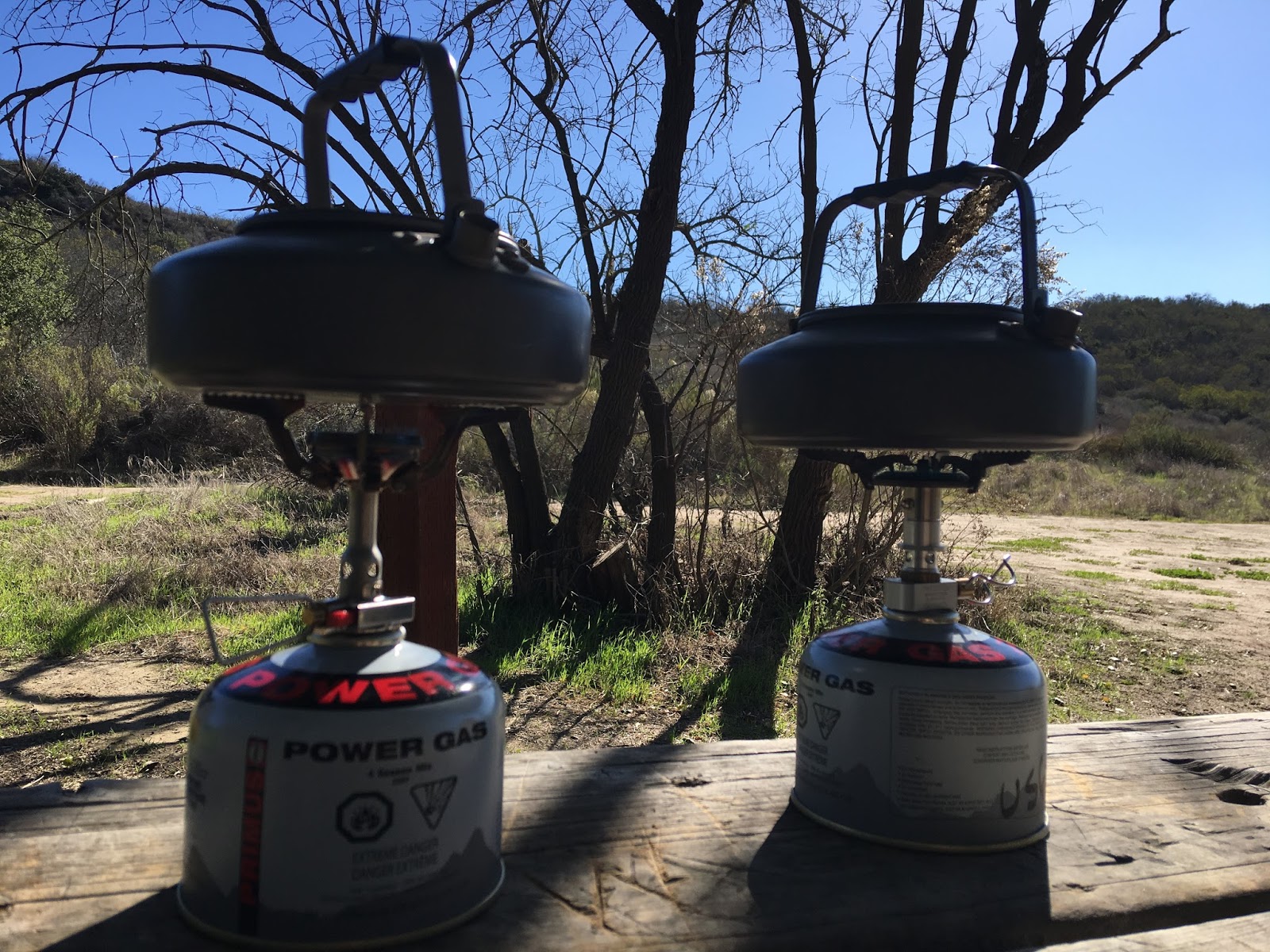
The Soto Microregulator, left, and the Soto WindMaster, right.  The WindMaster is somewhat taller than average.
OK, so what's this about the pot support?  Well, it's detachable.  This is a feature that you're either going to love or you're going to hate.  It works for me, but a lot of people apparently didn't like it or weren't willing to try it.  There are actually two pot supports available for the WindMaster.  I'll discuss the basic one that comes with the stove first and then the optional, larger "4Flex" pot support later.

The basic pot support is actually pretty good.  It provides plenty of support and is pretty grippy.  It supports small diameter pots well, including something as small as a standard Sierra cup.  And it's not hard to take on and off.  All it takes is a little practice.  I can even do it wearing fleece mittens.
The pot support attaches easily with just a bit of practice – even in midweight fleece mittens
So that little metal bit in my left hand, above, is the pot support.  It's kind of a flat color.  If you drop it, it's hard to find.  My solution is to use a Sea to Summit mini carabiner (9 grams) to immediately clip the pot support to the valve handle the second I remove the support from the stove.
A Sea to Summit mini carabiner
In the photo below, you can see the carabiner hanging off the valve handle. The carabiner hanging there takes a bit of getting used to when you turn the valve handle, but it's no big deal.
A Soto WindMaster in use.
Note carabiner hanging on the valve handle.
OK, so I've talked about the relative wind proofness of the WindMaster.  How does it work?  Well, for one, the burner head is recessed which tends to guide the flames up toward the pot and limits the amount that wind can blow the flames off course.  Second, the lower portion of the burner head is angled such that wind naturally flows down, around, and away from the burner head.
The Soto WindMaster, left, has a recessed burner head.  Note that you can barely see the flame.
Most stoves have an open burner head, such as the stove on the right.
Note how the flame on the stove on the right is being blown over to the left by the wind.  Goodbye, heat.
I actually kind of enjoyed watching just how well the Soto WindMaster's burner head worked.  In test after test, I could see an open burner's flame being blown to one side or another whereas the WindMaster's flame was still centered on the pot.

Now, how wind proof is the WindMaster?  Is it as windproof as say the high tech MSR Windburner? Um, no.  No way.  The Windburner is a freaking miracle of windproofness.  If you expect to be in seriously windswept areas and really need just absolutely rock steady performance in wind, then get the MSR Windburner not the Soto WindMaster.

However, the Windburner* is larger, heavier, and more expensive than the WindMaster.  If you do your homework and find that an upright canister stove is right for you, the WindMaster will offer far better performance in wind than other similar stoves.  How do you "do your homework?"  Well, you might check out my post, What Makes a Good Backpacking Stove?

*The Windburner is on sale at REI for $99 right now which is a pretty good price considering that MSRP is $130.
Disclosure:  I receive no remuneration from REI for mentioning them here.  I just happen to know that they have the Windburner on sale right now.  I am however an REI customer, and I do occasionally make purchases from them.
Soto WindMaster, left, with a recessed burner head.  Soto Microregulator, right, with an open burner head.
Note how the Microregulator's flame is blown off to the left whereas the WindMaster's is not.
Much ado has been made about stoves with regulator valves being able to really cook lately.  I kind of laugh.  Yes, Jetboil made a big deal about how you can really control the flame on their relatively new MiniMo regulator valved stove.  Why do I laugh?  Because Soto has been doing it all along. Soto is really ahead of other stove companies in terms of technology, so I laugh when other companies make a big deal about something that Soto has been doing for several years.  Soto would never have put out stoves with crappy burner control like that on the first generation regulator valved Jetboils.
Noodle dish prepared on a Soto WindMaster.
You can actually cook with the Soto WindMaster, to include fine simmering.
Now, another thing about the WindMaster:  The "Stealth" ignition.  Soto's Stealth ignition (found on several Soto stoves) is the best in the industry.  Period.  Nobody's ignition is as sophisticated and reliable as Soto's.  Many companies sort of bolt this big kludgy ignition thing to the side of their stoves and then have a wire running up the side of the burner column.  The ignition system then ends with an exposed wire directly in the flame.  This wire often warps in the heat or snags on things – and fails.  Soto has a much more elegant control and runs their wire up through the inside of the burner column.  Then, at the top of the burner column, instead of a little wire sticking out just waiting to be snagged, they put a much more stable strip of metal that doesn't jut out the way wire ignitions do.  Notice also, in the photo below, that the ignition point is in the center of the burner.  This has two advantages:  1) It's a heck of a lot less likely to snag on something when located in center of a burner than an ignition on the rim of a burner and 2) there's a sort of "island" in the center of the burner head that the ignition point sits in.  The ignition point is less exposed to heat and is less likely to become warped or otherwise damaged.
The ignition point of Soto's Stealth ignition is the strip of silver colored metal (not a wire) in the center of the burner head.
Now, notice something else in the photo, above.  Look at the pot supports.  Those are not that little pot support we saw before.  This is the optional "4Flex" pot support that can be purchased to supplement the pot support that comes with the stove.  The 4Flex offers a wide surface for larger pots.
A 2.6 liter pot on a a Soto WindMaster equipped with the optional 4Flex pot support.  Really stable.
In fact, the supports are not the worry here; the small size of the canister is.
Canister "feet" can help but are not absolutely required.
 I found the 4Flex to be a really nice option with large pots (as in group cooking or snow melting).
The WindMaster's optional 4Flex pot support offers excellent stability for larger pots.
I've gone from skeptic to convert.  I really like the quality and flexibility of the WindMaster – as well as it's ability to handle wind.  If I go out solo or with one other person, I can take the basic pot support.  I don't have to take up a lot of room in my kit with an unnecessarily large pot support.  On the other hand, on trips with a larger group or larger pots – or pans as in fish frying, pancakes, etc. – I take the 4Flex, and then I don't have to worry about my pot being "tippy."  With the 4Flex, even fairly large pots are very stable.  The one thing you might worry about with large pots is not the pot supports at all but rather the canister.  A large pot with a small canister at the base could be a little tippy on uneven ground.  Several companies offer canister "feet" that one could purchase if one were concerned.  I didn't find them necessary,

A final note:  On local hikes, I might do stove testing, but on my "big" hikes where it's a really a special hike, I don't do stove testing.  I take stoves that I like and trust.  The last couple of photos were from my hike on the John Muir Trail this past summer.  In other words, this isn't a stove that I test and then stick on a shelf never to be seen or heard from again.  No, this is a stove I actually use.  I have dozens and dozens of stoves sent to me for free from companies that would like me to do a review.  I can pretty much use any stove I like.  If a stove makes it on a trip where I'm not testing, you know it's a good stove.

The Soto WindMaster

What's Good About It?
  • World's lightest canister gas stove with piezoelectric ignition  (67 g/2.3 oz).
  • Superior wind handling
  • Reliable, sophisticated piezoelectric ignition
  • Good pot stability on both large and small pots with multiple pot support options
What's Not So Good About It?
  • A little on the tall side.
  • More expensive than many comparable stoves
  • The smaller pot support is easy to lose – unless you use a mini carabiner and always clip the support to the valve handle when you take the pot support off.
The Soto WindMaster:  Highly Recommended.

I thank you for joining me on another Adventure In Stoving.

HJ

Disclosures:  I received the WindMaster stove free of charge from a third party (not Soto in other words) for the purpose of this review.  I purchased the 4Flex support with my own money.   I am not compensated for my reviews except for the trivial amount of money I receive from the ads on my blog (about $1.00 USD per day at last check).  The income from my blog pays for fuel and occasional parts and accessories, but I in no way derive my living from my blog.  My blog is basically a hobby which leaves me free to review stoves any dang way I please.  


Appendix – "What Makes a Good Backpacking Stove?"

An evaluation of the Soto Windmaster based on my fourteen point "What Makes a Good Backpacking Stove?" framework.

  1. Suitability – Is this stove suitable for what I want to do?
    • Cooking  – The Windmaster can pretty much support any type of cooking from high heat, rapid boiling and snow melting to slow simmering.  The fine control of the flame is very good.
    • Conditions – Like all upright canister stoves, the WindMaster would not be my first choice for temperatures under 20 Fahrenheit/-7 Celsius.  The WindMaster may be used at all elevations although the piezoelectric ignition will be less reliable above 10,000 feet/3000 meters in elevation.  No matter what elevation one uses a stove with a built in ignition, always carry a second source of ignition (non-piezo lighter, matches, firesteel, etc.).  The WindMaster will handle windy conditions better than most upright canister stoves but would not be a good choice for extremely windy conditions.
    • Capacity  – The Windmaster can easily support pots from about 250 ml (depending on proportions) to about 2000 ml with the basic pot support, but over 1500 ml, you'd have to be a bit cautious about using a small canister.  With the larger 4Flex pot supports, 1500 ml to 3500 ml, probably larger, pots can be accommodated, but one might want to use canister "feet" to make the whole assembly more stable.
  2. Reliability/Robustness – Can it “take a licking and keep on ticking?”
    I found the stove to be quite solid.  Some have complained that the basic pot support is "flimsy."  I did not find it so, and found it to be quite solid once properly emplaced on the burner head.  As with all canister stoves, one must keep the threaded area clean, and one should avoid spilling food on the burner head.  Do not set the stove down in the dirt if you can avoid it.  One should also keep the canister threads clean lest abrasives (dirt, grit, etc.) get into the threads of your stove.  Always use the cap on the canister when not in use.  Avoid Coleman brand canisters which don't have a cap  or save a cap from another brand and use it if you buy a Coleman canister.  Why Coleman doesn't provide a cap on their canisters is beyond me.  Dumb idea, Coleman.
  3. Weight  –  The WindMaster weighs 67 g/2.3 oz which is in line with other major stove brands (MSR, Snow Peak, Optimus, Primus, etc.).  There are titanium stoves coming out of China, some by Fire Maple which is actually a decent brand, that are lighter, but you will sacrifice pot stability and the ability to handle wind.  Some will find this trade off acceptable; others will want to carry the extra ounce to get better pot stability and windproofness.  It is a choice; the choice is yours.
  4. Price – Do I have mortgage my home to afford this thing? 
    At MSRP $75, the WindMaster is in the upper range of upright canister stoves.  The WindMaster offers high quality construction and engineering, good pot stability, an excellent ignition, and superior wind performance.  Some will consider it worth the price; others will not.  Always look for sales. Never be in a hurry to purchase gear.
  5. Stability – Pot stability is well above average for upright canister stoves.  The detailed engineering of the pot supports makes them more grippy than most.
  6. Efficiency (i.e. fuel economy) – The WindMaster has better fuel economy than most upright canister stoves, particularly in wind.  The WindMaster will not have as good fuel economy as an integrated canister stove like a Jetboil  unless one uses a heat exchanger pot in which case the fuel economy of a WindMaster may rival that of a Jetboil.  
  7. Windproofness –  The WindMaster is of a design that gives it better performance in wind than other upright canister stoves.  This is one of the chief features of the stove (hence the name).  One should not use a full 360 degree windscreen with the WindMaster or any upright canister stove.  Overheating the canister could result in an explosion.  See my post on Windscreens for ideas and precautions related to windscreens with upright canister stoves.
  8. Compactness – The WindMaster is reasonably compact for its class, but it is taller than most upright canister stoves.  There are many upright canister stoves that are significantly more packable.
  9. Ease of use – Generally, the WindMaster is a pretty easy to use stove, but it does have the detachable pot support.  I found that I could put on the pot support with one hand, even in midweight mittens, and I didn't think it was a big deal, but some people just absolutely hate the detachable pot support.  You must make provision to not lose the post support.  I clip mine to the valve handle when not in use.
  10. Ease of maintenance/field repair –  Like most upright canister gas stoves, tools and spares are not included with the stove.  Note that in four years of using the stove, I encountered no instances where I needed to perform maintenance or repairs on the stove.  Spares and tools are more typically included with liquid fuel or multi fuel stoves.
  11. Speed – Please refer to the video in the main body of the review.  Basically, I found the stove to be fast.  Boil times will vary with conditions, but the WindMaster is far less affected by wind (the chief enemy of good boil times) than other upright canister stoves.  No, I won't quote an exact time.  Such quotes are fairly irrelevant since there are no standards for test conditions.  The water temperature, air temperature, fuel used, valve setting, elevation above sea level, and type of pot will all cause the boil time to change.  I found boil times to be in line with other major stove brands and faster in wind.
  12. Noise – Average. About the same as most ported gas stoves, i.e. fairly quiet.  Not as quiet as an alcohol stove but no where near as loud as a liquid fueled stove with a "roarer" type burner (e.g. Primus Omnifuel, MSR XGK or DragonFly, Optimus Nova, etc.)
  13. Fuel considerations (availability/versatility/morality) 
    • Availability.   The WindMaster uses standard threaded canisters.  One can use any reputable brand of canister gas.  See Can I Use Any Brand of Gas Canister?  Standard threaded canisters are widely available in the United States, Canada, the UK, Australia, New Zealand, and Japan.  Availability may be limited elsewhere.  In some areas, particularly in France, non-threaded canisters are the norm.  In the Middle East and Eastern Europe, only puncture type canisters (no valve) may be available.  No matter where you are planning to go, check the availability of fuel.
    • Versatility.  Generally, only threaded canisters may be used, but there are adapters that will allow one to use non-threaded valved canisters, puncture type canisters, 100% propane canisters, and 100% butane bayonet-connector type canisters.  Always check availability of adapters before embarking on a trip.  If possible, obtain and test adapters in advance.  Some adapters from China are of extremely poor (i.e. dangerous) quality.  Liquid fuels such as alcohol, gasoline, or kerosene may not be used.
    • Morality/Ethics.  Canister gas is generally considered to be better for the environment than wood fires. Use of wood fires a) often lead to an area being stripped of wood and b) have significantly higher fire danger.  However, on the other hand, while canisters can be re-cycled, most of the canisters wind up in the land fill.  Even recycling of canisters takes energy and other resources and is not as low impact, environmentally, as a liquid fueled stove or alcohol stove.  Some people have gone back to liquid fueled stoves (gasoline or kerosene) or alcohol stoves to reduce their environmental impact. 
  14. Safety/Legality.  
    • General.  Standard threaded canisters are generally considered safe; however, do not allow the temperature of the canister to exceed 50 degrees Celsius (122 Fahrenheit).  Leaving a canister in the back window of a car on a hot day is not a good idea.

      The valve on a canister can stick in the open position when you disconnect the stove.  NEVER disconnect the stove near a candle or other open flame or hot surface.  Disaster may result if the valve sticks open.  If the valve does stick in the open position, simply replace the burner on the canister and try again.  If the valve on the canister continues to stick, leave the burner on the stove and control the gas with the valve on the burner.
    • Fire safety and regulations.  In terms of fire safety, canisters are fairly safe, but care must be taken not to allow the canister to tip over while the stove is in use.  If the liquid fuel inside the canister hits the flame, a fireball several feet in diameter may erupt.  This may cause an injury, a fire, or worse.  Canister stoves are generally allowed during most fire bans in the western United States whereas alcohol and wood stoves are generally not allowed.  Regulations may vary elsewhere.  A California Campfire Permit is required in California for stoves of all types.   There are also total fire bans that are sometimes invoked.  Always check with the local land management agency where you intend to hike.
      Canister stoves do not require priming and are free from the dangers of priming.

Sunday, December 3, 2017

Deal Alert! (Soto WindMaster on sale)

The Soto WindMaster is on sale for $55 on Massdrop (a "group buy" site) – if just ten people sign up.  That's an outstanding deal for a stove that often retails for $20 more (i.e. $75 is normal).

Adventures in Stoving is typically about evaluating stoves, not about promoting sales, but a lot of people have expressed interest in the WindMaster, and this is as good of a deal as I've seen.

Please understand that I derive no percentage of the sales.  There are no "affiliate links" or anything like that.  This is just a good deal I noticed.

Links

Note that if you use that link (if you aren't already a member), you get a $10 credit, and I also get a $10 credit. 
Cold weather testing the WindMaster.

The Stove
It's no secret that I consider the Soto WindMaster to be the best quality upright canister stove on the market today.  See my review of the Soto WindMaster.  It's wind resistant in a way other stoves of this class just aren't (well, except for its budget minded cousin, the Amicus), and it's a good balance of versatility, efficiency, and weight.  Not only that, it's just quality in every respect.

The Soto WindMaster
Rumor Control
There were rumors that Soto was going to discontinue distribution of the WindMaster in North America, but, no.  I spoke to the Soto rep, and Soto has no plans to discontinue the WindMaster.

Simul-testing the WindMaster against a "control" stove.
The WindMaster is at left.
No matter the conditions, the WindMaster always came out ahead – while using less fuel.

I hope this is helpful to someone, and I do hope you will forgive the commercial intrusion on this, a site focused on what we do in our lives outside of work (well, unless you're a guide or something).

HJ


Performance testing the Soto WindMaster against a "control" stove.
Note:  The individual in the photo is a highly trained stove professional.
Don't try this at home (seriously, go for a hike; you have a much better stove already in your kitchen at home).
Apologies for the waste generating food shown in the photo.  We got a free case because they were due to expire.

Thursday, November 17, 2016

What's All This About the Soto Amicus?

OK, so, what's all this about the Soto Amicus?  I mean why all the fuss?  There are dozens of upright canister gas stoves available out there.  Primus, MSR, Optimus, Snow Peak, Jetboil, etc. – in short, all the major stove companies – have upright canister stoves out on the market, in fact, most of those companies have multiple stoves available.  So who cares about just one more upright canister gas stove?  Big deal.  Yawn.

Well, maybe.  But maybe not.  Maybe there's more to it than that.  Let's keep reading, and we shall see.

UPDATE 18 December 2017:  My finalized Review of the Soto Amicus is now available.
The New Soto Amicus
OK, so why am I excited?  Well, I'll tell you.  But rather than a long winded technical explanation, just watch this short, three minute video, and then let's go from there.

OK, now did you see that in the video?  The stove on the left, the Soto Windmaster, beat the stove on the right by almost a full minute.

And did you catch what I said?  The Windmaster won every time.  And believe you me, I ran test after test after test.  Due to the circumstances of my life, this stove, the Windmaster, is probably the most thoroughly tested of any stove I own.

Let me explain:
I had a job end a few years ago.  I had been with the company for over 21 years, but they let me go.  I hadn't looked for a job in a long, long time.  The world had changed.  There really wasn't much of an internet when I had last looked for job.  Now I was a tech worker around 50 years old.  There's a tremendous prejudice in the tech sector against older workers.  I had three mouths to feed.  I was desperate for money.  When I had work, I would work as many hours as humanly possible.  So, sorry stove hobby, but you're on hold.

But of course I never stopped hiking during that time.  Job hunting is the very worst sort of mental torture.  My escape was to set aside one day per week for hiking.  And I brought stoves.  And on many of those trips, this rather intriguing Windmaster.  So this stove is tested.

OK, so, um, weren't we talking about the Amicus?  Why are you going on and on about the Windmaster?

Oh, right.  Now, the Windmaster is actually the best upright canister stove available today in the US market (in my opinion) – and it isn't selling well.  Why?  Well for one, it's pretty expensive for an upright canister stove.  At $75 MSRP, it's tough to sell stoves when one can just go get an MSR PocketRocket or a Snow Peak GigaPower for about $40.  [Note:  Campsaver* has the Windmaster and the Amicus for way less than MSRP].  Two, the Windmaster has a detachable pot support (easy to lose) which just about nobody likes.  Three, the Windmaster is a pretty tall stove and doesn't fit into a lot of smaller pots.

*Disclosure:  I have no relationship whatsoever with Campsaver.  I don't get a nickel for telling you about them.  I'm just telling you because they've got a frickin' steal of a deal going on right now as I write this. 

So, enter the Amicus.

Why am I excited?  I'll tell you.  Just look at the burner head.  It has the same type of burner head as Windmaster.
The recessed burner head of the Soto Amicus.
Gone is the detachable pot support, and the MSRP is now thirty dollars less at $45.00.  Now, that's a competitive price when you consider that the new MSR Pocket Rocket II (coming in 2017) also has an MSRP of $45 and the new JetBoil MightyMo has an MSRP of $50.  Soto has finally gotten real with their prices.

So, if this stove has significantly better features and wind handling properties than the competition, then I think that Soto could really go places with this one.  I'll report more on that as I go through my review process.  Stay tuned.

Summary and Next Steps
The above video shows why I think the Soto Amicus has real potential.  Soto really has developed a wind resistant burner technology.  Will the Amicus be as good as the Windmaster?  I honestly don't know. Yet.  But I should have a pretty good some time later this year after I've taken it out into the field over the coming weeks.  Stay tuned.

Good points about the Amicus:
  • The price is good ($45 MSRP with piezo* vs. $75 for their last stove).
  • The weight is in range with the competition (about 2.7 oz/75 g) – and the Amicus has a piezoelectric ignition* whereas many of its competitors do not.
  • Far more compact than its predecessors.
  • Good pot supports (finally!)
  • Best in the business piezoelectric ignition*. Nobody even comes close to Soto's engineering here, not even close.  
  • Potentially outstanding wind resistance (I haven't completed my field tests yet, so it's just "potentially" at this time). 
Soto may have a real winner here.

OK, enough discussion.  I need to get out there and complete my field trials.

As always, I thank you for joining me,

HJ

*A version of the Amicus without a piezoelectric ignition is available for $5 less.

The best in breed "Stealth" ignition of the Soto Amicus.  Nobody else even comes close.
No little ceramic doohickey to break.  No unsupported, exposed wire constantly in the flame.
No big plastic or metal thingy glommed onto the side of the burner.

Thursday, December 29, 2016

Deal Alert! (Stove on Sale)

I'm going to depart from the normal here and put a commercial link in a blog post.  May my readers forgive me.

Please understand that I derive NO BENEFIT from this post nor if you make a purchase*. This is just a good deal I noticed.

UPDATE 30 December 2016:  I just noticed today that Campsaver has also placed the smaller but similar Amicus on sale as follows:
  • Version without ignition:  $32.
  • Version with ignition:  $36

Cold weather testing the WindMaster.
It's no secret that I consider the Soto WindMaster to be the best quality upright canister stove on the market today.  I believe I said as much in my review of the WindMaster.  It's wind resistant in a way other stoves of this class just aren't (well, except for its budget minded cousin, the Amicus), and it's a good balance of versatility, efficiency, and weight.  Not only that, it's just quality in every respect.
The Soto WindMaster
That said, Campsaver.com has the Soto WindMaster on sale for about $20 less than MSRP.  For your convenience here is a link:  Soto WindMaster on sale at Campsaver.

As far as I know, Campsaver is a reputable establishment.  Friends of mine have had good experiences.  However, note that I have never done business with them.  Caveat emptor.  This is information only; do with it what you will.

Simul-testing the WindMaster against a "control" stove.
The WindMaster is at left.
No matter the conditions, the WindMaster always came out ahead – while using less fuel.

I hope this is helpful to someone, and I do hope you will forgive the commercial intrusion on this, a site focused on what we do in our lives outside of work (well, unless you're a guide or something).

HJ

*Note to Campsaver if you happen to read this:  I can't be bought, but it wouldn't hurt you to try, now would it?  I like dark chocolate.  :)    Seriously though, Campsaver, I've been Jonesing like mad to have a look at one of those Optimus Polaris Optifuel multi-fuel burners.  Send me one, and I guarantee all other stoves will go on hold.  I will straight away review the Polaris.  I'm completely serious about this.  You can leave a comment below and I'll get an email and physical address to you forthwith.

Performance testing the Soto WindMaster against a "control" stove.
Note:  The individual in the photo is a highly trained stove professional.
Don't try this at home (seriously, go for a hike; you have a much better stove already in your kitchen at home).
Apologies for the waste generating food.  We got a free case because they were due to expire.

Sunday, December 18, 2016

Review: The Soto Amicus

Who is making the highest quality backpacking stoves available today?  At least in the US market, it's Soto Outdoors of Japan.  Their latest entry is the Soto Amicus (OD-1NV), an upright canister stove.

Note:  In addition to this review, I have two preliminary posts on the Soto Amicus that contain additional information and photographs:


The new Soto Amicus
What's an upright canister stove?  Please see my recent blog post:  What is a Remote Canister Stove? which describes the two major types of canister gas stoves (upright and remote) and lists the advantages and disadvantages of each.  It's worth knowing the difference.

Overview
The Soto Amicus is a small, relatively lightweight, relatively inexpensive upright canister stove.  There are dozens of such stoves available on the market today.  How is the Amicus any different from any other stove?  Well, the Amicus is the best built of the lot and has a really nice design, but that's not what sets it apart.  Soto claims that they have developed a new type of burner head, one that can handle wind better than other stoves.  This windproofness would set the Amicus apart from other stoves.  So, either the Amicus handles wind better or it's really nothing special.  Therefore, wind testing was the major focus of my field testing.  Is Soto just "blowing smoke" or are they really on to something here?

See the sections on "Wind Testing" and "The Bottom Line in Wind," below.
Simul-testing the Soto Amicus vs. the Optimus Crux at Crystal Cove State Park
Build Quality
Who is the largest auto maker in the world?  Well, it used to be General Motors, an American corporation, but now, it's Toyota, a Japanese corporation.  Why?  They build a better automobile.  We've seen this transition from American corporations to Japanese corporations in many fields such as bicycles, electronics, fishing gear, etc.  Typically, the Japanese engineering, ergonomics, and build quality is just plain better, and people are willing to pay more for it.

We may now be seeing this trend in backpacking gear as well.  Montbell (of Japan) is a much sought after brand among backpackers in the know.  Evernew (again, of Japan) makes some of the best ultralight titanium pots.  And Soto makes the best backpacking stoves available today.
The Soto Amicus deserves an award for excellence in engineering.  Such attention to detail.
Pot Supports
Soto's engineering and build quality is beyond reproach, but that doesn't mean that they've always read the market perfectly.  Their first upright canister stove available in the United States, the Micro Regulator, was a good stove and was met with wide acceptance, but there were those who found the pot supports "fiddly" (they had to be first moved to a particular spot on their arms and then rotated into place) and didn't like that sometimes the pot supports would flop down when there was no pot on when the stove was moved.
.
Soto then came out with the WindMaster, which I consider to be the best upright canister stove available in the US market today.  For those who are interested, I have a review of the Soto WindMaster available here on my blog.  Again though, the pot supports were "different."  They detached when the stove was packed away.  The detachable pot supports could easily be lost if one were not careful.  I myself was not bothered by this; I simply used a micro carabiner to clip the detached pot support to the valve handle of the stove the minute I took the pot support off.  However, a lot of people just absolutely hated this feature.

On this, the Soto Amicus, Soto's third entry of this type into the US market, I think they've finally gotten it right.  One does rotate the support into place, but on the Amicus, one does not have to find the "sweet spot" on the pot support to get it to rotate.  One simply pushes it up into place in one smooth, effortless motion, and, once in place, they're not going anywhere.  One has to push up and then push out, against the spring loading, to retract the pot support.  It's easy to retract the pot support, but it's unlikely to happen on its own.
The spring loaded pot support rotates into place in one smooth motion and then clicks onto a hook and stays put.  Nice.
The pot supports are literally so simple that a child could do it.
The pot supports?  So easy that a child can do it.
And they work.  Not only are they easy to extend and retract, not only do they stay in place once set, they're just danged good pot supports.  Of its class, the Amicus has the best pot stability that I've seen.  The WindMaster, if one gets the optional 4Flex pot support, has far better pot stability, but the WindMaster is a larger, more powerful, ultralight stove and is really not in the same class as the smaller, budget minded Amicus.  The only stove that really comes close to the Amicus in this class is the Snow Peak GigaPower.

Part of why the Amicus has such good pot stability is that it has not the typical three but rather four pot supports.  The Amicus also has more "teeth" on it's pot supports than most stoves, and those teeth are precisely made, gripping pots better.  Many pot supports on other stoves are a bit rounded off, and they just don't grip as well.
My daughter demonstrating the stability of the Soto Amicus with a 1.9 L pot, which is a pretty good sized pot for such a little stove – but it's really not a problem with the Amicus.
Now, I've said that the Amicus has good pot stability.  Does that mean you can use any size pot you like?  Probably not.  Something on the order of a 3L pot is probably a practical upper limit, and you'd want to be careful when stirring.  I compared the pot stability of the Amicus to each of the following stoves.  The Amicus had better pot stability with a wider range of pots than any of these stoves except the WindMaster (with 4Flex support mounted) although the GigaPower came close:
  • MSR Micro Rocket
  • MSR Pocket Rocket
  • Optimus Crux
  • Snow Peak LiteMax
  • Snow Peak GigaPower
  • Soto Micro Regulator
  • Soto WindMaster
Compactness/Packability
The Amicus is a fairly small stove.  It's about the width of my hand.
The diminutive Amicus.  It packs down small.
When the pot supports are folded away, it packs down pretty small.  It fits easily in a 550 ml mug type pot.  However note:  While I could get the Amicus and a 110 g sized canister of fuel into the 550 ml mug type pot, I could not close the lid.  However also note, I'm not aware of any stove that could fit in my little mug type pot along with a 110g canister with the lid closed although the Snow Peak LiteMax comes very very close.  Even the Optimus Crux, which is a pretty flat stove when the burner is folded, cannot fit in this 550 ml mug with a canister and have the lid closed.  The Amicus is about as packable as an MSR Micro Rocket.  A Snow Peak GigaPower is slightly more compact.  An Amicus far more compact than the MSR Pocket Rocket.  The Soto Amicis is more compact than either the Soto Micro Regulator or the Soto WindMaster.
The Soto Amicus in a small 550 ml mug type pot.
Special Features
One of the outstanding features of the Soto line of upright canister stoves is their "Stealth" piezoelectric ignition system.  The wire is run up through the burner column (rather than being on the outside), and the spark point is in the center of the burner rather on the rim.  The Soto ignition is far less likely to snag on things and is less obtrusive.
The simple red button and housing of the Amicus' excellent piezoelectric ignition.
Notice how there are no exposed wires and that there is nothing mounted to the side of the burner.
With the spark point of the Stealth ignition located in the center of the burner, it is not directly in the flame, giving it an edge in reliability over other ignition systems.
The silver strip of metal in the center of the burner head is the spark point of the Amicus' excellent Stealth piezoelectric ignition.
Of all the stoves I have in my collection that have various forms of piezoelectric ignitions (I have at least 10), the Soto ignition system is far and away the most reliable, most sophisticated, and least obtrusive.  No one else in the industry even comes close to the quality and reliability of the Soto Stealth Ignition.

That said, "good" and "perfect" are not one in the same.  The Stealth ignition is the best in the business (nobody else really comes close), but even the best ignition is subject to breakage or failure.  Always carry a second (or third) source of ignition such as a lighter, matches, or fire steel.

Note that the Stealth ignition is optional.  A version of the Soto Amicus is available without the ignition.

Weight
Per the Soto website:
  • The Soto Amicus weighs 2.6 oz/75 g in the version without the Stealth ignition.
  • The Soto Amicus weighs 2.9 oz/81 g in the version with the Stealth ignition.
However, on my scale, the Amicus with ignition weighs 2.8 oz/78 g.  For comparative purposes, I'll list the weights of several stoves in the same class.  For reference, I'll also list the weights of the other two upright Soto canister stoves even those are higher end stoves and are not in the same class.  These weights were all measured in grams by me on my scale.  Weights per the manufacturer may differ.
StoveGramsOunces
Soto WindMaster (with ignition)662.3
Soto Micro Regulator (with ignition)692.4
MSR Micro Rocket (no ignition)732.6
Soto Amicus (with ignition)782.8
Snow Peak Gigapower  (no ignition)863.0
MSR Pocket Rocket  (no ignition)863.0
Optimus Crux  (no ignition)883.1

The weight of the Amicus is generally in line with other stoves of its class, however there are higher end stoves like the Snow Peak LiteMax that are quite a bit lighter. There are also some really inexpensive stoves coming out of China like the FMS-116T at 1.7 oz/48 g (sold in the US as the Olicamp Kinetic Ultra), the FMS-300T at 1.6 oz/45g (sold in the US as the Olicamp Ion Micro), or the incredibly light BRS-3000T at 0.9 oz/25 g.  Note however that none of the stoves out of China has anywhere near as good pot stability, and neither do they have the sophisticated ignition of a Soto stove.  But each to his or her own I suppose.

In addition, it is worth noting that Japan has some of the highest gas stove safety standards in the world.  I am not aware of any Chinese stoves that have been able to meet the strict Japanese standards.  I have seen some US (Coleman) and European (Primus) brands on my trips to Japan.

The BRS-3000T is not to my knowledge certified to operate in the US. You can get one sort of "under the table" on eBay or Amazon, but no company sells it in the US.  If the stove causes an injury or fails, you have little legal recourse.

Cooking Ability
Canister gas stoves generally cook well.  They have a highly adjustable flame.  If you adjust the flame well and have appropriate cookware, there isn't really much in the way of limitations to what you can cook.  The Amicus is no exception.  On the Amicus, I was able to get a barely there flame capable of a very low simmer.

Wind Testing
OK, now to the heart of the matter.  As I said in the beginning, either the Amicus lives up to its claims of windproofness or there's really nothing that sets it apart from a whole host of similar stoves.  Sure, the Amicus has better build quality and the really nice Stealth ignition – which absolutely should be considered when evaluating a stove, but those qualities alone aren't enough to make the Amicus truly stand out.  On the other hand, Superior wind resistance would absolutely put the Amicus ahead of the pack.

But first, why should anyone care about wind?  Well, in the extreme, a stove can just plain blow out, and blow out so often that one just can't cook with it.  See the rather dramatic first video in Windburner vs. Jetboil Wind Testing.

But that's the extreme case.  What about more typical winds?  Well, depending on the circumstances, wind can really cut your fuel economy.  Instead of the heat going into the pot, the heat gets blown out and away and is wasted.  Whereas you might normally be able to boil 500 ml of water with 7 g of fuel, in wind, you might take 10 or 11 g of fuel.  If you normally use 25 g of fuel per day, you're on a four day trip, and you're carrying a 110 g canister of fuel, you can't afford to be burning an extra 3 to 4 g of fuel per 500 ml boiled.   At 3 to 4 g extra per 500 ml boiled, you're talking about something like 6 to 8 g extra of fuel per day which over four days equates to 24 to 32 g more fuel needed than usual – you're going to run out of fuel before the end of your trip!

Note:  The above numbers are intended to be illustrative.  I chose 25 g per day because 25 is easy to work with when you have a four day trip and canisters are between 100 g and 110 g in capacity. They are reasonable numbers, but they are not not actual observations.  See Calculating the Fuel Needed for a Trip for how to calculate gas consumption for a trip and for how I got the quantity 25 g.

A stove with better wind handling has more constant fuel consumption which allows you to plan more accurately so that you don't run out of fuel.  Of course you're going pick a sheltered spot to cook and all that, but still, wind can make your stove unpredictable.  So a stove that can handle wind well is a desirable thing.

So, how did the Amicus do?  Well, check out the below video.  I'm just using my iPhone to shoot the video, so you'll have to turn up the sound.
Basically, I found Soto's claims to be true.  This isn't all that surprising given that  I had already established that their WindMaster was better in wind than other stoves.   See the video in my review of the Soto WindMaster.  But I couldn't just assume that the Amicus would be as good.  Yes, the Amicus did have the same type of semi-enclosed, concave burner head, but the Amicus' head was smaller and farther away from the pot.

How did I establish that Soto's claims of superior wind handling are true?  By running simultaneous test after test after test.
Side by side, simultaneous testing of the Soto Amicus vs. the Optimus Crux.
My "baseline" stove was the Optimus Crux.  Both the Crux and the Amicus are rated at 10,200 BTU's.  In still air, they both boil water in about the same time; there's no significant difference in boil time between the two.

However, as soon as the wind kicked up, the Soto Amicus always pulled out ahead.  Both stoves took longer to boil in wind, but the Crux was far more affected.  Just in observing the flame, I could see that the Amicus' flame was far less affected by wind.
A highly trained Adventures in Stoving engineer observing the flame characteristics of the Soto Amicus in wind.
Not only could I visually observe that the Amicus' flame was far less affected, I could run the Amicus at a far lower setting.  As low as I could turn down the flame, the Amicus never blew out.  Not so with the open burner Crux.  I was doing a simmer test with the Crux, the flame was steady and had been running for some time, but when a gust of wind came through, the Crux blew out, and I had to re-light the stove.

But it is the boil times that speak the loudest.  The normally equal Amicus would boil 40 to 45 seconds faster than the Crux in moderate winds with occasional gusts.  Clearly, the Amicus is the better stove in wind.

Are these results fairly universal?  I mean I just tested the Amicus against one stove, right?  Well, it is true that I did test against just one stove, but burner heads are fairly generic.  With open burner heads, the flames are just more vulnerable.  In addition, I got the same results with the WindMaster (which was tested against a different stove).  The Windmaster has the same type of burner head as the Amicus.  I am therefore pretty confident that the Amicus will fare better in wind than any unprotected burner head.

Now, does this mean that you can cook in gale force winds with the Amicus?  Uh, no.  If you want that kind of windproofness, you've got to go with something like the MSR Windburner or the MSR Reactor.

The Bottom Line in Wind
The Amicus will be far more consistent and predictable than other stoves, giving you the ability to a) plan more accurately, b) conserve fuel, and c) simmer better in wind.

Price
The $40 MSRP of the Amicus (without ignition, add $5 for the ignition version) is something of a first for Soto.  Soto has heretofore introduced fairly high end stoves.  Their first upright canister stove available was the Micro Regulator, MSRP $70, and their second was the WindMaster, MSRP $75.  The Amicus, with ignition, has an MSRP of $45, and without ignition, the MSRP is $40.  This is a huge jump in affordability for a Soto stove, and you're getting a heck of a lot of quality and functionality for that low price.

As of 7 December 2017, Backcountry Edge has the Soto Amicus on sale for $31.96 without ignition or $35.96 for the version with the ignition.  That is a steal of a deal.
Note:  I have a) no financial relationship with Backcountry Edge, and b) I have never purchased anything from them.  This is just information; this is not a recommendation. Caveat emptor.

Summary  – The Soto Amicus

What's good about it?
  • Excellent build quality
  • High quality piezoelectric ignition system
  • Best of breed pot stability
  • Good packability/compactness
  • Easy to use, well thought out pot supports (I think they finally got it right with the Amicus)
  • Affordable (excellent value for the dollar compared to other major stove company prices)
  • Clearly superior wind resistance

What's not so good about it?
  • It's a little heavier than I would like.

The Soto Amicus:  Highly recommended

In conclusion, as I reflect on the Soto Amicus, I find that there isn't much that I dislike about it except that perhaps it could be a bit lighter.  It's a nice stove that's head and shoulders above the other stoves in its class.

As always, I thank you for joining me.

HJ

Appendix I – Technical Data

Manufacturer:  Soto Outdoors
Date Available:  Currently available
Manufacturer's Website:  http://www.sotooutdoors.com
MSRP:  $40 (no ignition); $45 (with Stealth ignition)
Weight (measured):  78 g/2.8 oz
Materials:  Primarily steel
Packed dimensions:  1 9/16" x 1 9/16" x 2 7/8" (40 mm x 40 mm x 73 mm).
Unpacked dimensions:  4 1/8" x 4 1/8" x 3 5/16" (105 mm x 105 mm x 84 mm).
Size/Model tested:  The version with the Stealth ignition.
Requirements:   A standard threaded canister of gas (sold separately).
Warranty Information:  Contact Soto Outdoors through their website (see above).
Colors available:  Silver.

Appendix II – Disclosures

The stove used in this review was provided by Soto Outdoors at no cost to me.  Inasmuch as I own three other Soto stoves as well as over 100 other stoves of various types, sizes, and vintages, a free stove is highly unlikely to influence my review one way or the other.  I have reviewed this stove as objectively as I am able.  I have had no business dealings with Soto Outdoors other than to contact them in order to obtain the stove used in this review.  I receive no remuneration from Soto or anyone else for my reviews.  I receive no benefit when someone purchases a Soto stove.  I do own multiple Soto stoves; all such stoves were obtained through third parties except the stove used in this review.

In addition, just so you know, I earn very little from this blog – typically about a dollar a day, maybe a little more.  I've earned $30.71 according to Google for this month.  That's enough to pay for hosting fees and for fuel, so in that sense the blog is self-supporting, but that amount of money is nothing when one has a family of three to feed, house, etc.  Basically, this is my oddball little hobby, and that's about all it is.

Appendix III – Calculating Fuel Needs

This section has been moved to a separate blog post:  Calculating Fuel Needs.