QuietStove.com

Showing posts sorted by relevance for query refilling. Sort by date Show all posts

Thursday, January 19, 2012

Refilling Gas Canisters

I refill my own gas canisters.  This procedure is not recommended by any manufacturer.  There may also be certain legal sanctions against refilled canisters.  I'm not a lawyer, but my understanding is that in the US refilled canisters may not be transported across state lines and that refilled canisters may not be sold.

UPDATE 26 March 2017:  There is a another method of canister refilling, a method using the G-Works Gas Saver.  The G-Works Gas Saver is cheaper and easier to use than the adapter I used in the below post.  The G-Works Gas Saver is also better in that it does not use 100% butane (which is only good for warmer weather).  Please see:  The G-Works R1 Gas Saver – Refilling Backpacking Canisters II.

There are certain dangers that go along with using gas, even if you're using your stove in exactly the manner prescribed by the manufacturer.  Gas is flammable.  Gas can explode.  Know and understand the dangers before working with gas.

If one chooses to refill his or her own canisters, there are certain additional dangers including but not limited to:
  1. Overfilling.  If you fill a gas canister beyond it's stated capacity, the internal pressure may cause the canister to leak, burst, or explode.
  2. Gas leaks.  Gas may escape during refilling with or without equipment failures or malfunctions.  Such gas could ignite or explode.  Leaking gas can also be very very cold, and cold injuries could result.
  3. Damage to valve or threads.  The valve or threads could become damaged or worn during refilling.  No problem may occur during the refilling itself, but the damaged threads or valve could be hazardous later on.
  4. Refilling with gases with too high a vapor pressure.  Canisters come with a specific mix of gases.  If one were to refill with different gases or a different mix of the same gases, the vapor pressure of the resultant mix might exceed the strength of the canister.   Do NOT fill backpacking type canisters with 100% propane under any circumstances.
Clearly, there are dangers to canister refilling.  If you choose to refill gas canisters, you are making a decision to engage in a practice that you know to be dangerous.  If you of your own free will choose to engage in a practice that you know to be dangerous, don't blame me or anyone else for your choices.

That said, I will describe how I refill canisters.  I will also describe what steps I take to partially mitigate the dangers of refilling, but understand that no matter how safe your procedures are, refilling gas canisters is by its very nature dangerous.  You might be able to somewhat reduce the danger, but refilling is dangerous no matter what.

Step one is of course to get an empty canister.  Today, I'm going to refill a Coleman brand standard threaded 220g canister.

Caution
The newer orange label Coleman canisters do not work with many brands of stoves. The older green label Coleman canisters seem to work fine.
A Coleman brand 220g standard threaded gas canister.
The first step in refilling is to weigh the canister.  Why weigh the canister?  I weigh the canister to establish a maxium full weight.  You do NOT want to overfill the canister.  The best practice is to weigh the full canister when you first bring it home from the store.   The weight of the full canister when you bring it home from the store should be considered the maximum full weight.  

What if I forgot to weigh the canister when it was new?  Well, if you weigh the canister when it is empty and then add the capacity of the canister, in this case 220g, then you should also be able to determine the maximum full weight of the canister.
The empty weight of a Coleman 220g canister is approximately 143g 
The empty weight of a Coleman brand 220g canister is 143g.  The capacity is 220g.  Therefore, the maximum full weight is 363g.  Do NOT exceed the maximum full weight when you refill.  If you exceed this weight, the pressure inside the canister may exceed the strength of the canister.  If the canister leaks, bursts, or explodes, very serious injuries could result.  Do NOT exceed the maximum full weight of the canister.

Next, I mark the weights on the canister.  I tend to lose slips of paper, so I mark the canister itself.
The empty and full weights, marked directly on the canister.
Next, I mark the canister as refilled by writing an "R" on the bottom of the canister.  I then put a hash mark next to the "R" every time I refill the canister.  One hash mark indicates one refill, two hash marks indicates two refills, and so on.  
An "R" on the bottom of the canister indicates that the canister has been refilled.  Hash marks indicate the number of refills.  This canister has been refilled one time.
Eventually the valve may become weakened with use.  After I've refilled a canister 12 times, I take the canister to the recycling center.  Twelve is an arbitrary number, but it is a relatively low number.  So far twelve has been a safe number.  I visually inspect the canister and threads/valve before refilling. If it looks bad, it is bad, and it goes in the recycle bin.

Now, after all that, I take out my refiller.
A refiller for standard threaded gas canisters.
I bought this refiller via eBay seller world_wide_2009 who apparently is in Japan.  I believe I paid $37.00 USD for the refiller.  I've had the refiller for at least two years.  With this somewhat expensive but high quality refiller, I feel like there is a) a reduced risk of damaging the threads or valve on a receiving canister, and b) very little gas leaks -- about the same amount as would normally leak when hooking up or unhooking a stove.  Very little in other words.  I've seen lots of scary looking homemade rigs of questionable quality.  I personally would rather pay the extra money and do it right. 

The instructions that came with the refiller were in Japanese but did include helpful pictograms.  Notice that I have the weight written on the refiller itself (88g).  While I'm in the process of refilling, I can weigh the canister without removing the refiller.  I just subtract 88g from the weight displayed on the scale in order to know the weight of the canister I'm in the process of refilling.

Note in the above photo that the connector shown attaches to a standard threaded backpacking type canister.  What does the other side connect to?
This side of the refiller connects to 100% butane canisters.
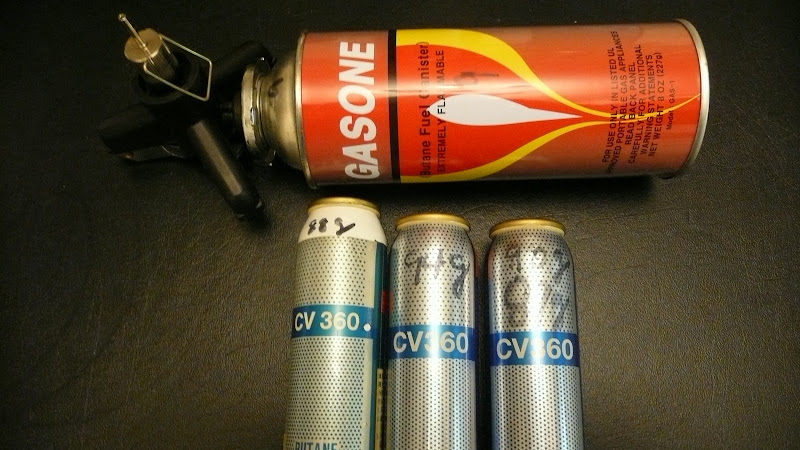
The opposite side of the refiller connects to the inexpensive 100% butane canisters of the type used in the restaurant industry.  Why butane?  Well, first butane is cheap.  If you're going to do your own refills, then you'd better have a source of gas cheaper than backpacking canisters.  If your refill gas isn't cheaper, why would you refill?  You'd just go buy the regular backpacking gas.  In my area, 227g of butane is $1.25 USD.  Backpacking canisters are about $5.00 for 110g or $6.00 for 220g.  100% butane is far cheaper.  Personally, I use 110g canisters more than any other size.  With refilling, I'm in effect paying $0.63 per 110g canister.  If you saw perfectly good 110g canisters on sale for $0.63, wouldn't you pick a few up?  I bet most people would.  My canisters are always on sale for $0.63.  I never hesitate to take out the gas stove whether on a day hike or a backpacking trip.  You want another cup of coffee?  Sure!  Why not?  How about two?  I rather like having an abundant source of cheap gas.  YMMV.  Each to his or her own.

Second, butane is relatively safe.  Pick up one of those little clear plastic cigarette lighters some time.  Hold it up to the light.  That clear liquid you see in there is butane.  Of the gases commonly used for backpacking canisters, butane has the lowest vapor pressure.  If that little cheap plastic lighter can hold the pressure of butane, your steel backpacking canister certainly can.  No matter what mix originally came in your backpacking canister, butane will have a lower vapor pressure.  Butane is pretty safe to use for refilling.  Do NOT fill backpacking type canisters with 100% propane under any circumstances.

The next step in refilling is to hook everything up.  First I screw the refiller onto the receiving canister.
The refiller screwed on to an empty 220g backpacking type gas canister
Next, I hook up the donating butane canister.  The larger hook on the connector clips onto the collar on the butane canister.
The collar on the butane canister clips on to the larger of the two hooks on the connector of the refiller.
The smaller of the two hooks on the refiller's connector slips through the notch on the collar of the butane canister.
The smaller of the two hooks on the refiller goes through the notch on the butane canister's collar.
The canister is then rotated to the right approximately 1/16th of a turn, locking the canister into the connector on the refiller.
The butane canister turns to the right and locks in place.
When all is said and done, the rig looks like this:
A refiller all hooked up and ready to transfer fuel.
Now, simply open the valve, and gravity will do the work for you.  The liquid butane in the donor canister will flow into the receiving canister.  Recall though that there is one complication:  There is a vapor feed tube inside the canister.
There is a plastic vapor feed tube inside the butane canister.
That tube aligns with the notch in the collar of the butane canister.   For maximum transfer, you want to tilt the canister at a bit of an angle with the notch on the collar of the butane canister pointing down
Prop the canister at a steep angle as shown with the notch pointing down.
The transfer is very slow.  Normally, I set it up and then go about my business.  I check it after a couple of hours.  The vapor feed tube appears to vary slightly brand to brand.  As a purely practical matter, MegaOne gas seems to be the easiest brand to transfer gas from.  GasOne is a bit more tricky.  Sometimes I've had to chill the receiving canister and warm the donating canister to get it to work right.  Each canister brand has a "sweet spot," that is an angle where the transfer works best.  You'll just have to experiment with that.  I've tried three different brands of butane thus far.  I've always been able to get it to work although some brands require more fiddling than others.

Since I'm writing a blog post, I don't want to wait a couple of hours for my results, so I'll just detach the refiller now and weigh it after only a few minutes.  Recall that our receiving canister weighed 143g when empty. 
The canister now weighs 184g
Not the world's clearest photo, but the canister now weighs 184g, a gain of 41g in just a few minutes.  I notice that there's typically a rush of gas when I first open the valve, and then a very very slow bubbling after that.  I can only hear the slow bubbling if I physically press my ear up to the donating canister.  When using a slow gravity feed like this, I haven't had a lot of problems with overfilling, but remember to periodically check the canister, especially with the small 100g class canisters.  When filling a 220g canister from a 227g canister, there is no worry of any significant overfilling.  I often leave 220g canisters hooked up overnight and simply unhook them in the morning.  The transfer is never 100%.  The donating canister almost always has at least a few grams of gas left behind.  Such is life.

NOTE:  These photos were all taken indoors where the light is good.  I typically refill outdoors where vapors cannot build up and there are no sources of ignition.

That's it.  That's how to refill canisters.  Remember, no matter how you go about it, refilling is innately dangerous.  Refill at your own risk.

Thanks for joining me on another Adventure in Stoving,

HJ

Appendix -- Advantages and Disadantages of Refilling

Advantages
1.  Lower cost in the long run.
2.  Custom filling.  If I am going on a trip where I'll need 140g of gas, I fill my canister to 140g and stop.  I do not need to carry a full 230g canister.  Weight savings: 70g.
3.  Topping off.  Say I come back from a trip with a canister with only 25g left.  Before I had a refiller, that gas would just sit on a shelf with no real value to me.  25g is too little to bother with.  Now, I just top off the canister, and the canister is as useful to me as the day I bought it.
4.  Reduced environmental impact.  Reusing anything reduces one's overall impact on the environment.  Yes, canisters can (and should!) be recycled, but recycling has environmental costs.  Yes, recycling is better than the landfill, but there are transport, processing, re-manufacturing, and distribution costs associated with recycling.  Yes of course I have the empty butane canister to deal with after refilling, but I'm primarily refilling the small 110g canisters from the larger 227g butane canisters.  I'm therefore reducing the overall number of waste canisters.  Ideally, I'd like to find an even bigger canister to refill from, but that opportunity has so far failed to materialize.

Disadvantages
1.  "Fiddle" factor.  You have to spend some time to refill the canisters.  Of course, any such fiddle is done in advance.  There is zero extra fiddle out on the trail.  I much prefer filling in advance over using an adapter out on the trail.
2.  Butane is only good for warm weather use.  100% butane is only good so long as the fuel stays above about 40F/5C.  If the fuel gets colder than 40F/5C, then your stove will have lackluster performance.  I personally do the majority of my backpacking and hiking in warmer weather, so this is not an inconvenience to me.

Wednesday, February 15, 2012

Refilling Coleman PowerMax Canisters

It's no secret that I like Coleman PowerMax gas canisters.  Note:  PowerMax canisters are called just plain "Max" in some locations outside the US.

First, they're aluminum which means they're quite light. The canister weight (tare weight) of a large 300g PowerMax canister is less than the canister weight of a small 110g standard threaded canister.

An aluminum Coleman PowerMax canister connected to an Xtreme stove
Second, at least in the US market, PowerMax canisters have the very best cold weather gas mix available (35% propane/65% butane). Outside the US, I've seen Max canisters labeled 40% propane/60% butane which is better still.  That gas mix when used in liquid feed mode (as designed in other words) can run in temperatures down to -4F/-20C (per Coleman).

Unfortunately, PowerMax/Max didn't make it in the market place. Most people either didn't understand the difference or weren't willing to commit to a proprietary, non-standard canister. Much like superior BetaMax lost out to inferior VHS, PowerMax lost out standard threaded canisters.

For those of us with PowerMax appliances, what to do? Well, of course you can use an adapter, but that's extra weight, extra bulk, and extra fiddle. Wouldn't it be nice if you could simply refill the PowerMax canisters? Of course it would. But how?

Well, I don't have all the answers, but I have a couple of ideas that I thought I'd throw out there and see where they go.

First a simple idea. Take a Brunton Fuel Tool or the like (Snow Peak and Primus sell something similar).
A Brunton Fuel Tool
Attach it by some means to an appropriate fuel source.
A Brunton Fuel Tool attached to a donor 100% butane canister via an angled adapter
Then insert the fuel tool into the PowerMax canister.
A Brunton Fuel Tool inserted into a Coleman PowerMax canister
I've had good success with this technique with refilling Rando 360 cartridges.
CV360 cartridges refilled by a Brunton Fuel Tool
Unfortunately, the aperture on a PowerMax canister is wider than on a Rando 360 cartridge.
The connector on a Coleman PowerMax canister
This technique doesn't work very well with the Brunton Fuel Tool "as is." However, if one were to add some "O" rings and spacers (which I haven't tried yet), I think this technique would work well for refilling.

However, this would be a fairly manually intensive technique. The Fuel Tool requires pressure to release the internal valve. In other words, the valve of the Fuel Tool has to be held in place by hand in order to transfer any fuel. With a 100% butane 50g Rando 360 cartridge, this is no big deal. With a 300g PowerMax canister that requires two different component gasses, this could be a bit of a pain in the neck.

But perhaps there is another way.

Let's take a look at a Coleman "X" stove. They're all fairly similar. In this case, I'll show a Coleman Xpert stove.
A Coleman Xpert Stove
Now note how the fuel line comes in from the right. A nut affixes the fuel line from the canister to the fuel line of the burner.

I think that if one were to unscrew the nut shown in the below photo
The nut shown above attaches the fuel line from the canister to the burner
that one could create an adapter that would affix to the underlying threads. In that way, we could use the connector of the stove itself to attach to a PowerMax canister. This would be a non-destructive use of the components of one's stove.

Now there are other candidate ways to connect to a PowerMax canister. 
1. A Kovea TKA-9504 type butane adapter affixes to a butane canister via a "cam and fingers" system similar to the way a PowerMax stove connector affixes to a PowerMax canister. But alas the connector on a PowerMax canister is too wide to fit into the adapter's opening. Even if it were to fit, the adapter has no pin with which to depress the Lindal valve of a PowerMax Canister.
A butane adapter with a "cam and fingers" connector similar to a PowerMax stove connector
2. The base of an MSR SuperFly stove clamps on to the collar of a canister rather than screwing or otherwide attaching to the canister connector itself. The "clamp" does fit on to the collar of a PowerMax canister, but unfortunately, as on a TKA-9504, the PowerMax canister's connector is too wide to fit into the opening of a SuperFly's connector. You can clamp on, but you can't get any gas to flow.
A SuperFly stove clamped to a PowerMax canister.  Unfortunately the connectors are incompatible and no gas will flow.
Neither of the above two candidates for attaching to a PowerMax canister is really suitable.

It seems to me that the best connector for a PowerMax canister is the one we already have; the one that came with the stove.

The "cam and fingers" connector of a Coleman PowerMax type stove
I don't have the machinery and tooling to construct an adapter that would connect to the end of a PowerMax stove's fuel line, but I think that's where a good solution to the problem of refilling PowerMax canisters lies. I hope someone with the proper skills and equipment can make use of the idea.

Note that PowerMax canisters are NOT designed to be refilled.  Refilling a non-refillable canister like a Coleman PowerMax canister in inherently risky.  If you refill a PowerMax canister, you are doing something that was never intended to be done to that canister, and you do so at your own risk.  I won't try to lay out all of the issues involved, but if you choose to refill non-refillable canisters like a PowerMax canister, you should read up on the issues involved, understand the dangers, and be very methodical and careful.  Please note that my surmise that refilling a PowerMax is possible does not mean it's a good idea.

There you have it; my thoughts at this juncture on refilling PowerMax canisters.

Thanks for joining me on another Adventure in Stoving,

HJ

Thursday, November 24, 2011

Gas Blends and Cold Weather Performance (Why not just use propane?)

I got a good question recently:
Hikin Jim, I see you refill [your backpacking canisters] with butane. What is the advantage over straight propane if propane works in lower temps? For that matter, why are these cartridges blended at all? I have wondered about this for a while.

An excellent (and important) question. It has to do with vapor pressures. Take a look at the following boiling points table.
 Boiling point
n-butane    -0.5C    31F
isobutane    -12C    11F
propane      -42C   -44F
 
As you can see, propane will vaporize (boil) at extremely low temperatures whereas n-butane ("regular" butane) has a vaporization point some seventy five Fahrenheit degrees higher. Quite a difference!

Let's say you have liquid propane in a container and the ambient temperature is a nice, comfortable 75F (24C). 75F is some one hundred nineteen degrees (Fahrenheit) above the boiling point of propane. Propane at that temperature desperately wants to boil and exerts tremendous vapor pressure against the walls of the tank, vapor pressure so strong that you need a fairly heavy steel container to hold it safely, such as those found on the big green 16.4oz (~460g) propane canisters from Coleman. The little lightweight canisters that backpackers carry could literally turn into a hand grenade at those pressures.

On the other hand, n-butane is relatively benign at those temperatures. Take a look at a clear plastic lighter some time. That clear liquid inside is n-butane. Yep, all that's needed to contain n-butane is some flimsy plastic. Contrast that with a 16.2 ounce Coleman canister! Of course the problem with n-butane is that if the fuel temperature falls below about 40F/5C, the vaporization isn't strong enough to run a typical gas stove.

Well, if propane is great but would catastrophically burst a backpacking canister and n-butane is easily contained but useless in cold weather, what to do? Well, you blend the two. The liquid blend takes on properties that lie somewhere between low pressure n-butane and high pressure propane. Better still, you get a chemist to rearrange the internal structure of the n-butane molecules a little and create isobutane. Isobutane is what is known as an isomer of butane. It's the same stuff, but the internal components have been put into a different arrangement, an arrangement that in this case works in our favor in that the boiling point drops by twenty degrees Fahrenheit! Nice, eh? It's like re-packing the trunk of your car. It's the same stuff, but in a different order. In the case of your car's trunk, things fit better. In the case of butane, the properties change a bit, and we've got a better cold weather fuel. The best cold weather blend for upright canister stoves is therefore isobutane mixed with propane. Note that I stressed the word "upright." More on that in a minute (see the second of the two below links).

The problem with this blending arrangement is that the higher pressure propane tends to boil off a bit faster than than the n-butane or isobutane. Toward the end of the life of the canister, all you have left is the "lesser" (in terms of cold weather performance) of your fuels. This is one reason why in cold weather you can get the dreaded "canister fade" where your flame slowly fades out toward the end of the life of your canister, and you can't operate your stove even though, when you shake the canister, you can still hear fuel sloshing around in there.

There are two things you can do to get good performance and avoid canister fade in cold weather.  One, you can take action to warm the canister or two you can switch to a liquid feed gas stove.

With respect to liquid feed gas stoves:  If gas is kept under sufficient pressure, it liquefies, i.e. the form of the fuel changes from a vapor into a liquid.  If you feed the fuel in liquid form to your stove, you no longer have to worry about which fuel in your blend has a tendency to boil off faster into a gas.  With liquid feed, the blend you start with is the blend your finish with.  Since the blend doesn't change with liquid feed, it's not quite so critical that the non-propane component of your fuel be isobutane.  Again, since the blend doesn't change, the cold weather performance of your fuel is just as good at the end of your canister as it was at the beginning, and you don't get such pronounced "canister fade" toward the end of the canister.

There are a lot of advantages to using a stove in liquid feed mode in cold weather, but be aware that not all gas stoves can be used in liquid feed mode.   Be sure to read the above linked article to find out what type of stove may be used safely.  You also need to buy the right brand of gas in order to get good cold weather performance.  Not all brands are equal.  For more information, please see my post on What's the Best Brand of Gas for Cold Weather?

As for refilling backpacking canisters, butane is cheap, readily available, and of lower pressure than the original contents (and therefore reasonably safe). Although reasonably safe, the one problem with refilling backpacking canisters with 100% butane is that they're no good if the fuel temperature gets much below about 50°F/10°C.  So, I just use my refilled canisters on fair weather trips.  I tend to prefer fair weather trips anyway, so refilling backpacking canisters works very well for me.  YMMV.  :)  I wish I had a source of cheap isobutane, but alas I do not. Refilling with 100% isobutane would also be reasonably safe if the canister originally contained a propane-isobutane blend. Refilling a backpacking canister with 100% propane could be a very deadly enterprise and should be avoided. But this post is really about why we blend gas and why we don't use 100% propane in backpacking canisters.  At some future point, I'll dedicate an entire post to the subject of refilling canisters.

Hope that clears things up a bit.

HJ


Related articles and posts:

Saturday, March 25, 2017

The G-Works R1 Gas Saver – Refilling Backpacking Canisters II

Ever notice how expensive the small canisters of gas are?  But the big canisters are cheap by comparison (per gram).  Wouldn't it be nice to pay the big canister rate for small canisters?  Well, you can – with a G-Works Gas Saver adapter.
A G-Works R1 Gas Saver adapter can help one avoid paying the "convenience charge" of small canisters.
I recently walked into a retailer and saw canister gas for $4.95 for 100 grams. Easy math:  $4.95 for 100 grams works out to $0.0495 per gram; that's basically a nickel (five cents) per gram of fuel. OK, so a nickel isn't that much, but why pay more?
A 100 gram canister of gas often retails for $4.95.  That's a nickel per gram.
You know that gas is so much cheaper if you buy the big 440 or 450 g canisters.  For example, at Walmart, I recently saw 440 g canisters for $7.72 or $0.0175 per gram.  That's basically two cents per gram, less than half the price of gas when sold in the 100 gram canister.
440 gram canisters for sale for $7.72
Well, I suppose five cents a gram isn't the end of the world, but wouldn't it be nice if you could buy gas for two cents a gram but in the small canisters?  I mean, with the 440 g size, who wants to carry those big, heavy beasts of a canister around for weekend's worth of hiking?  Not me, thank you.

Well, you can pay the big canister rate for small canisters.  Yes, that's right, you can.  You just need a G-Works R1 Gas Saver.  The G-Works Gas Saver basically hooks up two canisters.  When your 100 or 110 g canister runs out, you refill from a 440 or 450 g canister.  Thus, you pay the 440 g rate for the convenient 100 or 100 g size canister.

Custom Filling
You can also custom fill canisters to exactly the amount of gas you need for a given trip.  Say you need approximately 12 ounces of fuel (about 340 g) for a given trip.  Well, gas is only sold in the US in approximately 4, 8, and 16 ounce sizes (roughly 110, 220, and 450 grams respectively).  If you want 12 oz of fuel, you have to buy 16 oz and carry an extra quarter pound of dead weight.  Yes, you could flare off the gas, but that's kind of a waste.

Or, you could carry one 8 oz (about 230 g) and one 4 oz (about 110 g) canister, but remember a 100 g canister of gas weighs 200 g full and 100 g when empty.  In other words, the canister weighs as much as the fuel.  So, by carrying two canisters, you're carrying a lot more steel, and you're really not saving much weight by carrying one 4 oz and one 8 oz canister when compared to carrying a single 440 or 450 g canister.

For example, I took some full canisters, and put them on a scale:
Size Weight when full (g) Weight when full (g)
4 oz 213
8 oz 376
16 oz 622 Difference
Total 589 622 33

The difference between carrying 16 oz of fuel vs. 12 is only 33 g (1.2 oz) because of the weight of the canisters.  The weights between brands of canisters may vary, but these weights should be illustrative.  So, carrying 4 oz less in fuel saves me only about 1 oz in actual weight because of those darned steel canisters.

But what if I custom fill an empty 16 oz canister with 12 oz of fuel?  The weight of the canister does not change, and any reduction in fuel equates to an actual one-to-one reduction in weight.  If I fill with 4 oz less of fuel (113 g), I carry 4 oz less pack weight.  Yes, a bit of fuss to save a quarter pound, but remember that if the average backpacker (who carries something like 80 to 100 items in their backpack) could save just 2 oz on average per item, their pack would weigh on the order of ten pounds less overall.  Ounces are worth shaving wherever you can.  And if you're already using the G-Works adapter to pay the 440 g rate for 110 g canisters, why not not save a few ounces of pack weight while you're at it?

Caution!
Refilling canisters could be dangerous, very dangerous.  I'm talking about permanent injury, loss of eyesight, disfigurement, and even death.

You will note that I am not a lawyer.  I don't work for any company that could get sued here.  I'm not some ninny in an office who doesn't give a dang about whether you live or die in the back country so long as his company can't be sued.  I am just a fellow lover of the wilderness.  Any warning I give you is realistic and sober.  My warnings are not overblown silliness as are so many of today's legal warnings.  I'm giving it to you straight.  If you ignore me, you're a dumb ass, and I have little sympathy for you.  Don't come crying to me if you didn't heed my warnings.

In my original post on refilling gas canisters, I listed a series of precautions.  Read my original post on refilling gas canisters if you are thinking about refilling canisters of your own.  Please do your homework before you try something like this.  If you do try this, there's a certain danger to it, no matter what.  You're working with highly flammable, explosive gasses.  You've been warned.

Transfer from Like to Like
Not all canisters are created equal.  Some are stronger than others.  When you take canister gas from one canister and transfer it into another, you want to make sure that the receiving canister can handle the resultant pressure.  The ideal way to do this is to "stay within the brand." By "within the brand," I mean transferring Jetboil to Jetboil, Primus to Primus, etc.  If you transfer gas from a larger canister to a smaller canister of the same brand, you already know that the smaller canister can handle the pressure from that blend of gas.  Note:  Some companies, Primus in particular, have different blends:  Summer blend, winter blend, etc.  For companies with different blends, use a donor canister of the same blend as the receiving canister originally held.

If you can't find a donor canister of the same brand as your receiving canister, you can check on the company's website what blend (percentages of propane, isobutane, and n-butane) the canisters held to insure compatibility, but it's best to stay within the brand if you can.  Note that some companies do not publish their blend's percentages and that percentages can change over time.

Basically though, if you transfer from like to like, you minimize the risk that the receiving canister can't handle the pressure.

The Procedure
Custom filling/refilling is actually fairly simple.  I'll list the instructions below.

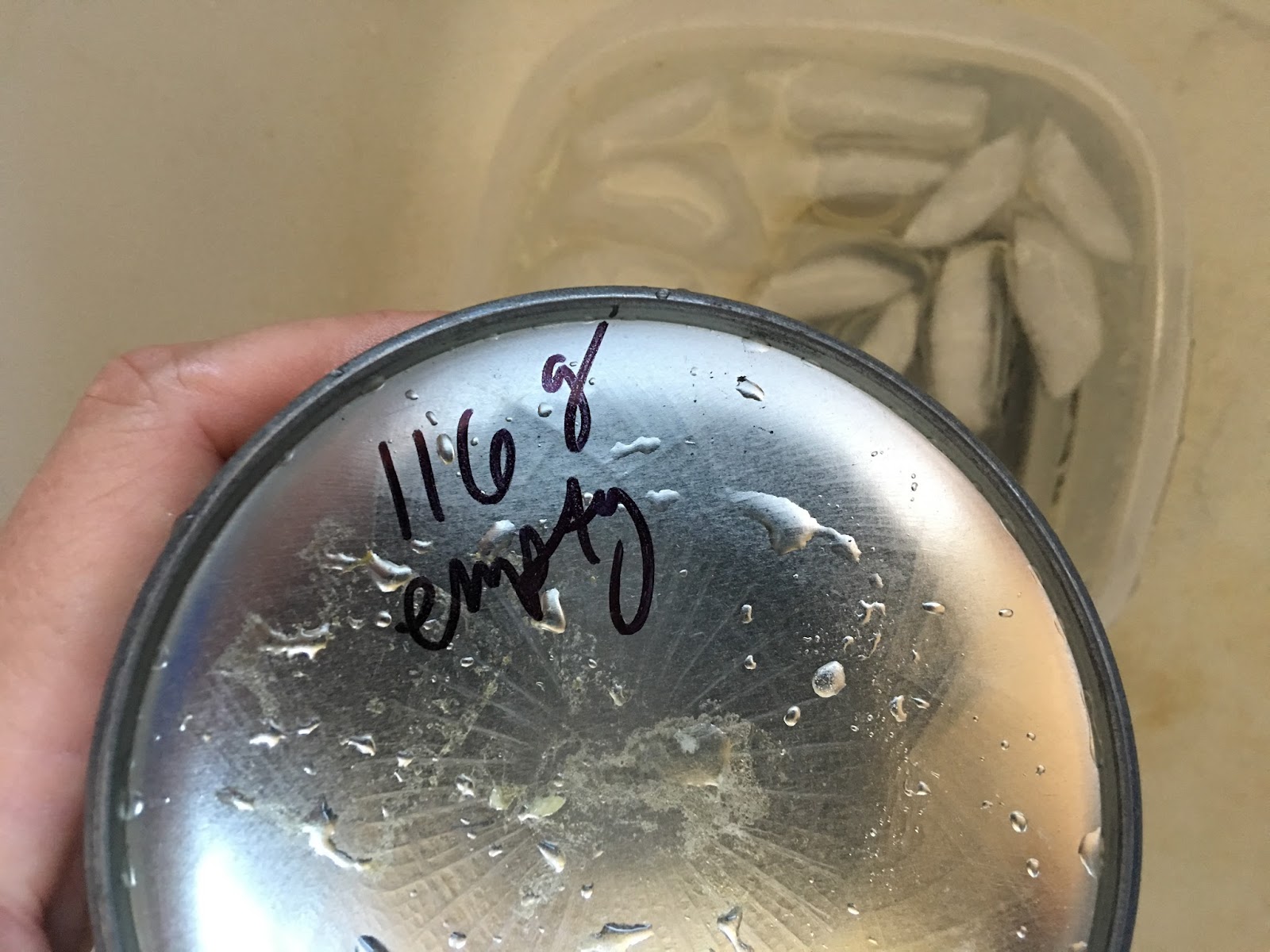
Before you start, weigh the empty canister.  The weight of the canister + the amount of gas the canister originally contained is the maximum safe total weight of the canister.  For example, if your receiving canister weighs 116 g when empty and originally held 220 g of fuel, then your maximum safe weight is 336 g (116 + 220 = 336).  The amount of fuel your empty canister originally held should be printed on the label of the canister.  If you can't read the label, get a different canister.  Only use canisters in good condition when refilling.
My receiving canister weighs 116 g when empty.
Once you've calculated your maximum safe total weight, do the following:
1.  Place the donor canister into a pan or pot of warm water.  I said warm water, not hot water.  Do not immerse a canister into hot water.  Hot water could cause the internal pressure of the canister to exceed the rating of the canister which could cause the canister to burst.  Do not put the canister in the pan while the pan is on a stove.  What if you left the stove on for a minute and got distracted?  Take the pot off the stove, and then put the canister into the warm (not hot!) water.
2.  Prepare an ice bath in a container that can hold the recipient canister and some water with ice.  You don't want the level of the water to exceed the height of the canister.  Keep the connector and Lindal valve area of the canister dry.
3.  Close the valve on the G-Works Gas Saver adapter.
4.  Screw on the empty receiving canister to the Gas Saver.
5. Take the donor canister out of the warm water, dry it off, and screw the donor on to the other connector on the Gas Saver.
6.  Place the receiving canister into the ice bath taking care to keep water out of the connector and Lindal valve area.
A G-Works Gas Saver properly hooked up with two canisters.
The donor canister is on top.  The receiving canister is on the bottom, in the ice bath.
Take care to keep water out of the connector and Lindal valve area of the receiving canister.
7.  Open the valve on the Gas Saver.

When you open the valve on the Gas Saver, you should hear gas flowing from the full donor canister into the empty receiving canister.

8.  After you've let it run for a minute or so, close the valve, take the receiving canister off the G-Works adapter, and weigh the receiving canister.  While you're weighing the receiving canister, put the donor canister back into the pan of warm (not hot!) water.  Repeat steps 6, 7, and 8 until the receiving canister is full.  Do not exceed the maximum safe fill weight of the canister.
Success!  My canister which weighed only 116 g when empty is now clearly full of gas,
BUT my maximum safe fill weight is 336 g.  I need to vent or burn off 10 g.
If you've over filled the canister, vent the canister outdoors away from any heat sources or open flame using the G-Works Gas Saver with one end attached to the over full canister and the other end not attached to anything.  When there is no canister attached to the other end, opening the valve on the Gas Saver vents the excess gas into the atmosphere.  Alternatively, you can just attach a stove to the over filled canister and burn off the fuel.

That's really all there is to it.  With the above described techniques and the G-Works Gas Saver, you can refill or custom fill smaller, lighter, more convenient canisters using larger, cheaper (per gram) canisters.

Versions
There are actually several versions of this adapter, all from Peakway.
1)  The old version of the basic adapter – 28 g (1.0 oz)
2)  The new version of the basic adapter – 36 g (1.3 oz)
3)  The "fancy" version with what appears to be a pressure relief valve.  I don't have this version and can't really comment on it.

I'm not sure why they switched from the old version of the basic adapter to the new version.  I can see what has changed, but I don't know the thinking behind the changes.  Perhaps it was just to reduce production costs; I don't know.

Concluding Remarks
Be safe and read all the cautions, please.  This is good stuff, but you do need to be careful.

Take care and happy stoving,

HJ

Appendix I – Custom Fuel Blends – DANGER
Danger.  We now depart from anything that might be considered remotely safe.  You're completely on your own here if you do this.  I'm not recommending this to you; I'm just saying it's physically possible.  Just because you can do something doesn't mean that you should.  I have not done this.  It's just too danged dangerous.  Try it at your own risk. And make sure your Life Insurance is all paid up, if you get my drift.  See photos of canister explosions, below.


What am I talking about?  Well, remember my recent post on the other G-Works adapter, the G-Works Propane adapter?  With that propane adapter and the G-Works gas saver adapter combined, you could add propane to a backpacking canister.
Never fill a backpacking gas canister with 100% propane.  

WARNINGS UPDATE, 8 April 2017: David, a chemical engineer, has left a series of remarks down in the comments section, below.  I suggest that you read them in detail if you're thinking of adding extra propane to a backpacking type canister.  Personally, I don't think you should try to add propane, but if you're going to try it, make sure you read, line by line, David's comments, below.

Why would you add propane to a backpacking canister?  Well, for cold weather.  Recall that propane is your best fuel for cold weather. In the US, the most propane content you can get in a backpacking canister is about 25% or 30% depending on whether it's mixed with isobutane or n-butane.  You could boost that percentage to 35% or 40% if you combine the G-Works propane adapter with the Gas Saver adapter.  No, I don't have any photos of this combination.  This is very dangerous and I have not tried it.

If you do add additional propane to your backpacking canisters, add the propane last.  Why?  Well, if you add propane to an empty canister, then, at least for a while, you've got 100% propane in there.  That could be bad, very bad.  Those little lightweight (comparatively) backpacking canisters cannot handle the high pressure of 100% propane.  DON'T DO IT.  I'm not sure you should add propane to a backpacking canister at all, but if you do, add the propane last, after the canister has a factory blended fuel mix in it.
Never fill a backpacking gas canister with 100% propane.  
A stove and pot destroyed by a canister filled with 100% propane.
Note how the canister has burst.
NEVER fill a backpacking type canister with 100% propane.
Backpacking canisters are only strong enough for partial propane mixes, typically 80/20 isobutane/propane or 70/30 n-butane/propane.  Filling a backpacking canister with 100% propane risks an explosion.  Backpacking canisters just aren't strong enough to handle the very high pressures involved with 100% propane.
Never fill a backpacking gas canister with 100% propane.

A stove and pot destroyed by a canister explosion.
NEVER fill a backpacking type canister with 100% propane.

Monday, November 7, 2011

Powermax Fuel Is Definitely Dead :(

I've seen every retailer in my area discontinue carrying Coleman Powermax Fuel all at the same time.  Suspicious, I wrote Coleman to ask if they had stopped making the canisters.

Here is the answer I received:
Jim,
The Powermax fuel has been discontinued, The fuel is being discontinued due to low volumes . You might still find some sporting good store from existing stock.
I apologize for the inconvenience.
Thank you,
Margie
Coleman Consumer Service

In other words, Powermax fuel is definitely dead.   :(

Powermax was the best format out there in terms of gas canisters.  It had no threads to cross thread, it had nice aluminum canisters that were very lightweight (a 110g standard canister is heavier than a 300g Powermax canister!), it had a wonderful 35% propane blend in the US (40% propane overseas), and its liquid feed mechanism allowed it to operate down to -4F/-20C according to Coleman (although many users report good results in temperatures down to -10F/-23C).
A Powermax canister has no threads to cross thread.  Just twist and click.
 Unfortunately, it wasn't standard.  The threaded canisters that are in fact the standard are by no means superior; they're just the standard.  Despite the fact that Powermax was clearly a superior canister, particularly for cold weather, it just didn't catch on.  Distribution was always limited, and only three backpacking stoves (the Coleman Xtreme, the Coleman Xpert, and the Coleman Xpedition) could use the canisters.
A Coleman Xtreme stove hooked up to a Powermax canister
 For those of you lucky enough to own one of the three stoves, fear not!  There are still a lot of Powermax canisters out there.  Check around, and you'll find them.  And the canisters can be refilled.  Yes, I know it says not to, but people have been refilling various canisters for quite some time without problems.  Do note that refilling does have potential dangers -- serious dangers.  Definitely read up on the issue before engaging in refilling.  But for a careful, knowledgeable person, the dangers are minimal.  The Coleman stoves that use Powermax canisters will now be a bit of a bother since fuel is no longer as readily available, but those who know these stoves know their worth!
The inferno that is the flame of a Coleman Xtreme stove
If you've got one of the three stoves that uses Powermax fuel, hang on to it -- and lay in a stock of Powermax canisters.

HJ

Related posts:

Thursday, November 22, 2018

The MSR XGK-EX

Behold the blast-furnace beast:  The MSR XGK-EX:  powerful, simple, dependable.
The MSR XGK-EX doing what it does best:  Cranking out the BTU's
It's been a while since I've had the opportunity to do a stove review (work, family, studying, etc.), but the opportunity to review an XGK-EX came up, and it was with the Section Hiker blog, a blog with which I've had successful collaborations with in the past.  And, given that winter fast approaches, what better stove to review than a tried and true snow melter?

A bit of background
The XGK line of stoves from MSR really ushered in the modern stove era.  A lot of stoves prior to the introduction of the XGK line were good stoves but were heavy, vulnerable to wind, and because of their small fuel tanks, required the carrying of a separate fuel bottle for refilling.  The Model 9, the first stove in what became the XGK line, was a significant step forward in terms of design and technology.  Larry Penberthy, the founder of MSR, was a engineer with a gift for innovation who loved mountain climbing.  He just wasn't satisfied with the gear of his day and decided he could do better.  It was Mr. Penberthy, for example, who really introduced non-wooden handles on ice axes.  Prior to Mr. Penberthy, pretty much everyone was still using wooden handles on their ice axes.

The latest installation in the XGK line is the XGK-EX.  Without further ado, let me provide you with a link to the review on Section Hiker:
https://sectionhiker.com/msr-xgk-ex-liquid-fuel-stove-review

I hope you fine the review to be of interest.

Thanks for joining me on another Adventure in Stoving,

HJ

Sunday, March 19, 2017

Coleman Canister Gas – Caution

Coleman brand gas canisters now only normally work with Coleman brand stoves.  You might get lucky, but the current orange label Coleman brand gas canisters just plain don't work with a lot of brands of canister stoves.
UPDATE 25 March 2017:  See caveats to the above in the "Stoves Tested" section.
UPDATE 27 March 2017:  There is an emergency work-around:  Coleman Canister Gas – Emergency Work-Around
UPDATE 28 March 2018:  Since the Coleman canisters don't work reliably with the majority of my stoves, I'm now using them as "donor" canisters when I refill my canisters that do work.  See:  Refilling Backpacking Canisters II

What has changed?
I've never had this problem before with the older green label Coleman canisters.   Recently, it seems there's been a change.  The new ones have an orange label (see photo, below), but the changes appear to go beyond color.  They just don't work with other brands of gas stoves.  I'm speaking here about backpacking type canisters only.  I am NOT referring to the big 100% propane green canisters.
Front row:  The older "green" Coleman canisters.
Rear:  The newer "orange" Coleman canister.
Here's how I happened on this:
I test stoves.  A lot of stoves.  I burn gas.  A lot of gas.
Simul-testing multiple stoves.  I burn a lot of gas.
So, I bought some of the big 450 gram Coleman canisters recently at Walmart.  They're the cheapest brand (at least when bought at Walmart).

When I got them home, they simply didn't work.  On any stove tried (see list, below).  And I've got a lot of stoves.  None of them worked – until I tried a Coleman brand stove.

Here's a quick video:

And I am not alone.  Others are reporting similar experiences.

NOTE:  I am not accusing Coleman of doing this deliberately.  Why would they do that?  They want to sell as many canisters as possible.  If they make it so their canisters cannot be used with other brands, their sales will go down. I think this is a goof, not a deliberate business decision.

Stoves Tested

These stoves did not work when tested with orange label Coleman gas canisters:
  • MSR Pocket Rocket
  • MSR Pocket Rocket 2
  • BRS-3000T
  • Markill Hot Rod
  • Soto WindMaster
  • Kovea Supalite
  • Monatauk Gnat/FMS-116T/Olicamp Kinetic Ultra
  • Snow Peak GeoShield
These stoves kind of worked with orange label Coleman gas canisters cranked down hard (NOT recommended):

  • Kovea Titanium/Markill Hotrod
  • Soto MicroRegulator
  • Optimus Crux

These stoves did work with orange label Coleman gas canisters:
  • Jetboil PCS (personal experience)
  • Jetboil MiniMo (reported)
  • Primus Eta Express
  • MSR Micro Rocket
  • Soto Amicus
  • Snow Peak GigaPower
  • eTekCity (multiple reports)
It looks like Jetboil and Primus brand stoves in general do work with Coleman brand orange label gas canisters, but obviously I haven't tested each and every model of Jetboil or Primus stoves.  You'll probably be fine, but you should test your Jetboil or Primus stove with Coleman canisters before you head out on the trail.  However, I have now one report of a Jetboil not working with an orange label Coleman canister.

Other brands are all over the map.  Some models work; others do not.  I've had reports of a Pocket Rocket working, but my Pocket Rocket did not.  This tells me that the Coleman canisters are very close, only off by maybe half a millimeter or something like that.  Their Lindal valve is recessed just a bit farther down in the threaded connector than other brands.  It doesn't take much.  Notice the middle category, above:  Stoves that kind of worked.  It's that close.  Your "mileage" not only may but will vary.

Recommended:  Test your stove with Coleman orange label canisters if you plan to use them.
Not recommended:  Cranking your stove down hard to get a Coleman canister to work.  Stove threads are typically aluminum or brass which is softer than the steel of the canisters.  Don't ruin a good stove over a $5 to $10 canister.  Just buy a more reliable brand.  I have had no problems with the following canister brands:

  • MSR
  • Snow Peak
  • Optimus
  • Primus
  • Brunton
  • Jetboil
  • Gas One
  • Glow Master
I haven't tried Olicamp canisters; I haven't seen them for sale locally.

Conclusion
So, be careful.  That Coleman canister may be cheap (when purchased at Walmart), but it may not work with your stove – unless your stove happens to be a Coleman stove (or probably Jetboil and Primus, perhaps others).  Perhaps I'm belaboring the obvious, but always test your stove with the canister you intend to use before you hit the trail.  This is probably a good idea with all brands but particularly with Coleman brand orange label gas canisters.

Happy stoving,

HJ

Friday, November 25, 2011

What's the Best Brand of Gas for Cold Weather?

For warm weather (above 50°F/10°C), it doesn't much matter what brand of gas you buy.

Caution!
The one exception to the above is Coleman gas canisters. At least for the Coleman canisters with the orange label, Coleman canisters do not work consistently with many brands of stoves.  You can however use Coleman canisters which are very cheap at Walmart to refill other canisters.  See:  Refilling Backpacking Canisters II.


NOTE:  This post was last updated on 11 April 2017.


For cold weather, the brand of gas you buy does make a difference.  Typically, gas canisters contain some blend of propane mixed with either "plain" butane (n-butane) or isobutane. Some canister brands contain all three gasses.  For cold weather use, you generally want a canister with as little n-butane as possible.  Even though propane is the best cold weather gas, I'd take a canister with 10% propane and 90% isobutane over a canister with 30% propane and 70% n-butane.  Why?  Because the propane will burn off at a faster rate than the n-butane, leaving you with nothing but n-butane toward the end of your canister.  Butane is a poor performer in cold weather.
Frozen lakes and snow, Sierra Nevada Mountains, June 2014
Why is butane a poor cold weather performer?  Why do we use blended gas?  Why don't we just use 100% propane?  That's all covered in my post on Gas Blends and Cold Weather Performance.

How can we cope with cold weather?  For more info on canister stoves in cold weather, see:  Gas Stoves in Cold Weather – Regulator Valves and Inverted Canisters
A frozen lake, Sierra Nevada Mountains, June 2014
What companies have got the best blend?  I don't have all the data, but here below is what I have.  This data is for the United States of America.  Brands and blends available elsewhere may vary.

GOOD WINTER GAS BRANDS:
  • Olicamp Rocketfuel is the best cold weather blend available in North America – at least based on the label.  It has 75% isobutane and 25% propane.  It's performance will not be radically better than an 80/20 mix, but Olicamp's 75/25 is a slightly better mix – if it is pure.  Any time there is isobutane, there will always be a certain percentage of plain n-butane present as well.  Here, quality control is essential.  How committed is Olicamp to quality control?  I don't know, but generally Olicamp Rocket Fuel's reputation is good.  Olicamp specifically advertises their blend, so they are clearly aware of the implications of the mix and are marketing it on that basis.
  • MSR is a good winter blend, 80% isobutane and 20% propane.  These numbers are confirmed on MSR's website.  MSR is pretty committed to the climbing and mountaineering community.  They are pretty committed to quality control.  I tend to trust MSR's numbers and believe that they have very low percentages of n-butane.  I generally go with MSR on my cold weather trips.  Your mileage may vary.
  • Snow Peak is 85% isobutane and 15% propane.  These numbers are confirmed on Snow Peak's website.  I tend to trust Snow Peak's numbers more since they are willing to commit to them in writing.  This mix isn't quite as good as Olicamp's or MSR's but is still a reasonably good mix.
BRANDS OF UNKNOWN QUALITY (in no particular order):
  • Jetboil is supposedly 80% isobutane and 20% propane.  Possibly.  I have not been able to confirm these numbers.  How much n-butane does it contain?  I don't know.   No where will Jetboil put down in writing what their actual numbers are.  This tells me that their blend varies a lot.  Jetboil wouldn't be my first choice simply because Jetboil will not commit, in writing, to any set of numbers.  My understanding is that they can have more than 5% n-butane and still advertise that their mix as "isobutane" so long as it's mostly isobutane.
  • Brunton is reputedly an 80/20 mix.  Maybe.  I have not been able to confirm these numbers.  Brunton's reputation isn't that good in cold weather.  They may have a relatively high percentage of n-butane (which again they can advertise as isobutane so long as the majority of the butane is isobutane).  Brunton would not be my first choice since they won't commit to a particular blend.
  • Sterno is an isobutane mix according to the label on their cans.  What is the mix?  Unknown.  How much n-butane does their "isobutane" mix contain?  Unknown.  If nothing else were available, I guess you could go with it, but I myself would probably go with a brand that will commit to a certain set of numbers.
  • GSI, likewise, is an isobutane mix according to the label on their cans.  What is the mix?  Unknown.  How much n-butane does their "isobutane" mix contain?  Unknown.  If nothing else were available, I guess you could go with it.  I'd rather have a commitment, but sometimes you don't have every brand available at a given location.  I'd go with an "unknown" like GSI over a known mix if the known mix were labeled as containing n-butane.

    BRANDS NOT RECOMMENDED* FOR WINTER USE (in no particular order)
    • Coleman regular threaded canisters (not Powermax) are 30% propane and 70% butane.  These numbers on on the side of the canister.
    • Primus is 25 % propane, 25 % isobutane, and 50 % butane per their website.  I suppose it's better than Coleman brand, but I'd still rather have a fuel with no regular butane at all.  Note that this is their "regular" mix.  They do have a winter mix and a summer mix.  Definitely don't use the summer mix for cold weather!  The winter mix may be good, but I haven't been able to track down any numbers.
    • Optimus brand is 25% propane, 75% butane, as printed on the side of the canister.  Since it contains regular butane, I wouldn't use it in cold weather.
    • Glowmaster is 20% propane and 80% butane per the side of the canister. 

    One caveat to the above:  If you're using standard threaded canisters in liquid feed mode (in other words, the canister is used upside down) or you're using a canister that is designed for liquid feed (e.g. a Powermax canister), the n-butane vs. isobutane issue matters less, although I would still generally prefer isobutane had I a choice.  In liquid feed mode, the liquefied gas stays blended and all of the fuels burn together at a constant rate.  With liquid feed, the propane does not burn off more quickly, and you're not left holding the bag with nothing but crummy (in cold weather) n-butane left.  In other words, with liquid feed, "regular" butane isn't such a bad thing provided that you've got plenty of propane content.

    For "normal" (canister right side up) use, avoid "regular" butane for cold weather.

    HJ

    *Because they contain "regular" butane, a very poor fuel in cold weather.

    Related articles and posts: