QuietStove.com

Showing posts with label canister gas. Show all posts

Wednesday, April 4, 2012

Canister Stoves 101: Thread Care

Don't screw on your canister stove too tight.

Why not?

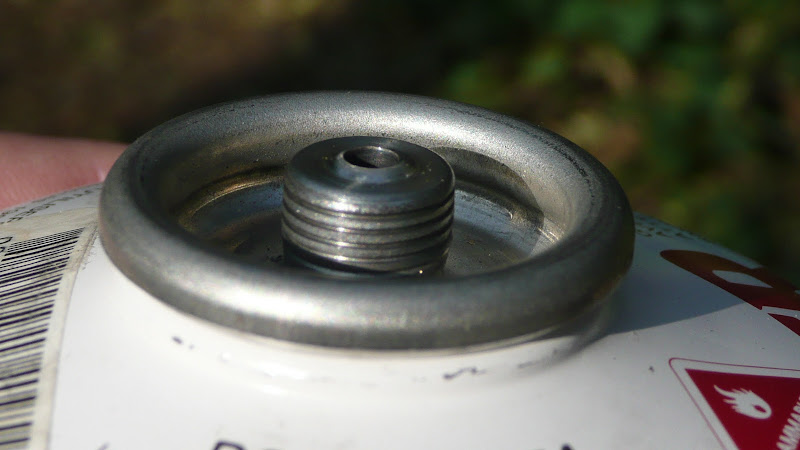
Well, take a look at the threads on a canister some time.
Notice how the threads do NOT go all the way out and form a sharp line.  These threads are rounded off.  That means that the only part of your stove's threads that are going to grip the canister is the very tip (very outer edge) of your stove's threads.

Whoa!  Wait a minute.  Do you mean to tell me that the only thing holding the stove on to a canister is the edge of the threads?

Yes, that's what I'm saying.  And that's a fairly thin bit of metal.  Too much pressure will put excessive wear on your stove's threads.  Heavy users have reported threads so worn that stoves have literally fallen off the canister.  Once your stove's threads are so worn that they no longer grip the canister, you're pretty much out of luck; you have to replace the stove.

So, Canister Stove Thread Care 101:
  • Don't over tighten.  If you're getting good gas flow and no leaking, that's tight enough.
  • Use the little cap on your canister.  Sure, it's a hassle to keep track of the little plastic cap, but dirt, sand, etc on the canister's threads could screw up that nice  stove you've got.  
  • Keep the threads clean on your stove.  Keep it wrapped in a bandana or something to keep crud out of the threads.  I normally keep my canister stove wrapped up and in my cook pot when it's in my pack.  Some stoves come with a little pouch or case which may be a good alternative if you don't store your stove in your pot.  Don't wrap your stove in something that sheds a lot.
  • Inspect the threads on your canister.  If there's damage on the canister threads, get a new canister (if available).  It's not worth it to use a damaged canister which might screw up your stove.
  • Do NOT cross thread.  Make sure you thread the canister on correctly and that it turns smoothly.  If it feels "funny," stop and check.  Cross threading is a great way to damage your stove.
I generally don't recommend lubricating the canister threads because crud might be more prone to stick to the lubricant, but I do know some people who lubricate the canister threads with silicon grease to prevent binding.  Perhaps there may be some advantage to this approach.

The main thing to remember with canister stoves is that a little care goes a long way.  Keep things clean, don't over tighten, and be careful how you screw on the canister.

I thank you for accompanying me on another Adventure in Stoving.

HJ


Related articles and posts:

Monday, March 19, 2012

Canisters, Cold, and Altitude: Gas in a Nutshell

OK, so here's the deal on canisters in cold weather and at higher elevations, in step-by-step form:

1.  Choose good gas.  For weather below 50°F/10°C, avoid butane mixes. Get an isobutane mix.  I've got all the major US brands sized up on my blog in What's the Best Brand of Gas for Cold Weather?  Above 50°F/10°C, it typically doesn't matter what brand or blend you buy.

2.  Know your limits.  Canisters containing isobutane mixes work reasonably well down to about 20F/-7C at sea level throughout the life of the canister if you use good gas (see item #1, above) and good technique (see item #4, below).  Now, that's just a number, which isn't a bad number if you just want the short version, but if you want to know more about that number, how I came up with it, and how to plan using it, see Gas Stoves: How Cold Can I Go?  Canisters get colder as you use them (canister "chilling") which can negatively impact performance.  See item #4, below, for how to compensate for canister chilling.

3.  Adjust for Altitude.  The higher you go, the lower the outside pressure.  The lower the outside pressure, the colder you can operate a canister gas stove.  You receive approximately a 1F per 1000' of gain colder advantage (about 0.5°C per 300m gain).  The idea that canister gas stoves don't work well at altitude is a myth.

4.  Use good technique.  Basically, start with a warm canister and keep the canister warm.  For "best practices," see Cold Weather Tips for Gas Stoves.

Now, in the above, I'm speaking primarily about "regular" gas stoves, the kind that screw right on to the top of a canister.  If you have a remote canister stove that is capable of inverted operation (see my Stoves for Cold Weather II article in Seattle Backpacker's Magazine for more information), then the limit in item #2, above, changes from about 20°F/-7°C to about 0°F/-18°C.  All of the other items still typically apply.  If you want to go out in weather that is that cold, I strongly suggest you do your homework, part of which should be to read Gas Stoves: How Cold Can I Go?

There, in the proverbial "nutshell," is how to deal with cold weather and adjust for altitude for canister gas stoves.

HJ

Related articles and posts:

Tuesday, March 13, 2012

Cheap Deals on Good Stoves

If you read my recent "Starter Stove" post, I recommended the Snow Peak GigaPower (GS-100) stove, 88g/3.1oz, as my "value for the dollar" pick.  The GigaPower is a really good stove, and I've seen it on the web for only $40 (not including any taxes or shipping).  Other stoves of comparable quality are about $60.

But there is another way:  eBay.  You can get some really cheap stoves on eBay.  Now, be really careful on eBay.  Some of those really cheap stoves aren't worth what you pay for them.  In fact, some of those really cheap stoves might be downright dangerous.  So, how do we separate the cream from the crud?  Well, you can't always, but buying brand name products is one way to greatly increase the chances of winding up with a decent stove.

Now, I know what you're thinking:  "Hey, Jim, I've already looked on eBay, and the brand name stoves on eBay aren't any cheaper than they are in the store."

Well, yes, but there is a good brand, a brand that maybe you've never heard of before, a brand that is a really good buy:  Kovea.  Kovea is a Korean company that has been turning out excellent products lately.  In fact, even though maybe you've never heard of Kovea by name, you may have used Kovea products.  Kovea makes stoves for major brands like MSR and Snow Peak.

Now, eBay is a mixed bag.  Sometimes you can find deals and some times you get ripped off.  So, shop around, and as always, caveat emptor.

But I'm looking at eBay right now, and I see a Kovea brand titanium stove, the KB-0101, with piezoelectric ignition for $42 including shipping.  Guys, that's a deal.  A comparable stove at my local retailer is $60 and that one doesn't have a piezoelectric ignition.  The stove I'm looking at is 88g/3.1 oz which may sound a little heavy for a titanium stove, but considering that it's got a piezolectric ignition built in, that's actually a very reasonable weight.  Recall that the Snow Peak GigaPower (GS-100) that I recommended earlier is also 88g/3.1oz but that the GigaPower does not have an ignition system.  I've seen the non-piezoelectric version of this stove personally, and it's a really nice stove.

I'm also looking at a really lightweight titanium Kovea gas stove, the KB-0707, 56g/1.98oz, for $42.50 + $5.00 shipping.  I have seen one of these in person, and it is a very nice stove.  Now you just find me a sub-two ounce titanium stove for that kind of money at a US retailer.  Maybe on sale, but certainly not at normal prices, and high end titanium stoves like this are usually excluded from sales and coupons.  The KB-0707 is 32g/1.13 ounces lighter than the GS-100.  Nice.

Is buying from eBay 100% safe?  No, of course not.  I'm sure we've all heard bad stories, and there are good reasons to buy from a local retailer where returns and exchanges may be a lot easier.  But if you're bargain hunting, eBay can be a great place, and Kovea is the top but relatively unknown brand that can save you money.

I thank you for joining me on another Adventure in Stoving,

HJ

Saturday, January 7, 2012

Backpacking Gas Canisters 101

What are the common canister types out there these days for backpacking use?

Basically, there are two common modern gas canisters suitable for backpackers, Camping Gaz (non-threaded) and 7/16ths UNEF threaded canisters.  Generally, stoves built for one type will not work with the other, but there are exceptions such as the relatively heavy MSR Superfly.  There are also much lighter DIY exceptions such as the "Super Gnat" that you can assemble in the matter of a few minutes.

UPDATE 28 March 2017:  No, manufacturers don't recommend it, and, yes, there are dangers, but canisters can be re-filled.  See:  Refilling Backpacking Canisters II

A non-threaded CV270 Camping Gaz canister (left) and a threaded 110g Snow Peak canister (right).

Before I discuss backpacking suitable canisters, let's clear out what's not really suitable:


Canisters NOT Suitable

Non-Backpacking Canisters:  Now, there are plenty of other canisters that you could use for backpacking including the big, heavy steel 16.4 oz/465g 100% propane cylinders as well as the "hair spray can" 8oz/227g 100% butane canisters used for table side cooking in restaurants, but these are generally unsuitable for backpacking.  Not recommended.  There are also 100% butane canisters for small hand blow torches and the like.  These typically do not fit backpacking type stoves.  Not recommended.

Obsolescent Canisters:  There are also older formats including the old puncture type gas canisters that  have no valve.  There's a sharp metal "bayonet" type object on stoves that use puncture canisters.  The "bayonet" quite literally punctures the canisters.  Yes, that's right, you're ripping through the metal top of the canister in order to get to the gas.  Needless to say, this is an older type canister!  On these old style canisters, the stove must remain in place until the canister is fully empty.  There is no valve built into the canister to allow you to separate the canister from the stove (until fully empty) for safe transport.  You can still buy the old puncture type canisters, but they have been implicated in a number of accidents and are not as safe as modern canisters with valves.  Not recommended.  Note:  In some lesser developed countries, puncture type canisters may be the only gas canisters available.  Travelers should check on what canister formats are available in the countries they intend to visit before departure.

Obsolete Canisters:  There are also dozens of old canister formats that have been discontinued including Hank Roberts, Campak, and PowerMax just to name a few.   Some of these were excellent formats.  However, they are no longer produced.  I'm not going to discuss them other than to mention that they exist.

Suitable Canisters
Modern Backpacking Canisters:    OK, now we're to the meat of this post:  Today's modern backpacking canisters.  There are two common types of gas canisters suitable for backpackers:

  • Camping Gaz Canisters (non-threaded).
  • Standard threaded canisters (with a 7/16ths UNEF thread).
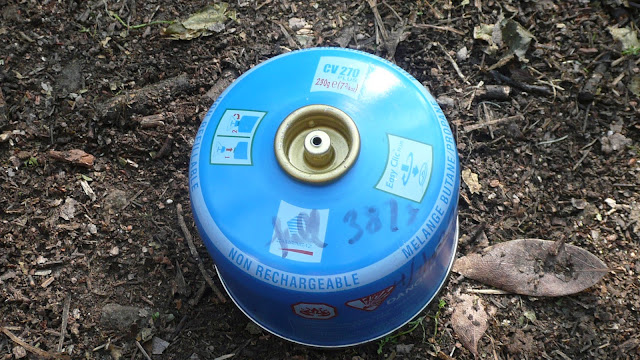
A 230g Camping Gaz canister.
Camping Gaz Canisters:  Camping Gaz canisters are made by, well, Camping Gaz.  Camping Gaz is the only known company that produces canisters to this specification.  The connectors on Camping Gaz canisters are non threaded.  Many people consider this a superior type connector because there are no threads to wear out or cross thread.  However, in most countries of the world, threaded canisters are the standard.  To my knowledge, only in France is the Camping Gaz canister considered the standard.
A close up of the (non-threaded) connector on a Camping Gaz canister
Camping Gaz canisters are not necessarily universally available outside France.  If you decide to buy a stove that uses Camping Gaz type canisters, you should make sure said canisters are available in your area.

UPDATE 2016.  Camping Gaz canisters, both the old puncture type and the newer non-threaded valved type are no longer distributed in North America.  You can find some old canisters sometimes, but once those are gone, that's it.  Personally, I would no longer buy a Camping Gaz type stove with the non-threaded connector unless maybe you just want it as a collector's item.

Camping Gaz canisters have a Lindal valve inside the connector.  The valve allows the canister to be removed from the stove for safe storage or transport.

Camping Gaz canisters come in two sizes:  230g and 450g.  A smaller size in the 100g range is not available.

Camping Gaz canisters contain a blend of propane and butane.  As such, Camping Gaz canisters are not the best choice for cold weather.  See What's the Best Brand of Gas for Cold Weather?  for further information.

Standard Threaded Canisters:  In most of the developed world, the standard for gas canisters for backpacking is a threaded canister with a 7/16ths UNEF thread.
A standard threaded backpacking type canister.  This one happens to be made by Snow Peak.
Standard threaded canisters are made by dozens and dozens of companies.  Generally, canisters from one company work perfectly fine with the stoves of another company.  Some companies try to intimate that their particular canisters will somehow make their stoves run better and that you should only use that company's particular brand of gas.  That's a bunch of horse hockey.  All major brands are interchangeable.  The only time you might get into trouble is buying some brand that you've never heard of in some remote corner of the world.  Otherwise they are all mechanically about the same.  However, the gas contained within isn't necessarily.  For warm weather (above 50F/10C), buy whatever is cheapest.  For cold weather, what's inside matters.  See What's the Best Brand of Gas for Cold Weather?  for further information.

Caution!
The one exception to the above is Coleman gas threaded canisters. At least for the ones with the orange label Coleman canisters do not work with many brands of stoves.
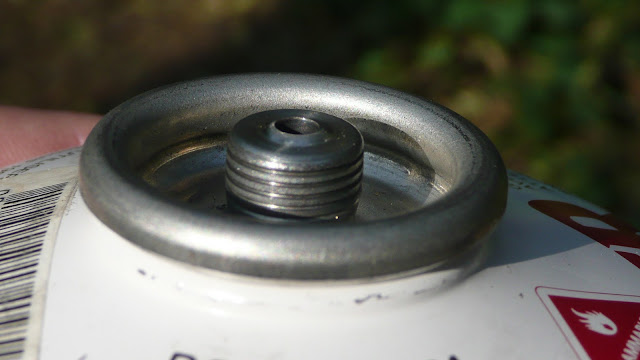
The 7/16ths UNEF threads of a standard threaded canister
Like Camping Gaz canisters, standard threaded canisters have a Lindal valve inside the connector.  The valve allows the canister to be removed from the stove for safe storage or transport.

Standard threaded canisters come in three size ranges:  small (100g to 113g), medium (220g to 230g), and large (450g).  The classes can also be expressed as 4oz, 8oz, and 16oz.  Be careful calling a canister "large."  Many stores only carry the 1xxg and 2xxg sizes.  Some people refer to the 2xxg canisters as "large."  It's best to specify what size you want in grams or ounces.

There you have it, a brief look at the basics of gas canisters.  Hopefully, that's helpful as you shop for gas or as you consider which stove to buy.

HJ


Related articles and posts:

Sunday, December 4, 2011

Fuel Price Guide (Dec. 2011)

Who's got the deals?  Who's ripping you off?  Take a look at the following fuel prices to see what's out there -- and compare it to what you're paying.  Exceptional deals are show in red colored type.

Note:  The following are fuel prices that I observed in person at the retailer listed on the date shown.  Be aware that sometimes I make mistakes and that sometimes retailers change prices.   All prices are shown in US dollars (USD).  All observations were made in and around Los Angeles, CA, USA.

I.  White Gasoline (Coleman Type Fuel) 
Big 5 Sporting Goods
(03 Dec 2011)
Coleman        Gallon  $11.99
 
REI (Recreational Equipment, Inc.)
(03 Dec 2011)
Crown          Quart   $ 8.00
MSR            Quart   $12.95
Crown          Gallon  $14.00
Coleman        Gallon  $11.95

Sport Chalet
(05 Dec 2011)
Coleman        Quart   $ 6.97
MSR            Quart   $ 9.99
Coleman        Gallon  $10.97

Sports Authority
(05 Dec 2011)
Coleman        Quart   $ 6.99

Wal-Mart
(19 Nov 2011)
Coleman        Quart   $ 5.88
Coleman        Gallon  $ 9.68

II.  Gas (propane, isobutane, butane)
Big 5 Sporting Goods
(03 Dec 2011)
Camping Gaz    190g    $4.99    $0.0263/gram
Coleman        220g    $6.99    $0.0318/gram
Camping Gaz    230g    $6.99    $0.0303/gram (that price makes no sense compared to the 450g size, but that's what they quoted me)
Primus         230g    $5.99    $0.0260/gram
Camping Gaz*   450g    $6.99    $0.0155/gram
Coleman        465g    $4.49    $0.0097/gram (100% propane)
Worthington-2  465g    $8.99    $0.0097/gram (100% propane) (Two Pack)


REI (Recreational Equipment, Inc.)
(03 Dec 2011)
JetBoil        100g    $4.95    $0.0495/gram
Snow Peak      110g    $4.50    $0.0409/gram
MSR            113g    $4.95    $0.0438/gram
Snow Peak      220g    $5.50    $0.0250/gram 
MSR            227g    $5.95    $0.0262/gram 
JetBoil        230g    $5.95    $0.0259/gram
JetBoil        450g    $9.95    $0.0221/gram
Coleman        465g     Out of stock 03 Dec 2011

Sport Chalet
(05 Dec 2011)
JetBoil        100g    $4.99    $0.0499/gram
Optimus*       110g    $3.95    $0.0359/gram
Snow Peak      110g     Discontinued at Sport Chalet
MSR            113g    $3.99    $0.0353/gram
Optimus*       220g    $4.45    $0.0202/gram
Snow Peak      220g    $5.50    $0.0250/gram
MSR            227g    $4.99    $0.0220/gram  Updated 11 Jan 2012
Camping Gaz*   230g    $4.99    $0.0217/gram  
JetBoil        230g    $5.99    $0.0260/gram    
Camping Gaz*   450g    $6.99    $0.0155/gram
JetBoil        450g    $9.99    $0.0222/gram
Coleman        465g    $2.97    $0.0063/gram  (100% propane)

Sports Authority
(05 Dec 2011)
JetBoil        100g    $4.99    $0.0499/gram
MSR            113g    $4.99    $0.0441/gram 
Coleman*       220g    $6.99    $0.0318/gram
MSR            227g    $5.99    $0.0264/gram    
Coleman        465g    $2.99    $0.0064/gram  (100% propane)
Coleman-2      465gX2  $5.69    $0.0061/gram  (100% propane) (Two Pack)

Wal-Mart
(19 Nov 2011)
Coleman*       220g    $4.88    $0.0221/gram
Coleman        465g    $2.86    $0.0061/gram  (100% propane)
Worthington-2  465gX2  $5.12    $0.0055/gram  (100% propane) (Two Pack)

*NOT recommended for use below 50F/10C.  Why? See:  What's the Best Brand of Gas for Cold Weather?


III.  Kerosene or Kerosene "substitute"
Wal-Mart
(19 Nov 2011)
Coleman                      Quart   $ 5.88 ($23.52/gallon)

IV.  Alcohol
Home Depot
(28 Dec 2011)
Klean Strip SLX Denatured    Gallon  $15.98
Klean Strip Green Denatured  Quart   $ 6.69 ($26.76/gallon)

Wal-Mart
(28 Dec 2011)
Yellow HEET (methanol) 12oz  12pk    $16.44 ($14.61/gallon)


I hope you find the information helpful,

HJ

Friday, November 25, 2011

What's the Best Brand of Gas for Cold Weather?

For warm weather (above 50°F/10°C), it doesn't much matter what brand of gas you buy.

Caution!
The one exception to the above is Coleman gas canisters. At least for the Coleman canisters with the orange label, Coleman canisters do not work consistently with many brands of stoves.  You can however use Coleman canisters which are very cheap at Walmart to refill other canisters.  See:  Refilling Backpacking Canisters II.


NOTE:  This post was last updated on 11 April 2017.


For cold weather, the brand of gas you buy does make a difference.  Typically, gas canisters contain some blend of propane mixed with either "plain" butane (n-butane) or isobutane. Some canister brands contain all three gasses.  For cold weather use, you generally want a canister with as little n-butane as possible.  Even though propane is the best cold weather gas, I'd take a canister with 10% propane and 90% isobutane over a canister with 30% propane and 70% n-butane.  Why?  Because the propane will burn off at a faster rate than the n-butane, leaving you with nothing but n-butane toward the end of your canister.  Butane is a poor performer in cold weather.
Frozen lakes and snow, Sierra Nevada Mountains, June 2014
Why is butane a poor cold weather performer?  Why do we use blended gas?  Why don't we just use 100% propane?  That's all covered in my post on Gas Blends and Cold Weather Performance.

How can we cope with cold weather?  For more info on canister stoves in cold weather, see:  Gas Stoves in Cold Weather – Regulator Valves and Inverted Canisters
A frozen lake, Sierra Nevada Mountains, June 2014
What companies have got the best blend?  I don't have all the data, but here below is what I have.  This data is for the United States of America.  Brands and blends available elsewhere may vary.

GOOD WINTER GAS BRANDS:
  • Olicamp Rocketfuel is the best cold weather blend available in North America – at least based on the label.  It has 75% isobutane and 25% propane.  It's performance will not be radically better than an 80/20 mix, but Olicamp's 75/25 is a slightly better mix – if it is pure.  Any time there is isobutane, there will always be a certain percentage of plain n-butane present as well.  Here, quality control is essential.  How committed is Olicamp to quality control?  I don't know, but generally Olicamp Rocket Fuel's reputation is good.  Olicamp specifically advertises their blend, so they are clearly aware of the implications of the mix and are marketing it on that basis.
  • MSR is a good winter blend, 80% isobutane and 20% propane.  These numbers are confirmed on MSR's website.  MSR is pretty committed to the climbing and mountaineering community.  They are pretty committed to quality control.  I tend to trust MSR's numbers and believe that they have very low percentages of n-butane.  I generally go with MSR on my cold weather trips.  Your mileage may vary.
  • Snow Peak is 85% isobutane and 15% propane.  These numbers are confirmed on Snow Peak's website.  I tend to trust Snow Peak's numbers more since they are willing to commit to them in writing.  This mix isn't quite as good as Olicamp's or MSR's but is still a reasonably good mix.
BRANDS OF UNKNOWN QUALITY (in no particular order):
  • Jetboil is supposedly 80% isobutane and 20% propane.  Possibly.  I have not been able to confirm these numbers.  How much n-butane does it contain?  I don't know.   No where will Jetboil put down in writing what their actual numbers are.  This tells me that their blend varies a lot.  Jetboil wouldn't be my first choice simply because Jetboil will not commit, in writing, to any set of numbers.  My understanding is that they can have more than 5% n-butane and still advertise that their mix as "isobutane" so long as it's mostly isobutane.
  • Brunton is reputedly an 80/20 mix.  Maybe.  I have not been able to confirm these numbers.  Brunton's reputation isn't that good in cold weather.  They may have a relatively high percentage of n-butane (which again they can advertise as isobutane so long as the majority of the butane is isobutane).  Brunton would not be my first choice since they won't commit to a particular blend.
  • Sterno is an isobutane mix according to the label on their cans.  What is the mix?  Unknown.  How much n-butane does their "isobutane" mix contain?  Unknown.  If nothing else were available, I guess you could go with it, but I myself would probably go with a brand that will commit to a certain set of numbers.
  • GSI, likewise, is an isobutane mix according to the label on their cans.  What is the mix?  Unknown.  How much n-butane does their "isobutane" mix contain?  Unknown.  If nothing else were available, I guess you could go with it.  I'd rather have a commitment, but sometimes you don't have every brand available at a given location.  I'd go with an "unknown" like GSI over a known mix if the known mix were labeled as containing n-butane.

    BRANDS NOT RECOMMENDED* FOR WINTER USE (in no particular order)
    • Coleman regular threaded canisters (not Powermax) are 30% propane and 70% butane.  These numbers on on the side of the canister.
    • Primus is 25 % propane, 25 % isobutane, and 50 % butane per their website.  I suppose it's better than Coleman brand, but I'd still rather have a fuel with no regular butane at all.  Note that this is their "regular" mix.  They do have a winter mix and a summer mix.  Definitely don't use the summer mix for cold weather!  The winter mix may be good, but I haven't been able to track down any numbers.
    • Optimus brand is 25% propane, 75% butane, as printed on the side of the canister.  Since it contains regular butane, I wouldn't use it in cold weather.
    • Glowmaster is 20% propane and 80% butane per the side of the canister. 

    One caveat to the above:  If you're using standard threaded canisters in liquid feed mode (in other words, the canister is used upside down) or you're using a canister that is designed for liquid feed (e.g. a Powermax canister), the n-butane vs. isobutane issue matters less, although I would still generally prefer isobutane had I a choice.  In liquid feed mode, the liquefied gas stays blended and all of the fuels burn together at a constant rate.  With liquid feed, the propane does not burn off more quickly, and you're not left holding the bag with nothing but crummy (in cold weather) n-butane left.  In other words, with liquid feed, "regular" butane isn't such a bad thing provided that you've got plenty of propane content.

    For "normal" (canister right side up) use, avoid "regular" butane for cold weather.

    HJ

    *Because they contain "regular" butane, a very poor fuel in cold weather.

    Related articles and posts:

    Thursday, November 24, 2011

    Gas Blends and Cold Weather Performance (Why not just use propane?)

    I got a good question recently:
    Hikin Jim, I see you refill [your backpacking canisters] with butane. What is the advantage over straight propane if propane works in lower temps? For that matter, why are these cartridges blended at all? I have wondered about this for a while.

    An excellent (and important) question. It has to do with vapor pressures. Take a look at the following boiling points table.
     Boiling point
    n-butane    -0.5C    31F
    isobutane    -12C    11F
    propane      -42C   -44F
     
    
    As you can see, propane will vaporize (boil) at extremely low temperatures whereas n-butane ("regular" butane) has a vaporization point some seventy five Fahrenheit degrees higher. Quite a difference!

    Let's say you have liquid propane in a container and the ambient temperature is a nice, comfortable 75F (24C). 75F is some one hundred nineteen degrees (Fahrenheit) above the boiling point of propane. Propane at that temperature desperately wants to boil and exerts tremendous vapor pressure against the walls of the tank, vapor pressure so strong that you need a fairly heavy steel container to hold it safely, such as those found on the big green 16.4oz (~460g) propane canisters from Coleman. The little lightweight canisters that backpackers carry could literally turn into a hand grenade at those pressures.

    On the other hand, n-butane is relatively benign at those temperatures. Take a look at a clear plastic lighter some time. That clear liquid inside is n-butane. Yep, all that's needed to contain n-butane is some flimsy plastic. Contrast that with a 16.2 ounce Coleman canister! Of course the problem with n-butane is that if the fuel temperature falls below about 40F/5C, the vaporization isn't strong enough to run a typical gas stove.

    Well, if propane is great but would catastrophically burst a backpacking canister and n-butane is easily contained but useless in cold weather, what to do? Well, you blend the two. The liquid blend takes on properties that lie somewhere between low pressure n-butane and high pressure propane. Better still, you get a chemist to rearrange the internal structure of the n-butane molecules a little and create isobutane. Isobutane is what is known as an isomer of butane. It's the same stuff, but the internal components have been put into a different arrangement, an arrangement that in this case works in our favor in that the boiling point drops by twenty degrees Fahrenheit! Nice, eh? It's like re-packing the trunk of your car. It's the same stuff, but in a different order. In the case of your car's trunk, things fit better. In the case of butane, the properties change a bit, and we've got a better cold weather fuel. The best cold weather blend for upright canister stoves is therefore isobutane mixed with propane. Note that I stressed the word "upright." More on that in a minute (see the second of the two below links).

    The problem with this blending arrangement is that the higher pressure propane tends to boil off a bit faster than than the n-butane or isobutane. Toward the end of the life of the canister, all you have left is the "lesser" (in terms of cold weather performance) of your fuels. This is one reason why in cold weather you can get the dreaded "canister fade" where your flame slowly fades out toward the end of the life of your canister, and you can't operate your stove even though, when you shake the canister, you can still hear fuel sloshing around in there.

    There are two things you can do to get good performance and avoid canister fade in cold weather.  One, you can take action to warm the canister or two you can switch to a liquid feed gas stove.

    With respect to liquid feed gas stoves:  If gas is kept under sufficient pressure, it liquefies, i.e. the form of the fuel changes from a vapor into a liquid.  If you feed the fuel in liquid form to your stove, you no longer have to worry about which fuel in your blend has a tendency to boil off faster into a gas.  With liquid feed, the blend you start with is the blend your finish with.  Since the blend doesn't change with liquid feed, it's not quite so critical that the non-propane component of your fuel be isobutane.  Again, since the blend doesn't change, the cold weather performance of your fuel is just as good at the end of your canister as it was at the beginning, and you don't get such pronounced "canister fade" toward the end of the canister.

    There are a lot of advantages to using a stove in liquid feed mode in cold weather, but be aware that not all gas stoves can be used in liquid feed mode.   Be sure to read the above linked article to find out what type of stove may be used safely.  You also need to buy the right brand of gas in order to get good cold weather performance.  Not all brands are equal.  For more information, please see my post on What's the Best Brand of Gas for Cold Weather?

    As for refilling backpacking canisters, butane is cheap, readily available, and of lower pressure than the original contents (and therefore reasonably safe). Although reasonably safe, the one problem with refilling backpacking canisters with 100% butane is that they're no good if the fuel temperature gets much below about 50°F/10°C.  So, I just use my refilled canisters on fair weather trips.  I tend to prefer fair weather trips anyway, so refilling backpacking canisters works very well for me.  YMMV.  :)  I wish I had a source of cheap isobutane, but alas I do not. Refilling with 100% isobutane would also be reasonably safe if the canister originally contained a propane-isobutane blend. Refilling a backpacking canister with 100% propane could be a very deadly enterprise and should be avoided. But this post is really about why we blend gas and why we don't use 100% propane in backpacking canisters.  At some future point, I'll dedicate an entire post to the subject of refilling canisters.

    Hope that clears things up a bit.

    HJ


    Related articles and posts: