QuietStove.com

Showing posts with label propane. Show all posts

Friday, April 13, 2012

Gas in Cold Weather: The Myth of "Fractioning"

I'd like to dispel a myth that's out there: the myth of "fractioning."

Supposedly, if you've got a typical canister of gas (i.e. containing propane and some form of butane), in cold weather (temps below the vaporization point of all but the propane), only that fraction of the fuel that is propane will burn. Supposedly.

Here's an example of the myth: You have a canister that is 70/30 butane/propane. Propane vaporizes at -44F/-42C; butane at +31F/-0.5C. Now, say it's 20F/-7C out. According to the myth, only 30% (that fraction of the mix that is propane) will burn off.

That's the myth.  What really happens?  Well, take a 70/30 canister out in 20F/-7C weather and burn it until it's empty. Now weight it. You'll find the weight is lower than if only 30% of the fuel had burned off.

Why? Well, when you mix liquid hydrocarbons, they combine to form a blend. The blend has properties that lie "between" the properties of the constituent fuels. For example, the boiling point of a 70/30 blend of propane and butane will have a boiling point between -44F/-42C and +31F/-0.5C. The math is non-trivial, but if you know the formulae, you can calculate the resultant boiling point. In this case, a 70/30 blend has a boiling point of about 0F at standard pressure (1 atmosphere/1013mBar).

Now there is a little bit of a catch to all this. This "blend" of liquid hydrocarbons in a canister of gas (recall that there's so much pressure inside a cansiter that our gasses liquefy) still has two distinct molecules in it: Propane molecules (C3H8) and butane molecules (C4H10). The propane molecules have a higher vapor pressure than the butane molecules. In other words, the propane molecules tend to vaporize more than the butane molecules in the blend. How does a canister typically work? Well, you draw vapor off the top, and then more of the liquid portion of the fuel vaporizes to replace the drawn off vapor. If the propane is what most readily vaporizes, then the propane will be removed from the blend more rapidly than the butane. This is called "preferential" vaporization. Because the propane is vaporizing faster than the butane, your blend will change over time as the canister empties.  As the blend changes, so will the vaporization point.  Toward the end of the life of the cansiter, all the propane will be gone and only your secondary fuel will remain.

Uh, isn't this "preferential" vaporization the same as "fractioning?"

No, not at all. Remember that the myth of fractioning calls for only the propane to burn leaving behind all of the butane. What happens in reality is that the blend vaporizes some butane and some propane throughout the life of the canister until the propane is gone. Yes, you will reach a point where all of the propane is gone and only butane remains, but the fact of the matter is that you will be burning off far more fuel than if only propane alone were burning.

With fractioning (if it were true), you could only burn of 30% of the fuel in a 70/30 canister. With preferential burning, you burn more like 75% of your fuel before you wind up with nothing but butane left (the actual amount burned varies with altitude and temperature of course).

This brings up two important points:
1. Don't use canisters with regular butane in cold weather. Eventually all your propane will burn off, leaving behind whatever else is in your canister. If you've got isobutane (vaporizes at +11F/-12C) as your secondary fuel you've got a 20F (10C) degree advantage over a canister that has regular butane (vaporizes at +31F/-0.5C) as its secondary fuel.

2. Stoves that can handle running with the canister upside down (inverted canister stoves) draw fuel off the bottom of the canister. If you're drawing fuel off the bottom, you're only drawing liquid. If you're not drawing vapor, then it doesn't matter which fuel vaporizes at what rate. Inverted canister stoves start and end with the same fuel blend. If you start with 70/30, you end with 70/30, and your vaporization point stays low, allowing you to run your stove in much colder weather than a conventional upright (screws onto the top of the canister) gas stove. With an inverted canister stove, you can burn all of your fuel in cold weather (assuming that your blend's vaporization point is sufficiently high for the weather).

So, there you have it: What's really going on in that canister of yours in cold weather. I hope this puts the myth of "fractioning" to bed.

I thank you all for joining me on another Adventure in Stoving,

HJ

Related articles and posts:

Thursday, January 12, 2012

The Kovea LPG (Propane) Adapter

I recently picked something up that turns out to be pretty useful:  A Kovea LPG (Propane) Adapter.  This adapter allows one to run a standard threaded canister gas type backpacking stove off of one of those green Coleman 16.4oz/465g cylinders of 100% propane, you know the typical propane canisters that everyone uses for camping stoves and camping lanterns for car camping.
An LPG (propane) adapter made by Kovea
Whoa!  Running a backpacking stove off of 100% propane?  Couldn't that be dangerous?

Well, maybe, and I certainly wouldn't have bought a no-name adapter made in China, but Kovea is a top gas stove manufacturing company with an excellent reputation world wide.  If Kovea makes it, it's quality, and I wanted to give it a look.  Speaking of which, let's take that puppy out of the packaging.

First impression:  This thing is beautiful.  I mean look at it.  Really nice build quality.
A Kovea propane adapter.  This end connects to a typical 16.4oz/465g cylinder of propane of the type that are used for camp stoves and camp lanterns.
A Kovea propane adapter.  This end connects to a typical threaded backpacking stove.
It is made from really solid feeling metal, so it is heavy (105g), but boy is the thing well built.

Now, notice something.  On the side of the adapter there is a little set screw which helps regulate the gas.
There is a set screw on the side of the adapter to help regulate the pressure.
When I tested the adapter, I didn't need to use the set screw.  In other words, it worked just fine out of the box, but it's nice to know that it's there if you need it.  Now, a word of warning:  propane is going to have a higher vapor pressure than the gasses typically used for backpacking.  Yes, the gasses typically used for backpacking include propane, but not 100%.  Usually propane is no more than about 1/3 of the total mix.

Higher vapor pressure could mean higher danger, so pay attention.  If the pressure is too high, you could get flame "lift off" where the flame is blown away from the burner.  In that situation, the flame will frequently die out while the gas is still flowing.

OK, let me get this straight.  I've got a hot stove with the flame out but the gas is still gushing out.  Um, couldn't that be a little dangerous?

Why yes, as a matter of fact it could.  Gas + air + heat = KABOOM!  If you're lucky, all you'll lose is your eyebrows.  If you're unlucky, you'll be finding out for 100% sure whether or not there really is a God, if you know what I mean.  So, warning:

Propane is a highly flammable and potentially explosive gas.  
Backpacking stoves are not designed to operate on 100% propane.  Use at your own risk.  Risk includes loss of property, serious bodily injury, and death.

The first rule, if you've made the decision to accept the risk of using a backpacking stove with 100% propane, is to turn things down low.  Start low, and turn things up slowly.  There's no law that says you have to open the valve completely, so don't.

The adapter comes with some instructions.
The instructions for the "set screw" on the side of the adapter.
Unfortunately, the instructions are written in Korean, which is not a language with which I am conversant.  Still, it's pretty obvious from the pictogram what the set screw does.

Another diagram shows the method of employment, although it will probably be fairly straightforward for anyone who has used both 100% propane camping appliances as well as canister gas backpacking stoves and lanterns.
How to hook up the adapter (shown in orange)
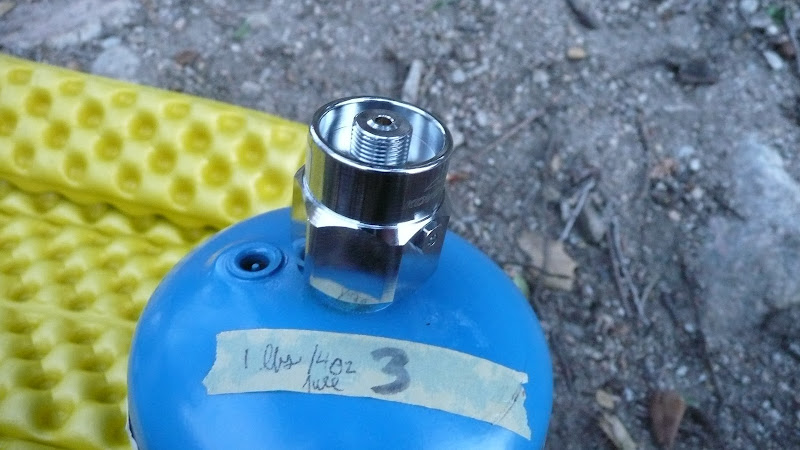
Just in case you're Korean isn't up to speed, here's what the adapter looks like when you hook it up (below).  Note that the propane canister I'm using happens to be blue.  The canister is blue because of the  particular brand of the canister.  Typically canisters are green, but whatever, the adapter hooks up the same.
A Kovea LPG (propane) adapter attached to a propane canister. 
Your backpacking stove then screws into the threads that you can see on the adapter in the photo above. Inside the adapter is the equivalent of a Lindal valve.  In other words, gas doesn't start immediately come shooting out of the adapter when you hook it up.
A Markill Hot Rod backpacking stove in operation on 100% propane.
Really pretty straightforward, but as with any backpacking stove, be freaking careful.  Always listen after hooking everything up before firing up the stove.  If you hear a leak, proceed no further until you've resolved the problem.  Failure to do so could have catastrophic results.

I'll cover the more practical aspects of 100% propane use for backpacking in a separate post.  In this post, I just wanted to showcase the adapter.


Final warning:  Adapters open up a whole new world in terms of fuel and stove combinations that can be used. Adapters  also open up a whole new world of hurt if you exceed the limitations of a particular set up. Just because you can hook up something up doesn't mean it's a good idea. Above all else, be careful.


Thanks for joining me on another Adventure in Stoving,

HJ

Thursday, December 29, 2011

100% Propane for Backpacking? YES!

What's the "holy grail" of canister gas for cold weather backpacking?  100% propane.  Propane is the best.  Plain butane won't vaporize below 31F/-0.5C.  Even isobutane just sits there and looks at you below 11F/-12C.  But propane?  Propane vaporizes all the way down to -44F/-42C.  Sweet!

What's that you say?  Propane is only available in those big heavy steel cylinders that are 16.4oz/465g net weight?  And the total weight is even more than that?  And you're not about to carry that on your back?

Hey, I'm with you.  Don't blame you a bit.  Those big green steel cylinders are just impractical for backpacking.  Too bulky, too heavy, and the stoves that go with them aren't any better.  But what if there were a better way?

Introducing the Bernzomatic Power Cell.
A Bernzomatic Power Cell
Take a close look at that label
A Bernzomatic Power Cell is 100% propane
That's propane baby!

But will it work with backpacking stoves?  Let's have a look.
The connector on a Bernzomatic Power Cell is a standard 7/16 UNEF threaded connector
That's a standard 7/16 UNEF threaded connector, the same one used by backpacking stoves.  Let's try it out.
A Snow Peak GS-100 stove on a Bernzomatic Power Cell
Well, I'll be danged.  Sure enough, it works.  But now you've got an upright type canister stove mounted on a long, slender bottle.  No way is that going to be stable.  We're back to impractical again. What to do?

Well, what if you could separate the burner from the bottle?  You can -- if you have something like a Brunton Stove Stand.
A GS-100 stove connected to a Bernzomatic Power Cell via a Brunton Stove Stand
Well, that's an improvement, but that canister is still a little on the tippy side.  Can't we just lay it down?
A Bernzomatic Power Cell laying on its side.
As a matter of fact, we can.  And, in case you can't see it in the above photo, that stove is on and in use.
 

Warning:  When you lay this canister on its side or turn the canister upside down, you are feeding liquid propane into your stove.  Burning liquid propane can be extremely dangerous.
To play it safe, you should follow the manufacturer's recommendations.  The manufacturer recommends that the canister always be used in the upright position.  See the full warning at the bottom of this post before you try laying the canister on its side or turning the canister upside down.
A close up of the flame of a GS-100 stove running on 100% propane from a Bernzomatic Power Cell
Now, I started with a completely full canister, so by putting the canister on its side, I should be getting liquid feed, the kind of feed you'd want to use in cold weather.  But, just to be sure, I leaned the canister up against the hillside.
A Bernzomatic Power Cell, completely inverted
And how does it work when completely inverted?  Just fine thanks.
A GS-100 stove running on liquid propane from a Bernzomatic Power Cell
The really interesting thing about these tests I ran with 100% propane is that I made absolutely no modifications to the stove or stove stand in any way, shape, or form.  In other words, I was able to run the stove on liquid propane (which is what you get when you invert the canister) without adding any pre-heating device.  I ran my tests in weather that was about 50F/10C air temperature.  In colder weather, a device to conduct heat from the flame to vaporize the fuel before it reaches the burner head may be needed.  At the temperatures I was operating in, the normal properties of propane were sufficient to vaporize the fuel.  I experienced no flaring.  I did allow the stove to warm up before inverting the canister.

There you have it, ladies and gentlemen, practical  propane for backpacking, the holy grail of cold weather canister stoves.  You saw it here first, on Adventures in Stoving.

OK, but now the bad news.  These are hard to find.  They are out there, and they do exist, but they aren't widely available.  But they're very worthwhile if you can find some.  It appears that Bernzomatic may no longer be making these, so once the existing supply is gone, that may be it.  Grab 'em while you can!
UPDATE 12 Jan 2012:  A thoughtful reader wrote Bernzomatic.  Bernzomatic has indeed discontinued the PowerCell (PC8).  The only such canisters available are the ones currently on shelves.  Once those are gone, no more will be available.

WARNING:  Any use of a fuel or a stove in a manner not recommended by the manufacturer may be dangerous or even deadly.  You may also void any warranty and/or nullify any legal protections you might otherwise have.  The preceding blog post shows techniques that are inherently dangerous.   Inverting the canister is against the manufacturer's recommendation.  Burning liquid propane can be extremely dangerous.  If you invert (turn upside down) the canister or lay the canister on its side, you will get liquid propane. Screw up here, and you may be cooking a lot more than your dinner, get it?
The author mentions these techniques solely because he believes that they might be of interest, but the author does not warrant in any way that these techniques are safe.  Indeed, these techniques are not safe and are by their very nature dangerous.  Use of these techniques may lead to property damage, great bodily harm, or even death.  The author does not recommend the techniques shown in this blog post.  If you decide to use the dangerous techniques shown in this blog, that is your decision, and you must accept that you have deliberately chosen to engage in a dangerous activity. 

HJ

Technical Appendix
Net weight:      226g/8oz of liquefied propane.
Gross weight:    365g/12.87oz (about 3/4lbs in other words)
Empty weight:    139g/4.90oz
Connector type:  Standard 7/16 UNEF threaded with a female Lindal type valve.
Manfucturer:     Bernzomatic
Stove stand:     142g/5.00oz

Sunday, December 4, 2011

Fuel Price Guide (Dec. 2011)

Who's got the deals?  Who's ripping you off?  Take a look at the following fuel prices to see what's out there -- and compare it to what you're paying.  Exceptional deals are show in red colored type.

Note:  The following are fuel prices that I observed in person at the retailer listed on the date shown.  Be aware that sometimes I make mistakes and that sometimes retailers change prices.   All prices are shown in US dollars (USD).  All observations were made in and around Los Angeles, CA, USA.

I.  White Gasoline (Coleman Type Fuel) 
Big 5 Sporting Goods
(03 Dec 2011)
Coleman        Gallon  $11.99
 
REI (Recreational Equipment, Inc.)
(03 Dec 2011)
Crown          Quart   $ 8.00
MSR            Quart   $12.95
Crown          Gallon  $14.00
Coleman        Gallon  $11.95

Sport Chalet
(05 Dec 2011)
Coleman        Quart   $ 6.97
MSR            Quart   $ 9.99
Coleman        Gallon  $10.97

Sports Authority
(05 Dec 2011)
Coleman        Quart   $ 6.99

Wal-Mart
(19 Nov 2011)
Coleman        Quart   $ 5.88
Coleman        Gallon  $ 9.68

II.  Gas (propane, isobutane, butane)
Big 5 Sporting Goods
(03 Dec 2011)
Camping Gaz    190g    $4.99    $0.0263/gram
Coleman        220g    $6.99    $0.0318/gram
Camping Gaz    230g    $6.99    $0.0303/gram (that price makes no sense compared to the 450g size, but that's what they quoted me)
Primus         230g    $5.99    $0.0260/gram
Camping Gaz*   450g    $6.99    $0.0155/gram
Coleman        465g    $4.49    $0.0097/gram (100% propane)
Worthington-2  465g    $8.99    $0.0097/gram (100% propane) (Two Pack)


REI (Recreational Equipment, Inc.)
(03 Dec 2011)
JetBoil        100g    $4.95    $0.0495/gram
Snow Peak      110g    $4.50    $0.0409/gram
MSR            113g    $4.95    $0.0438/gram
Snow Peak      220g    $5.50    $0.0250/gram 
MSR            227g    $5.95    $0.0262/gram 
JetBoil        230g    $5.95    $0.0259/gram
JetBoil        450g    $9.95    $0.0221/gram
Coleman        465g     Out of stock 03 Dec 2011

Sport Chalet
(05 Dec 2011)
JetBoil        100g    $4.99    $0.0499/gram
Optimus*       110g    $3.95    $0.0359/gram
Snow Peak      110g     Discontinued at Sport Chalet
MSR            113g    $3.99    $0.0353/gram
Optimus*       220g    $4.45    $0.0202/gram
Snow Peak      220g    $5.50    $0.0250/gram
MSR            227g    $4.99    $0.0220/gram  Updated 11 Jan 2012
Camping Gaz*   230g    $4.99    $0.0217/gram  
JetBoil        230g    $5.99    $0.0260/gram    
Camping Gaz*   450g    $6.99    $0.0155/gram
JetBoil        450g    $9.99    $0.0222/gram
Coleman        465g    $2.97    $0.0063/gram  (100% propane)

Sports Authority
(05 Dec 2011)
JetBoil        100g    $4.99    $0.0499/gram
MSR            113g    $4.99    $0.0441/gram 
Coleman*       220g    $6.99    $0.0318/gram
MSR            227g    $5.99    $0.0264/gram    
Coleman        465g    $2.99    $0.0064/gram  (100% propane)
Coleman-2      465gX2  $5.69    $0.0061/gram  (100% propane) (Two Pack)

Wal-Mart
(19 Nov 2011)
Coleman*       220g    $4.88    $0.0221/gram
Coleman        465g    $2.86    $0.0061/gram  (100% propane)
Worthington-2  465gX2  $5.12    $0.0055/gram  (100% propane) (Two Pack)

*NOT recommended for use below 50F/10C.  Why? See:  What's the Best Brand of Gas for Cold Weather?


III.  Kerosene or Kerosene "substitute"
Wal-Mart
(19 Nov 2011)
Coleman                      Quart   $ 5.88 ($23.52/gallon)

IV.  Alcohol
Home Depot
(28 Dec 2011)
Klean Strip SLX Denatured    Gallon  $15.98
Klean Strip Green Denatured  Quart   $ 6.69 ($26.76/gallon)

Wal-Mart
(28 Dec 2011)
Yellow HEET (methanol) 12oz  12pk    $16.44 ($14.61/gallon)


I hope you find the information helpful,

HJ